

What if your most expensive diagnostic hardware became a financial liability before it even reached its half-life? In the fast-moving world of medical imaging, the rapid depreciation of medical-grade monitors and the high upfront costs for specialized diagnostic workstations often force facilities into a corner. Effective radiology equipment budget planning is no longer just about procurement; it's about surviving a landscape where technology evolves faster than traditional capital cycles. You shouldn't have to choose between clinical excellence and a healthy balance sheet, yet the complexity of bundling PACS software with high-end hardware can quickly drain your operational liquidity.
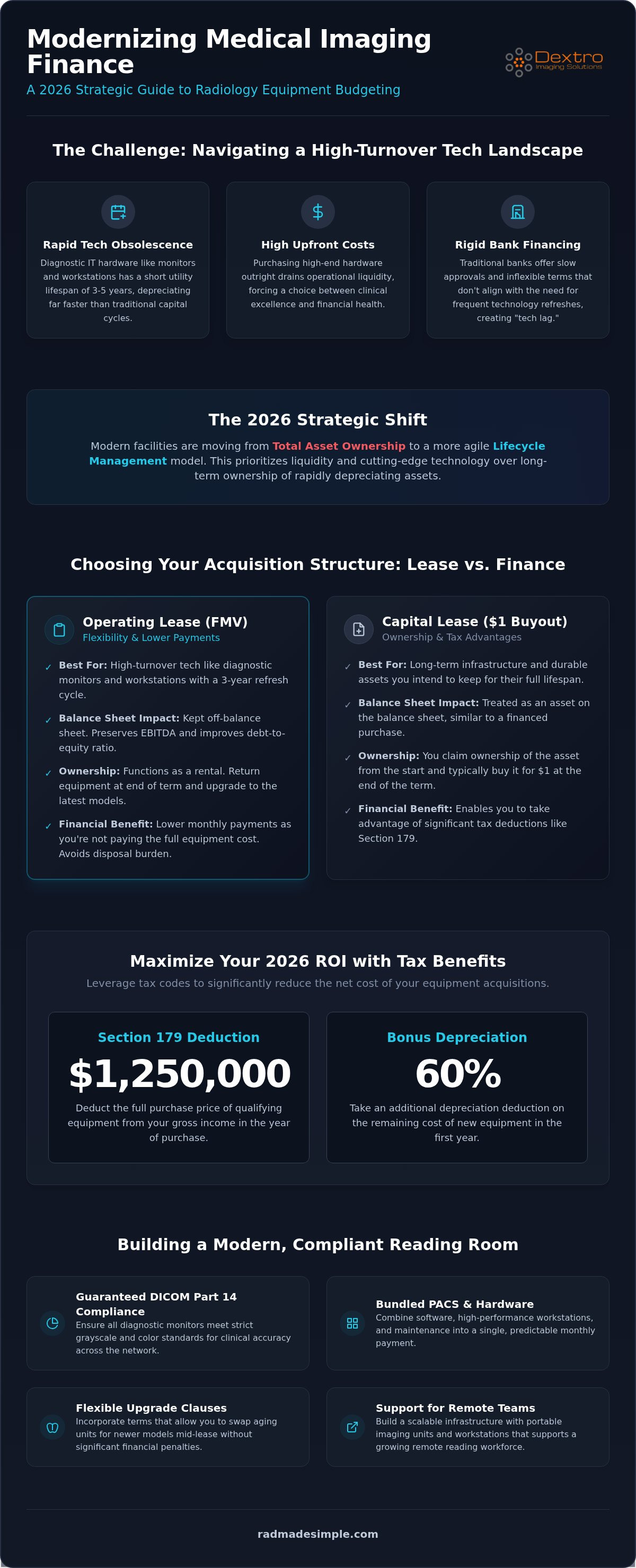
This 2026 strategic guide helps you master the complexities of medical imaging finance to modernize your facility while protecting your cash flow. You'll learn how to secure high-performance workstations and monitors while ensuring guaranteed DICOM Part 14 compliance across your entire network. We'll explore how to build a scalable infrastructure for remote reading teams and leverage the 2026 Section 179 deduction limit of $1,250,000 to your advantage. This roadmap moves you from asset ownership to lifecycle management, keeping your diagnostic capabilities at the cutting edge without compromising your financial stability.
Key Takeaways
- Learn why 2026 fiscal strategies prioritize liquidity over total asset ownership to keep pace with rapid technological shifts.
- Compare capital and operating leases to understand how different acquisition structures directly impact your facility's EBITDA and balance sheet.
- Streamline your radiology equipment budget planning by bundling PACS Harmony and high-end hardware into a single, predictable financial structure.
- Discover how to leverage the $1,250,000 Section 179 deduction limit and 60% bonus depreciation to maximize your 2026 tax benefits.
- Maintain technical standards with high-performance diagnostic monitors and reliable portable imaging units that guarantee DICOM Part 14 compliance.
The 2026 Landscape of Radiology Equipment Budget Planning
Effective radiology equipment budget planning in 2026 requires a departure from traditional "buy-and-hold" asset management. While foundational medical imaging technologies like MRI and CT units remain long-term capital fixtures, the diagnostic ecosystem now relies heavily on high-turnover digital infrastructure. This includes high-performance diagnostic monitors, PACS software, and specialized workstations that require frequent updates to maintain clinical standards. Modern departments are shifting their focus toward liquidity, recognizing that owning a monitor for a decade is often a liability rather than an achievement.
In this environment, you must distinguish between "static" assets and "dynamic" technology. A workstation or a portable reading unit has a much shorter utility lifespan than a heavy-iron scanner. While an X-ray suite might serve a facility for fifteen years, diagnostic IT hardware typically hits a performance ceiling within three to five years. Failing to account for this difference leads to "tech lag," where radiologists are forced to use sluggish, outdated systems that hinder productivity and increase burnout.
Why Traditional Bank Loans Often Fail Radiologists
General corporate banking often struggles to evaluate the specific needs of a radiology department. Standard banks typically require tangible collateral that they can easily value, often overlooking the critical importance of a Jusha medical monitor or a specialized reading station. Their approval processes are frequently too slow for the fast-paced nature of technological shifts. Additionally, rigid repayment terms don't account for the reality that workstations need replacing long before a ten-year loan would be satisfied. This misalignment can trap a facility in debt for equipment that is no longer clinically viable.
The Rise of Specialized Medical Imaging Finance
Specialized lenders offer a more agile approach to radiology equipment budget planning. These partners understand the clinical value of high-end hardware and the necessity of DICOM Part 14 compliance. They provide bundled solutions that merge hardware, software licenses, and maintenance fees into a single monthly payment. This structure aligns perfectly with insurance reimbursement cycles, ensuring that your cash flow remains positive while your technology stays current. By choosing a partner that understands the nuances of the field, you can secure flexible terms that support remote reading teams and scalable growth without the friction of traditional banking.
Leasing vs. Financing: Choosing the Right Acquisition Structure
Selecting the right financial vehicle is the most critical step in radiology equipment budget planning. Your choice between a Capital Lease and an Operating Lease dictates your facility's tax position and operational agility. A Capital Lease, often structured as a $1 Buyout, behaves like a financed purchase. It allows you to claim ownership and take advantage of Section 179 deductions. Conversely, an Operating Lease or Fair Market Value (FMV) lease functions as a rental. This keeps the equipment off your balance sheet, which can improve your debt-to-equity ratio and preserve EBITDA.
Professional guidance on Leasing vs. Financing emphasizes that the decision should align with the equipment’s expected lifespan. Modern contracts should include an "Upgrade Clause." This allows you to swap out aging units for newer models mid-term without significant financial penalties. You should also bundle maintenance and technical support into your monthly payment to avoid unpredictable repair costs.
Operating Leases for High-Turnover Technology
Operating leases are the preferred choice for diagnostic monitors. These units require precise calibration and often lose their clinical edge within three years. Since you aren't paying for the full cost of the equipment, monthly payments are significantly lower than traditional loans. When the term ends, you simply return the monitors and upgrade to the latest Jusha models. This streamlined process ensures your radiologists always work with high-performance displays without the burden of disposing of obsolete hardware.
Capital Leases for Long-Term Infrastructure
For durable assets like high-end radiology reading workstations, a Capital Lease is often more effective. These systems serve as the backbone of your reading room and offer long-term value through asset equity. By choosing this structure, you can lock in fixed interest rates to hedge against 2026 market volatility, which currently sees industry-specialist lenders offering rates between 8% and 12% APR. This provides a predictable path to ownership while maximizing your depreciation benefits.
If you're unsure which path fits your current volume, you can explore customized acquisition plans that balance ownership with cash preservation.
Financing Software and Integrated PACS Solutions
Financing software presents a unique hurdle because traditional lenders often prioritize "hard assets" they can repossess. In 2026, software is the nervous system of the clinic, yet it remains an intangible asset. This makes radiology equipment budget planning more complex when integrating tools like PACS Harmony or specialized voice recognition. You must decide between the Software as a Service (SaaS) model and financed perpetual licenses. While SaaS offers low entry costs, a perpetual license financed over five years often results in lower total cost of ownership. By bundling these licenses with your diagnostic workstations, you create a single, unified monthly payment that covers both the "brain" and the "body" of your imaging suite.
Modernizing Workflow with PACS Financing
Integrating multi-site operations requires robust solutions like aycan PACS. When building your 2026 budget, you must account for more than just the software license. Successful plans include data migration costs, which can range from $3,000 to over $40,000 depending on the volume of historical studies. Budgeting for a vendor-neutral archive (VNA) and secure cloud storage ensures your facility remains agile. Specialized finance packages often roll these implementation fees and technical support into the monthly structure. This approach prevents implementation fees, which typically range from $1,000 to $10,000, from disrupting your operational liquidity. For a deeper look at asset evaluation, consult this comprehensive guide to purchasing radiology equipment.
Financing Teleradiology and AI-Enhanced Dictation
Remote reading is no longer an optional perk; it's a structural necessity. Financing voice recognition for radiologists allows your team to slash turnaround times without a massive upfront software hit. You can scale these remote capabilities by financing portable radiology workstations and Radcom Compact units. These bundles should explicitly include the costs of cybersecurity and HIPAA-compliant remote access. In an era of increasing data breaches, ensuring your finance package covers ongoing security patches is a non-negotiable requirement. Integrating these costs into your radiology equipment budget planning protects your facility's reputation and long-term financial health.
Maximizing ROI and Section 179 Tax Benefits in 2026
Effective radiology equipment budget planning requires a deep understanding of the current fiscal environment. In 2026, the Section 179 deduction serves as a powerful lever for facility modernization. This tax code allows you to deduct the full purchase price of qualifying equipment from your gross income in the same year it's put into service. By combining this with specialized financing, you can significantly reduce your tax liability while keeping your initial cash outlay minimal. This often creates a net-positive cash flow scenario where the tax savings exceed the first year’s lease payments.
Strategic timing is essential to capturing these benefits. You must also account for the financial value of reduced downtime. Technical maintenance contracts, when rolled into your capital plan, transform unpredictable repair costs into a fixed, manageable operational expense. This ensures your high-end hardware remains operational, protecting the revenue streams your facility relies on.
The 2026 Tax Advantage for Imaging Centers
For the 2026 tax year, the Section 179 deduction limit is $1,250,000, with a phase-out threshold beginning at $3,130,000. This incentive applies to both new and pre-owned medical imaging hardware, providing flexibility for growing practices. Additionally, 2026 offers a 60% bonus depreciation rate for qualifying assets. To maximize these benefits, your equipment must be installed and operational by December 31st. Planning your acquisitions early in the fourth quarter ensures you avoid shipping delays that could push your tax advantage into the following year.
Calculating Performance-Based ROI
Beyond tax savings, you must evaluate the operational return on investment. High-performance reading stations and ergonomic workstations directly impact radiologist productivity and reduce fatigue-related errors. While the initial cost of diagnostic radiology monitors is a factor, the real ROI is found in strict DICOM Part 14 compliance. Consistent calibration reduces the risk of misdiagnosis and the need for costly re-reads.
Faster reporting turnaround times also build trust with referring physicians, which drives higher referral volumes and facility revenue. When your infrastructure supports seamless workflows, the resulting efficiency gains often pay for the equipment upgrade within the first 24 months of operation. To optimize your facility's financial health, request a custom ROI analysis to align your technology needs with your 2026 fiscal goals.
Building Your Modern Reading Room with Dextro Imaging Solutions
Dextro Imaging Solutions bridges the gap between financial strategy and clinical execution. While the previous sections detailed the strategic shift toward liquidity and tax optimization, Dextro provides the practical architecture to realize those goals. We simplify the acquisition of high-end diagnostic hardware by offering customizable bundles. These packages integrate Jusha Diagnostic Monitors, Radcom Compact portable units, and PACS Harmony software into a single, predictable monthly payment. This streamlined approach removes the complexity of radiology equipment budget planning, allowing you to modernize your facility without exhausting your cash reserves.
Technical accuracy remains our priority. Our team provides expert guidance and radiology equipment compliance support to ensure your facility meets all DICOM Part 14 requirements. We don't just deliver hardware; we provide the ongoing technical support necessary to maintain these standards throughout the equipment's lifecycle. This ensures that your high-stakes professional requirements are met with precision and reliability.
Tailored Solutions for Teleradiology
Remote reading requires specialized tools that don't compromise on diagnostic precision. Dextro simplifies the process of financing a traveling radiologist workstation setup to ensure accuracy regardless of location. These setups bundle Radcom Compact units with secure, integrated PACS connectivity, providing a turn-key solution for remote teams. We manage the remote installation and provide ongoing hardware maintenance, so your radiologists focus on interpretation rather than troubleshooting connectivity issues.
Next Steps: Consultation and Implementation
Transitioning to a high-performance workflow starts with a clear understanding of your specific needs. Our consultation process involves reviewing your current technical specifications and identifying the most efficient path to DICOM compliance. We provide customized quotes that reflect the radiology equipment budget planning strategies discussed in this guide, including Section 179 considerations and optimized leasing terms. By partnering with Dextro, you secure more than just equipment; you gain a dedicated partner committed to your facility's long-term operational success.
Securing Your Facility’s Technological Future
Modernizing your department requires a strategic pivot from traditional asset ownership to proactive lifecycle management. By prioritizing liquidity and leveraging the 2026 Section 179 tax benefits, you can maintain a competitive edge without depleting your capital reserves. Successful radiology equipment budget planning integrates high-performance hardware with scalable software solutions to ensure long-term clinical excellence. This approach protects your cash flow while guaranteeing your team has the tools they need to deliver accurate, timely diagnoses.
Dextro Imaging Solutions acts as your partner in this transformation. We provide specialized expertise in Jusha medical monitors and Radcom Compact portable radiology workstations to support both on-site and remote teams. Our comprehensive PACS Harmony integration ensures your workflow remains seamless and compliant. It's time to replace financial complexity with streamlined, high-performance operations that empower your radiologists and protect your bottom line. Streamline your radiology workflow with Dextro Imaging Solutions today.
Frequently Asked Questions
What are the typical interest rates for radiology equipment financing in 2026?
Specialized medical lenders in early 2026 typically offer APRs between 8% and 12% for qualified facilities. Traditional banks may offer lower rates ranging from 6% to 9%, while online lenders can reach 22% for those with thinner credit profiles. These rates reflect the specialized nature of medical hardware. Choosing a specialist lender often provides more flexibility than traditional banking because they understand the clinical value of your diagnostic assets.
Can I finance used or refurbished diagnostic monitors for my practice?
Yes, you can finance pre-owned or refurbished diagnostic monitors, and they often qualify for significant tax advantages. The 2026 Section 179 rules allow for the deduction of both new and used medical imaging hardware. This is a practical strategy for facilities managing tight margins. It allows you to secure high-performance Jusha monitors while reducing your total capital outlay and maintaining your 2026 radiology equipment budget planning goals.
Does Section 179 apply to leased radiology equipment or only purchases?
Section 179 applies to $1 buyout capital leases as if they were direct purchases. This allows you to deduct the full equipment price in the year you put it into service. For Fair Market Value (FMV) leases, the tax treatment differs because they are typically considered operating expenses rather than financed purchases. You should consult a tax professional to determine which structure maximizes your facility's cash flow for the 2026 fiscal year.
How long are the typical terms for medical imaging equipment leases?
Medical imaging equipment leases typically range from 36 to 60 months. For high-turnover technology like diagnostic workstations, shorter 36-month terms are common to ensure the hardware stays current. Heavier infrastructure might extend to 72 or 84 months. These terms are designed to align with the expected clinical utility of the equipment. This prevents you from paying for obsolete technology after its performance has peaked and its utility has diminished.
Can I bundle PACS software and workstation hardware into a single agreement?
You can absolutely bundle PACS Harmony or aycan PACS software with your workstation hardware into a single financial agreement. This unified approach is a core part of modern radiology equipment budget planning. It simplifies your accounts payable by consolidating software licenses, implementation fees, and hardware costs into one monthly payment. Bundling also ensures that your software and hardware refresh cycles remain perfectly synchronized for maximum workflow efficiency.
What happens at the end of a fair market value (FMV) lease for monitors?
At the end of a Fair Market Value lease, you typically have the option to return the monitors, purchase them at their current value, or upgrade to newer models. Most facilities choose to return the equipment and start a new lease for the latest Jusha diagnostic monitors. This prevents the accumulation of aging, out-of-warranty hardware and ensures your reading room always meets the highest technical standards without a large capital hit.
Is a down payment required for specialized radiology equipment financing?
Specialized radiology financing often requires little to no down payment for well-qualified medical practices. Many industry-specialist lenders offer 100% financing that covers the equipment, shipping, and installation costs. This preserves your operational liquidity for other needs like staffing or facility expansion. While some banks might request 10% to 20% down, specialized partners focus on the clinical revenue potential of the equipment rather than just traditional asset collateral.
How does financing affect my medical imaging compliance and calibration requirements?
Financing allows you to roll technical maintenance and calibration contracts directly into your monthly payment structure. This ensures your Jusha monitors remain in strict DICOM Part 14 compliance without requiring separate, unpredictable service fees. By integrating these costs into your finance agreement, you protect your facility from the risks of misdiagnosis and regulatory non-compliance. It creates a secure environment where your hardware is always performing at its peak capability.


