

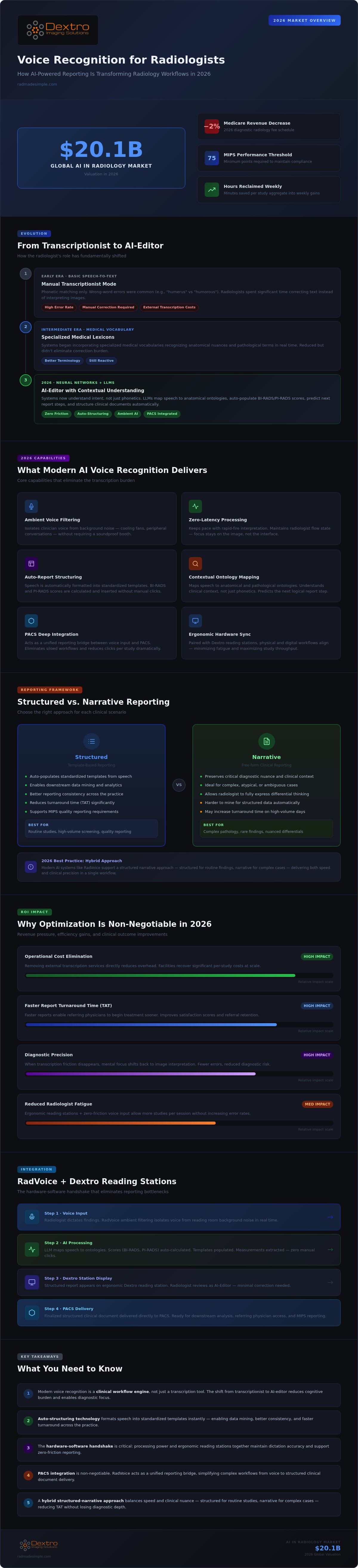
If you spend more time correcting your dictation software than you do analyzing complex imaging, you aren't just losing time; you're compromising diagnostic focus. The transcriptionist burden is a documented reality for many practitioners who find themselves editing text instead of interpreting scans. In 2026, the global AI in radiology market has reached a valuation of $20.1 billion, yet many facilities still struggle with high turnaround times and transcription errors that introduce unnecessary diagnostic risk. You likely feel the pressure of maintaining a 75 point MIPS performance threshold while managing the 2 percent decrease in diagnostic radiology Medicare revenue estimated for this year.
This guide demonstrates how modern voice recognition for radiologists has evolved from a simple transcription tool into a streamlined, AI-enhanced workflow engine. You'll discover how to achieve zero-friction dictation and automatic report structuring through deep integration between software and hardware. We'll examine the shift toward ambient AI, the implementation of new MIPS Value Pathways, and how pairing RadVoice with Dextro reading stations eliminates reporting bottlenecks. By the end of this article, you'll understand how to transform your reporting process into a high-performance asset that supports both clinical precision and operational efficiency.
Key Takeaways
- Understand why modern reporting tools are evolving into clinical workflow engines that prioritize diagnostic focus. You'll learn how to transition from a manual transcriptionist to a precise AI editor.
- Explore how auto-structuring technology formats your speech into standardized templates instantly. This shift allows for more accurate data mining and better reporting consistency across your practice.
- Discover the importance of the hardware-software handshake for maintaining high dictation accuracy. We explain how processing power and ergonomic Dextro reading stations support real-time, zero-friction reporting.
- Implementing voice recognition for radiologists works best when it's deeply integrated with your PACS and diagnostic hardware. Learn how RadVoice simplifies complex workflows by acting as a unified reporting bridge.
- Master the balance between structured templates and narrative reporting for complex cases. We'll help you choose the right framework to reduce turnaround times without losing critical diagnostic nuance.
The Evolution of Voice Recognition for Radiologists: Moving Beyond Dictation
The role of the radiologist has undergone a fundamental transformation. Modern voice recognition for radiologists is no longer a passive text editor; it's a sophisticated clinical workflow tool. Previously, specialists acted as their own transcriptionists, spending valuable mental energy correcting typos and punctuation. In 2026, the arrival of advanced neural networks and Large Language Models (LLMs) has shifted the paradigm. You've become an AI-Editor, overseeing a system that understands intent rather than just phonetic sounds. This evolution is critical as the AI in radiology market grows to a projected $20.1 billion this year. These systems don't just record words; they interpret the structure of a diagnostic finding to support faster clinical decisions. To find the most effective tools for this transition, many professionals use Alternative Radar to compare software options and discover new digital solutions that optimize clinical productivity.
From Simple Speech-to-Text to Contextual Understanding
Early iterations of speech recognition technology often struggled with complex medical terminology, leading to "wrong-word" errors that required manual intervention. 2026 systems utilize specialized medical vocabularies that recognize anatomical nuances and pathological terms in real time. Contextual Voice Recognition is the ability to map speech to anatomical and pathological ontologies, ensuring the software knows the difference between "humerus" and "humorous" based on the surrounding clinical data.
By leveraging these ontologies, software like RadVoice can predict the next logical step in a report, suggesting templates or findings before they're fully articulated. This proactive assistance turns a traditional burden into a streamlined engine for data generation. It ensures that the final report is not just a block of text, but a structured clinical document ready for downstream analysis.
The ROI of Modern Reporting Systems
Efficiency directly impacts the bottom line and patient outcomes. High-volume centers now measure time savings in minutes per study, which aggregates into hours of reclaimed productivity every week. By eliminating the need for external transcription services, facilities significantly reduce operational overhead. Faster report turnaround times (TAT) also improve referring physician satisfaction, as clinicians can begin patient treatments sooner.
When you integrate voice recognition for radiologists into high-performance hardware like Dextro reading stations, the physical and digital workflows align. This synergy minimizes friction and maximizes the number of studies interpreted without increasing fatigue or error rates. Streamlining this process is essential for navigating the 2026 Medicare fee schedule changes, where diagnostic radiology faces a 2 percent revenue decrease. Optimization isn't just about speed; it's about maintaining viability through precision.
How 2026 AI-Powered Recognition Eliminates the Transcription Burden
In 2026, the distinction between dictating and reporting has vanished. High-performance voice recognition for radiologists now employs advanced ambient filtering to isolate the clinician's voice from background cooling fans or peripheral conversations. This environmental awareness ensures accuracy without requiring a soundproof booth. Coupled with zero-latency processing, the software keeps pace with rapid-fire interpretation. This speed is vital for maintaining a flow state, where your focus remains on the image rather than the interface. When the technical friction of transcription disappears, diagnostic precision naturally increases.
Automated Report Structuring and Data Extraction
Modern systems deliver the best of both worlds through a structured narrative approach. As you speak, the AI identifies key clinical indicators and automatically populates standardized templates. For instance, dictating specific lesion characteristics can trigger the system to calculate and insert BI-RADS or PI-RADS scores without manual clicks. It also extracts measurements and patient demographics directly from the DICOM header. This eliminates the risk of manual entry errors and transforms the report into a searchable, high-value data asset. To see how these tools fit into a modern department, you can explore how to simplify your radiology workflow with integrated solutions.
Clinical Decision Support at the Point of Dictation
The reporting environment now acts as an active clinical partner. Voice-activated commands allow you to cross-reference previous imaging findings instantly. If you dictate a finding that contradicts a prior study, the system flags the discrepancy for immediate review. Real-time clinical decision support (CDS) also monitors for critical findings like acute stroke or pulmonary embolism. If the software detects keywords associated with these conditions, it can trigger automated alerts or prioritize the study in the hospital workflow. This proactive safety layer reduces diagnostic risk while you stay focused on the primary interpretation task.
By leveraging these advancements, voice recognition for radiologists moves beyond simple speech-to-text. It becomes a diagnostic engine that understands the clinical context of every word. This shift ensures that your time is spent on medical expertise, not clerical corrections. As the industry moves toward more complex reporting requirements, having a system that anticipates your needs is no longer a luxury; it's a necessity for professional success.
Structured vs. Narrative Reporting: Choosing Your Framework
Choosing between structured and narrative reporting is no longer a binary decision. Structured reporting relies on standardized templates to ensure consistency across a department and facilitate large-scale data mining. Narrative reporting, by contrast, utilizes free-form dictation to capture the nuances of complex cases that rigid forms might overlook. In 2026, the industry has moved toward a hybrid model. This transition is essential for fueling downstream AI and machine learning initiatives, as diagnostic algorithms require high-quality, structured data to improve their predictive accuracy. When voice recognition for radiologists is implemented correctly, it serves as the bridge between these two reporting styles.
The Pros and Cons of Structured Templates
Standardized templates offer undeniable benefits for referring physicians. They provide a predictable layout that makes it easy for clinicians to find critical information quickly. However, many practitioners struggle with template fatigue, where the repetitive nature of filling out forms leads to decreased focus. Modern software like RadVoice mitigates this with Smart Macros. These voice-activated shortcuts allow you to populate entire sections of a report with a single phrase, significantly speeding up the entry process. This ensures that the clarity of a structured report doesn't come at the cost of your time or mental energy.
Hybrid Reporting: The Future of Diagnostic Communication
The hybrid approach represents the future of diagnostic communication. It allows you to use voice commands to fill structured data fields for objective measurements while maintaining a narrative Impressions section for expert synthesis. This method satisfies the needs of both data analysts and clinical partners. PACS Harmony unifies these reporting styles across various interfaces, creating a consistent experience regardless of the modality you're interpreting. Whether you're working through a high-volume X-ray list or a complex multi-sequence MRI, the system adapts the interface to match the clinical requirements.
Optimizing templates for different modalities is a critical step in reducing turnaround times. A CT chest report requires a different logical flow than a musculoskeletal ultrasound. By using RadVoice on Dextro reading stations, you can customize your voice-driven workflow to match these specific needs. This level of integration ensures that every report you generate is both compliant with modern standards and highly useful for patient care. It's about making the technology work for your clinical judgment, rather than forcing your judgment into a technological box.
Optimizing Your Reading Room for Voice Recognition Accuracy
High accuracy in voice recognition for radiologists depends on more than just the underlying algorithm. It requires a seamless handshake between the reporting software and the physical environment. If your workstation lacks sufficient CPU or RAM, you'll experience a noticeable lag between speech and text appearance. This delay breaks the flow state essential for high-volume interpretation. Acoustic management is equally vital; even the best AI struggles if the ambient noise floor from cooling fans or hallway traffic is too high. A quiet, well-configured room is the foundation of a zero-friction reporting experience.
There's also a direct correlation between what you see and what you say. Using Jusha medical monitors provides the diagnostic clarity needed to dictate with absolute confidence. When the image is sharp and DICOM-compliant, you spend less time second-guessing and more time articulating findings precisely. Visual certainty leads to clearer, more decisive dictation, which in turn reduces the need for manual text corrections.
Essential Hardware for High-Accuracy Dictation
Professional microphone selection is your first line of defense against transcription errors. Noise-canceling arrays are superior for busy reading rooms, while handheld dictaphones offer familiar tactile control for toggling recording states. Modern radiology reading workstations must also possess dedicated GPU power to handle the intensive requirements of real-time AI voice processing. Without this local processing strength, the system may stutter during complex dictations. High monitor refresh rates further reduce eye strain, allowing you to maintain the visual focus required for accurate reporting throughout a long shift.
Ergonomics and Workflow Integration
Physical comfort is a prerequisite for clinical accuracy. Positioning your microphone to avoid neck strain prevents fatigue-induced speech slurring as the day progresses. Many high-performance setups now include programmable foot pedals or dedicated buttons on the reading station to trigger specific voice commands. This configuration minimizes the clicks required to move between image manipulation and dictation, significantly lowering your cognitive load. By reducing these micro-distractions, you keep your mental energy focused on the diagnostic task. To build a reading room that supports peak performance, you can view our complete range of radiology workstations and integrated tools.
RadVoice: Integrating Advanced Speech Tools into Your Workflow
Transitioning to high-performance voice recognition for radiologists requires more than a software download. It demands a solution that unifies your digital reporting tools with your physical environment. RadVoice serves as this unifying engine, designed specifically to operate within the Dextro ecosystem. Whether you're working at a fixed Dextro Reading Station or utilizing Portable Radiology Workstations, RadVoice provides a consistent, high-accuracy experience. This integration eliminates the common "clunky" feel of legacy dictation systems, replacing it with a responsive interface that anticipates your clinical needs.
One of the most significant advantages of this approach is the unified support contract provided by Dextro Imaging Solutions. In a traditional setup, a microphone failure or a software glitch often leads to finger-pointing between different vendors. With a unified hardware and software agreement, you have a single point of contact for your entire reporting stack. This professional accountability ensures that technical issues are resolved quickly, maintaining your department's productivity and protecting your revenue streams in the competitive 2026 market.
Seamless PACS and RIS Integration
Redundant logins and fragmented interfaces are major contributors to radiologist fatigue. RadVoice integrates deeply with PACS Harmony, creating a single sign-on environment that synchronizes your patient list with your reporting templates. This synergy ensures that when you open a study in aycan PACS, the correct RadVoice template is ready for dictation immediately. For specialists managing teleradiology workloads, this level of integration is portable. You can maintain diagnostic precision and HIPAA compliance even on the move by utilizing specialized traveling radiologist workstation setups. These mobile configurations ensure that your voice tools perform consistently, regardless of your physical location.
Implementing a Future-Proof Reporting Strategy
Moving from legacy dictation to an AI-driven environment starts with a comprehensive audit of your current infrastructure. You'll need to assess your radiology PACS pricing alongside the potential ROI of reduced transcription costs and improved turnaround times. Once the financial framework is established, the focus shifts to staff training. Success depends on teaching radiologists how to act as AI-editors rather than manual typists. By using reporting data to identify bottlenecks, you can continuously optimize your department's efficiency. This data-driven approach ensures that your investment in voice recognition for radiologists remains a high-performance asset that evolves alongside your practice needs.
Empowering Your Diagnostic Workflow
Reporting requirements in 2026 demand a shift from manual data entry to strategic AI oversight. You've seen how modern voice recognition for radiologists eliminates the transcriptionist burden by automating report structures and providing real-time decision support. Success in this landscape isn't just about software; it requires a physical foundation of high-performance reading stations and diagnostic monitors. By aligning your digital tools with ergonomic hardware, you protect both your clinical focus and your practice's revenue.
Dextro Imaging Solutions simplifies this transition by providing a unified ecosystem where RadVoice AI integration meets Jusha diagnostic monitor accuracy. You don't have to navigate technical hurdles alone when you have access to Dextro's expert technical support. It's time to replace fragmented legacy systems with a streamlined workflow engine that works as hard as you do. Explore RadVoice and Modernize Your Radiology Workflow to secure your place at the forefront of diagnostic innovation. Your expertise deserves a reporting environment that empowers every word you speak.
Frequently Asked Questions
Is modern voice recognition accurate enough for complex radiology terms?
Modern voice recognition for radiologists has reached a level of precision where it handles complex anatomical and pathological terms with high accuracy. Systems like RadVoice utilize specialized medical vocabularies and neural networks trained on millions of diagnostic reports. This technology doesn't just record sounds; it understands the clinical context of your dictation. This contextual awareness significantly reduces "wrong-word" errors, ensuring that even the most nuanced musculoskeletal or neurological findings are transcribed correctly without manual intervention.
Can I use voice recognition for teleradiology from a home office?
You can absolutely use advanced speech tools in a teleradiology or home office environment. High-performance software is now designed to work across various network conditions, providing a consistent experience outside of the hospital. For the best results, pairing your software with a Dextro Portable Radiology Workstation ensures you have the local processing power required for real-time AI tasks. This setup allows you to maintain professional-grade reporting speeds and diagnostic accuracy regardless of your physical location.
What is the difference between front-end and back-end voice recognition?
The primary difference lies in when the speech is converted to text and who performs the editing. Front-end recognition happens in real time, allowing you to see and correct the text immediately as you speak. This is the preferred method in 2026 for reducing turnaround times. Back-end recognition records your voice for later processing by a transcriptionist or automated system. Most modern facilities favor front-end workflows to eliminate the delays associated with traditional transcription cycles.
How does voice recognition integrate with existing PACS systems?
Integration occurs through deep software hooks that allow the reporting tool to communicate directly with your PACS. Solutions like PACS Harmony act as a bridge, synchronizing patient demographics and study details between the image viewer and the dictation window. This connection eliminates the need for redundant logins and manual data entry. When you open a study in aycan PACS, the system automatically prepares the correct template, ensuring a seamless transition from interpretation to documentation.
Does voice recognition software require a specific type of microphone?
While basic microphones may work, high-accuracy dictation requires professional-grade hardware. We recommend using noise-canceling arrays or specialized handheld dictaphones that are designed to filter out ambient reading room noise. These devices are optimized for the specific frequencies of human speech, which helps the AI engine distinguish your voice from background sounds. Using the right microphone is a critical component of the hardware-software handshake that ensures your voice recognition for radiologists remains precise and reliable.
How much time can a radiologist expect to save with AI-driven reporting?
Time savings vary based on volume, but many practitioners report reclaiming several minutes per complex study. By using AI-driven features like auto-structuring and Smart Macros, you eliminate the clerical burden of manual formatting. Over the course of a full shift, these micro-savings aggregate into hours of recovered productivity. This efficiency is vital for maintaining diagnostic focus and meeting the high turnaround time expectations of 2026 clinical environments without increasing your personal fatigue.
What happens if the internet goes out during a cloud-based dictation session?
Most 2026 cloud-based systems include local caching mechanisms to protect your work during a network interruption. If your internet connection drops, the software typically switches to a local processing mode or stores your dictation until the connection is restored. This prevents data loss and allows you to continue your workflow without starting over. Once the system detects an active signal, it synchronizes your local data with the cloud server to ensure your reports are finalized and archived.
Is voice recognition for radiologists HIPAA compliant?
Yes, professional reporting solutions are built with strict adherence to HIPAA standards. Data is encrypted both in transit and at rest, ensuring that sensitive patient information remains secure. Enterprise-level providers also offer Business Associate Agreements (BAAs) to formalize their commitment to privacy regulations. When you use a compliant system like RadVoice, you can be confident that your reporting workflow meets all legal requirements for data protection and patient confidentiality in a teleradiology or hospital setting.


