

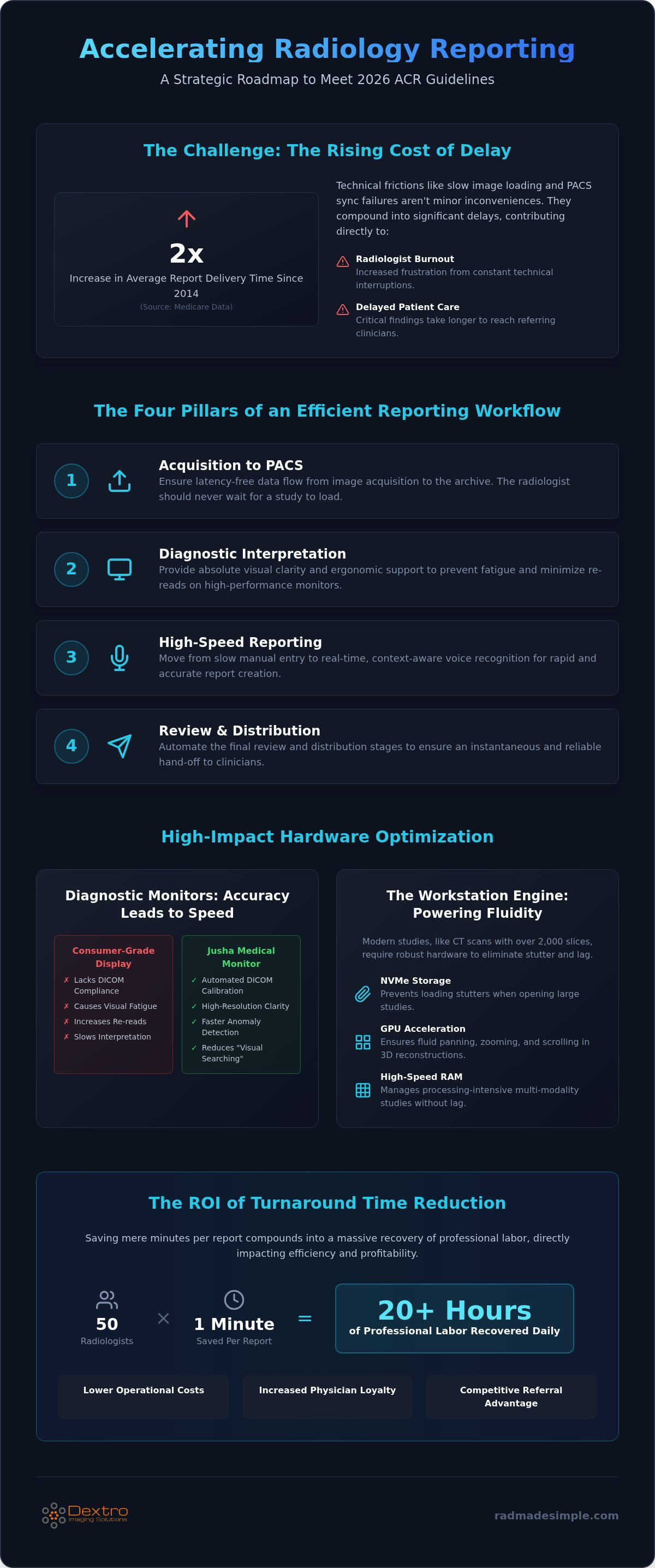
Since 2014, the average time required to deliver imaging results has roughly doubled, according to Medicare data. You likely feel the weight of this delay every time a PACS synchronization fails or a high-resolution image takes too long to load. These technical frictions aren't just minor inconveniences; they directly contribute to radiologist burnout and delayed patient care. Focusing on reducing radiology report turnaround time is now a critical priority for any facility aiming to meet the 2026 ACR guidelines for emergent and routine studies.
You deserve a workflow that moves as fast as your clinical intuition. Discover how optimizing your radiology hardware and software ecosystem can eliminate these bottlenecks and drastically accelerate report delivery. This guide provides a strategic roadmap for 2026, focusing on high-performance diagnostic monitors and seamless integration between dictation tools and image archives. We'll preview the specific infrastructure changes that turn technical lag into measurable efficiency gains and improved professional satisfaction.
Key Takeaways
- Learn how identifying and eliminating micro-delays in image loading and data entry can prevent massive reporting backlogs.
- Discover why upgrading to Jusha diagnostic monitors is a critical step in reducing radiology report turnaround time by decreasing visual fatigue and re-reads.
- Replace slow correction loops with real-time reporting by integrating context-aware voice recognition software into your existing PACS.
- Bridge technical gaps between disparate hospital systems using high-speed connectivity solutions like the Radcom Compact for faster image transfers.
- Optimize the physical reading environment with Dextro workstations to maintain high interpretation speeds throughout long shifts.
Understanding the Critical Drivers of Radiology Turnaround Time (TAT)
In 2026, turnaround time represents the complete lifecycle of a diagnostic study. It begins the moment a technologist completes image acquisition and concludes only when the final report reaches the referring clinician's notification system. Traditional views often blamed radiologist speed for delays. However, the reality is more complex. Modern reporting environments often suffer from micro-delays, which are those small, five-second lags in image rendering or data synchronization that compound across a shift. These seconds turn into hours of lost productivity, directly impacting your bottom line through Value-Based Care (VBC) metrics and hospital reimbursement rates.
The Four Pillars of an Efficient Reporting Workflow
A streamlined ecosystem relies on four distinct stages working in perfect synchronization. First, image acquisition must transition into a Picture archiving and communication system (PACS) without latency. If the data flow is sluggish, the radiologist is already behind before they even open the study. Second, the diagnostic interpretation window requires absolute visual clarity and ergonomic support to prevent fatigue. Third, reporting must move from manual entry to high-speed voice capture. Finally, the review and distribution stage should be automated to ensure the hand-off to clinicians is instantaneous.
Measuring the ROI of TAT Reduction
The financial argument for reducing radiology report turnaround time is undeniable. Consider a team of 50 radiologists. If each physician saves just one minute per report across a typical daily workload, the collective time recovered can exceed 20 hours of professional labor every single day. This efficiency doesn't just lower costs; it builds referring physician loyalty. In a competitive market, facilities that deliver accurate results faster become the preferred choice for outpatient referrals. You should view TAT as the heartbeat of modern diagnostic efficiency, where every pulse represents a critical step in the patient's care journey.
Identifying the hidden bottleneck is the first step toward modernization. Often, a facility invests in high-end software only to find that their existing hardware cannot keep pace with the processing requirements. When your display or workstation lags, it creates a ceiling for how much you can achieve. True optimization requires a balanced approach where hardware and software work as a unified force for reducing radiology report turnaround time.
Optimizing the Reading Environment with High-Performance Hardware
Many facilities overlook the physical interface when discussing workflow speed. Technical friction often stems from hardware that forces the radiologist to compensate for poor image quality or slow loading times. Consumer-grade displays are the leading cause of visual fatigue. These screens lack the sustained luminance and contrast required for DICOM Part 14 compliance. When a radiologist can't clearly see subtle pathology on the first pass, they perform more re-reads and manual adjustments. This "visual searching" adds minutes to every study, directly hindering your efforts in reducing radiology report turnaround time.
Diagnostic Monitors: Accuracy Leads to Speed
High-performance Jusha medical monitors solve this by providing automated calibration and high-resolution clarity. Automated DICOM checks ensure the monitor is always within diagnostic range, which eliminates the need for manual verification. This reliability allows for faster detection of subtle abnormalities. Research into improving operational efficiency in radiology highlights that standardized technical environments are essential for peak performance. Multi-monitor configurations further streamline the day by removing the need to toggle between clinical windows or patient history files.
The Workstation Engine: RAM, GPU, and Storage
Processing power is the silent partner in interpretation speed. Modern multi-modality studies, particularly large-volume CT scans with over 2,000 slices, demand significant hardware resources. NVMe storage is now a requirement to prevent loading stutters. GPU-accelerated image manipulation ensures that panning, zooming, and scrolling through 3D reconstructions remain fluid. Stuttering software is a primary source of frustration and distraction that breaks the radiologist's concentration.
Specialized radiology reading workstations, such as Dextro Reading Stations, are engineered for these intensive 8-12 hour shifts. They provide the stable, high-performance foundation needed to maintain interpretation speed without the risk of system crashes or thermal throttling. Beyond the internal components, the physical reading station matters. Physical strain from poor posture leads to micro-breaks and decreased focus. Dextro Reading Stations integrate ergonomic design with raw computing power to protect the user's productivity. By removing technical and physical discomfort, you create an environment where reducing radiology report turnaround time becomes a natural result of a frictionless workflow. You can explore our optimized hardware solutions to see how professional-grade equipment transforms the reporting experience.
Accelerating Reporting via Advanced Voice Recognition and PACS
Hardware provides the essential foundation, but software drives the final output. The shift to real-time reporting is the most significant factor in reducing radiology report turnaround time. Traditional transcription services introduce delays and human error that modern facilities can no longer afford. Modern 2026 software ecosystems eliminate these hurdles by merging the image and the report into a single, fluid process.
RadVoice: Streamlining the Dictation Process
Integrating voice recognition for radiologists directly into the reading station removes the friction of switching between applications. RadVoice uses context-aware medical vocabularies to ensure high accuracy from the first word. This reduces the "correction loop" where radiologists spend valuable time fixing misinterpretations. By using macro commands, users can automate standard findings and normal results with a single phrase. To achieve a truly efficient workflow, the dictation system must maintain an accuracy threshold that allows for zero-edit reporting on nearly every standard study. Direct integration ensures that dictation lives inside the PACS interface, keeping the radiologist's eyes on the images at all times.
Unified Workflow with PACS Harmony
Silos between imaging data and reporting tools create unnecessary clicks and cognitive load. PACS Harmony acts as the bridge, unifying disparate systems into a single, high-performance interface. When paired with aycan PACS, it enables seamless Vendor Neutral Archiving (VNA). This allows radiologists to access studies from multiple sites without the need to log into different portals or manage multiple passwords. The connection between voice recognition and report turnaround is well-documented, showing that integrated tools significantly outperform standalone systems. Real-time worklist management within this unified interface automatically prioritizes STAT cases, ensuring urgent findings reach clinicians immediately.
Structured reporting templates represent the final step in this automation. These templates ensure compliance with 2026 standards without requiring manual typing or complex formatting. By automating these forms, you ensure that every report is complete, consistent, and professional. This level of integration is essential for reducing radiology report turnaround time while maintaining the highest levels of diagnostic quality and regulatory compliance.
Workflow Optimization: Beyond the Software
Speed is not just a software setting; it is a product of the entire physical environment. Ambient lighting and acoustic control directly influence interpretation speed. Glare on a screen or a noisy hallway can break a radiologist's concentration, leading to costly re-reads and mental fatigue. Standardizing the reading room environment ensures that focus remains on the pixels rather than external distractions. Integrated communication tools also play a vital role. By allowing clinicians to consult with radiologists through silent, asynchronous channels, you preserve the "flow state" required for rapid interpretation and eliminate disruptive phone calls.
Connectivity remains a major hurdle for reducing radiology report turnaround time, especially in multi-site operations. The Radcom Compact manages this "Connectivity Gap" by providing high-speed image transfer and secure routing. It acts as a dedicated bridge, ensuring that large data sets move between facilities without the latency that often plagues traditional networks. This hardware solution ensures that high-resolution data is ready for interpretation the moment the radiologist opens their worklist.
Teleradiology Hardware Checklist for Home Offices
Remote reading is now a standard practice. However, a home office must mirror the hospital's diagnostic quality to maintain safety and speed. Maintaining a traveling radiologist workstation setup ensures that accuracy does not dip when the user leaves the main facility. High-bandwidth requirements and secure VPNs are non-negotiable for remote diagnostic reading. Portable Radiology Workstations provide a professional solution that does not compromise on resolution or processing speed, allowing for consistent TAT across different time zones and locations.
Ergonomics and Cognitive Load
Physical comfort preserves mental stamina over an eight-hour shift. Sit-to-stand desks help maintain alertness, while blue light filters serve as a vital speed-retention strategy by preventing eye strain. Adopting a "Simplified Workstation" philosophy involves removing non-essential technology from the desk to reduce cognitive clutter. This focus on ergonomics is a proven method for reducing radiology report turnaround time by keeping the interpreter energized and focused. You can view our full range of workflow-optimized hardware to find the right setup for your remote or on-site team.
Future-Proofing Your Radiology Department with Dextro Solutions
Building a high-speed reporting environment requires a partner that understands how every technical component interacts. Dextro Imaging Solutions unifies the entire technical stack to create a frictionless experience for the radiologist. When your Jusha monitors, Dextro workstations, and RadVoice software are engineered to work together, you eliminate the hidden compatibility lags that often stall productivity. This holistic approach is the most effective strategy for reducing radiology report turnaround time over the long term. By acting as a single-source partner, we provide a streamlined path for installation, maintenance, and expert support that generic IT providers can't match.
Seamless Integration Services
System reliability is just as critical as raw processing speed. Our technical support and maintenance teams focus on keeping your workstations at peak performance to prevent the unexpected downtime that creates reporting backlogs. We don't believe in one-size-fits-all solutions. Instead, we provide custom workstation builds that match hardware to specific subspecialty needs. Whether you're managing high-volume breast imaging or complex interventional cases, your hardware should support your specific workflow. For growing facilities, we offer comprehensive software licensing and PACS migration support to ensure your transition to a faster ecosystem is both seamless and secure.
The Dextro Advantage
Choosing specialized equipment makes a measurable difference in your department's daily output. Generic enterprise hardware isn't designed for the 24/7 diagnostic intensity required in 2026. Dextro Reading Stations are built specifically for these high-stress workloads, offering the thermal management and processing stability that consumer PCs lack. Jusha Medical Monitors are now the professional standard for diagnostic clarity, providing the high-resolution accuracy needed for confident, first-pass interpretations. Combining these elements creates a professional environment where speed and accuracy coexist without compromise.
The final step in reducing radiology report turnaround time is identifying exactly where your current infrastructure fails. Whether it's a legacy PACS causing data silos or outdated monitors causing eye strain, a targeted upgrade can unlock significant clinical capacity. We also provide radiology equipment compliance support to ensure your facility meets all current regulatory standards while maintaining maximum uptime. It's time to move past the bottlenecks of the past. You can Optimize your radiology workflow with a Dextro consultation to begin your transition to a modern, high-speed reporting ecosystem.
Modernizing Your Diagnostic Ecosystem for 2026
Achieving peak efficiency in 2026 requires a shift from viewing technology as a collection of tools to treating it as a unified ecosystem. By integrating high-performance Jusha monitors with specialized Dextro workstations and RadVoice software, you remove the micro-delays that aggregate into significant backlogs. We've explored how identifying technical friction and optimizing the physical reading environment are essential steps in reducing radiology report turnaround time. These strategic upgrades protect your radiologists from burnout while ensuring patients receive the timely care they deserve.
Modernizing your infrastructure doesn't have to be complex when you have a dedicated partner. As a leading Jusha Diagnostic Monitor Distributor, Dextro Imaging Solutions provides the specialized portable radiology workstations and expert technical support & maintenance required to keep your facility at the forefront of the field. It's time to replace legacy lag with a high-performance standard that supports your clinical expertise.
Upgrade your radiology workflow with Dextro Imaging Solutions and transform your department into a model of modern efficiency. Your team's success and your patient's outcomes are worth the investment in excellence.
Frequently Asked Questions
What is an acceptable radiology report turnaround time in 2026?
Current industry standards from the ACR define acceptable turnaround times based on study urgency. Emergent cases, such as strokes, should be reported in under 30 minutes. Urgent or STAT studies require completion in less than one hour, while routine outpatient studies generally target a 24-hour window. Meeting these benchmarks is essential for reducing radiology report turnaround time and maintaining accreditation with bodies like The Joint Commission.
How does diagnostic monitor resolution specifically impact reporting speed?
Higher resolution and contrast ratios allow radiologists to detect subtle pathologies faster with fewer manual adjustments. Jusha Diagnostic Monitors provide the clarity needed for first-pass interpretations. When a monitor lacks sufficient resolution, radiologists spend extra time zooming and panning to verify findings. This technical friction slows down the entire workflow. Investing in medical-grade displays directly reduces the time spent per study by minimizing visual fatigue and the need for re-reads.
Can voice recognition software really replace manual transcription for TAT gains?
Real-time voice recognition software like RadVoice has largely replaced traditional transcription because it eliminates the multi-hour delay of manual typing and proofreading. AI-assisted templates can generate first drafts up to 44% faster than legacy dictation methods. This transition removes the correction loop and allows for immediate report distribution. While older versions had high error rates, 2026 AI-driven tools offer the accuracy required for zero-edit reporting in most standard clinical scenarios.
Does PACS integration affect the time a radiologist spends on each study?
Deep integration between your PACS and reporting software significantly reduces the time spent on each study by eliminating redundant clicks. PACS Harmony acts as a bridge that unifies disparate imaging archives into one interface. This prevents the radiologist from having to log into multiple portals to view patient history or prior images. Every second saved on data synchronization and application switching contributes to reducing radiology report turnaround time across the entire department.
What are the main causes of radiology report delays in large hospitals?
Large hospitals often struggle with environmental friction, where legacy hardware cannot keep pace with modern software requirements. Common causes of delays include:
- Technical lag during image loading and PACS synchronization
- Inefficient reporting workflows that rely on manual data entry
- Hardware silos that prevent seamless access to prior studies
- Radiologist burnout caused by high caseloads and poor ergonomic support
Addressing these infrastructure bottlenecks is critical for accelerating delivery.
Is a portable radiology workstation powerful enough for high-speed reading?
Modern Portable Radiology Workstations are engineered with high-performance GPUs and NVMe storage to handle intensive multi-modality studies. These units provide the same processing power as stationary Dextro Reading Stations, allowing for high-speed reading in remote or teleradiology settings. They support full diagnostic resolution and DICOM compliance, ensuring that radiologists don't have to compromise on speed or accuracy when working outside the hospital. They're a reliable solution for maintaining TAT during after-hours coverage.
How often should diagnostic monitors be calibrated to maintain speed and accuracy?
Diagnostic monitors should undergo automated calibration daily to ensure they remain within DICOM Part 14 compliance. Jusha Diagnostic Monitors feature built-in sensors that perform these checks without manual intervention. This consistency is vital because even minor shifts in luminance can obscure subtle findings, leading to slower interpretation times or diagnostic errors. Regular calibration ensures the equipment performs at peak levels, which helps maintain a steady reporting pace throughout the year.
What is the cost of poor TAT for a private imaging center?
For private imaging centers, poor turnaround time leads to lost revenue through decreased referring physician loyalty. Clinicians prioritize facilities that deliver results quickly to expedite patient care decisions. Beyond reputation, delayed reports can impact Value-Based Care metrics and potential hospital reimbursements. When TAT exceeds the 24-hour routine standard, centers risk losing outpatient volume to competitors who have invested in high-speed reporting ecosystems and modernized hardware.


