

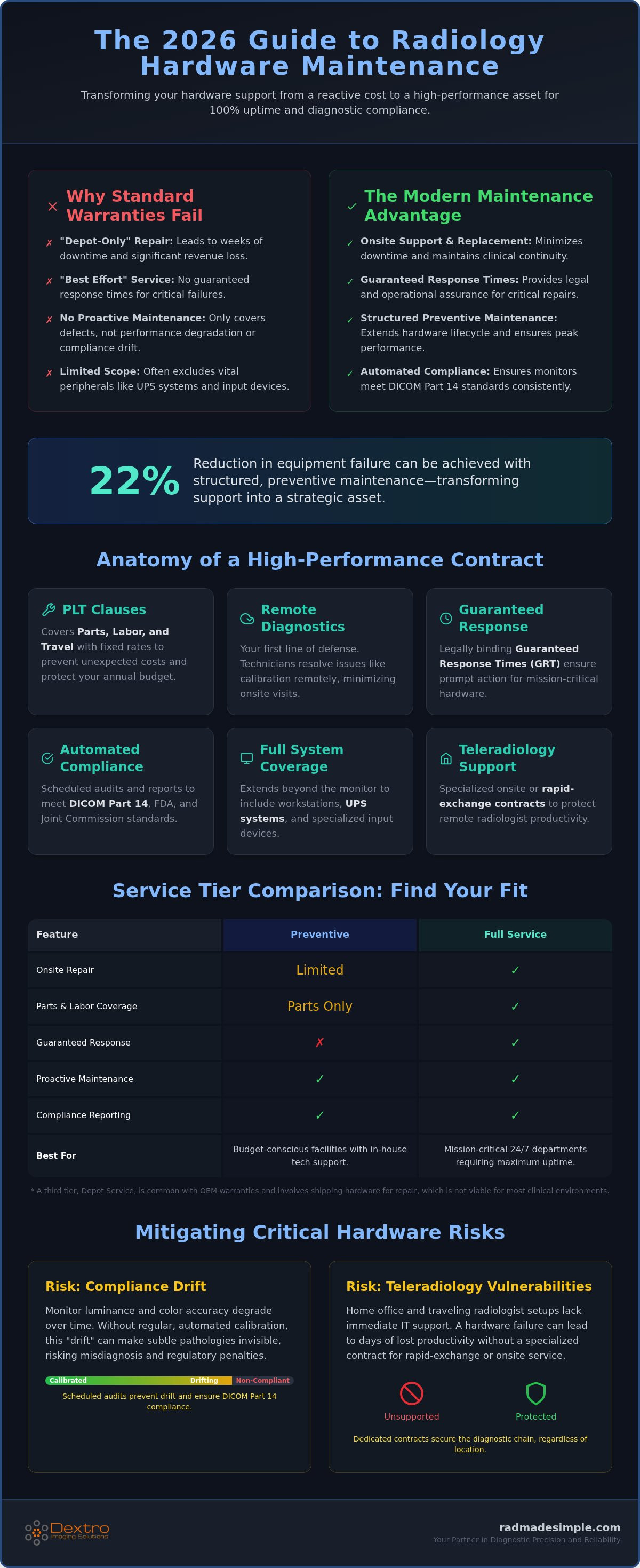
A modern radiology hardware maintenance contract is no longer just a repair agreement; it's a workflow protection plan that dictates your facility's financial health. In an era where structured preventive maintenance can reduce equipment failure by 22%, relying on reactive fixes is a strategy for obsolescence. You've likely experienced the frustration of unexpected downtime leading to lost revenue and a mounting patient backlog. It's difficult to manage hidden costs that exceed your annual budget while struggling to maintain DICOM Part 14 compliance on aging monitors.
We understand that your priority is precision and reliability without the technical complexity. This comprehensive 2026 guide will help you master the complexities of medical imaging service agreements to ensure 100% uptime and diagnostic compliance for your facility. We'll show you how to secure a predictable annual maintenance budget and guarantee response times for critical hardware failures. You'll also learn to leverage automated compliance and calibration reporting to meet the latest FDA Quality Management System Regulations and Joint Commission standards. By the end of this article, you'll have a clear roadmap to transform your hardware support into a seamless, high-performance asset.
Key Takeaways
- Understand why standard OEM warranties are insufficient for 24/7 clinical environments and how a comprehensive radiology hardware maintenance contract bridges the gap.
- Identify the essential PLT (Parts, Labor, and Travel) clauses and remote diagnostic capabilities that act as your first line of defense against hardware failure.
- Learn the SMART audit process to define your facility’s specific uptime requirements while identifying hidden exclusions in service agreements.
- Compare service tiers to effectively balance your annual maintenance budget with the need for high-performance support on diagnostic monitors and reading stations.
- Master the tools required for continuous DICOM Part 14 compliance through automated calibration reporting and certified hardware maintenance.
Why Standard Warranties Fail Modern Radiology Departments
Standard OEM warranties are designed to protect the manufacturer from defects, not to protect your facility from downtime. While a new piece of hardware might come with a 12-month warranty, this coverage often lacks the technical depth required for high-volume clinical environments. A comprehensive radiology hardware maintenance contract fills the critical void between basic functional coverage and high-performance optimization. It transforms hardware from a static purchase into a dynamic, supported asset that evolves with your facility's needs.
One of the most significant pitfalls is the "depot-only" repair model common in standard warranties. In a hospital operating 24/7, shipping a critical diagnostic monitor to a repair center for two weeks is not a viable option. This model ignores the reality of patient backlogs and the resulting revenue loss. Professional Medical Equipment Management requires onsite response times and immediate hardware replacement to maintain clinical continuity. Without these guarantees, your facility remains vulnerable to the high costs of extended equipment outages.
Proactive maintenance also extends the lifecycle of specialized hardware like Jusha Diagnostic Monitors. Unlike consumer screens, medical-grade displays require consistent monitoring to ensure they meet strict diagnostic standards. A functional screen that isn't calibrated is a liability, not an asset. Diagnostic accuracy requires more than just hardware that turns on; it requires hardware that performs to its original specifications every single day.
The Hidden Risks of Compliance Drift
Monitor luminance naturally degrades over time; this is an unavoidable physical reality. Without regular medical display calibration, subtle pathological details can become invisible to the radiologist. This "compliance drift" risks misdiagnosis and regulatory penalties. A robust maintenance agreement includes scheduled audits to provide radiology equipment compliance support, ensuring every pixel remains within DICOM Part 14 specifications.
Teleradiology Vulnerabilities in Home Office Setups
The shift toward remote work has introduced new vulnerabilities. A traveling radiologist workstation setup often lacks the immediate IT support available in a hospital setting. Remote workstations require specialized onsite or rapid-exchange contracts to prevent days of lost productivity. A specialized radiology hardware maintenance contract for remote setups ensures that teleradiologists have the same reliability as their onsite colleagues, protecting the integrity of the diagnostic chain regardless of location. This dedicated support is essential for maintaining portable diagnostic reading stations at peak performance.
Anatomy of a 2026 Radiology Hardware Maintenance Contract
A radiology hardware maintenance contract must be viewed as a technical blueprint for operational stability rather than a simple insurance policy. It should explicitly define Parts, Labor, and Travel (PLT) clauses to prevent budgetary surprises. In 2026, travel costs for specialized engineers can fluctuate significantly; securing fixed rates or inclusive travel in your agreement is a professional necessity. You don't want your annual budget derailed by the logistics of a single repair visit.
Modern contracts prioritize remote diagnostics as the first line of defense. Technicians can often resolve calibration issues or minor firmware glitches through secure remote access before a physical failure occurs. This proactive approach ensures that hardware remains functional while minimizing the need for onsite visits. If a site visit is required, look for Guaranteed Response Times (GRT) rather than "Best Effort" service levels. A "Best Effort" clause provides no legal recourse for delays, which is unacceptable for mission-critical imaging departments.
Don't overlook the peripherals that complete your diagnostic environment. A robust contract includes the workstation, Uninterruptible Power Supply (UPS) systems, and specialized input devices. If your UPS fails, your high-end diagnostic station is useless. Including these items ensures a seamless recovery process. If you're looking to streamline your setup, exploring high-performance Dextro Reading Stations can simplify your maintenance needs by unifying your hardware ecosystem.
Parts Availability and EOL Considerations
Specialized monitors like Jusha units often require proprietary internal components. Your contract should guarantee access to these specific parts rather than generic alternatives that might compromise image quality. Handling End-of-Life (EOL) hardware is equally vital. A smart agreement includes a transition plan for EOL units, ensuring they remain supported until a replacement is integrated. We recommend stocking critical components like the Radcom Compact locally to bypass supply chain delays and maintain connectivity.
Software Integration and Firmware Updates
Hardware doesn't exist in a vacuum. A modern radiology hardware maintenance contract must include regular firmware patches to maintain PACS Harmony stability. Outdated firmware can lead to connectivity drops or rendering errors. Optimizing hardware also supports advanced tools like voice recognition for radiologists, where processing speed directly impacts reporting efficiency. Ensuring your hardware is optimized for these AI-driven workflows is a core requirement for 2026. This integration prevents the "finger-pointing" between hardware and software vendors that often delays resolution.
Service Tier Comparison: Full Service vs. Preventive vs. Depot
Selecting the right radiology hardware maintenance contract requires a clear understanding of your facility's operational volume and clinical criticality. Full Service agreements represent the gold standard for hospital departments where every minute of downtime directly impacts patient outcomes. These comprehensive plans cover all onsite labor, travel, and high-cost parts, providing total peace of mind for mission-critical hardware. In contrast, Preventive Maintenance (PM) Only models offer a budget-friendly alternative for non-emergency units. These focus on scheduled check-ups and calibration to prevent failure, though they leave emergency repair costs as a separate, variable expense.
Depot Repair is a logical choice for portable radiology hardware or remote teleradiology setups. In these scenarios, shipping a unit for specialized repair is often more cost-effective than dispatching an onsite engineer, especially when utilizing a reliable provider like Sameday Express Inc. to handle the critical logistics. Hybrid models are also gaining traction in 2026 for mixed-modality environments. You can choose Full Service for your primary diagnostic monitors while opting for PM Only on secondary administrative screens. This tailored approach optimizes your annual spend without compromising essential uptime. It simplifies your budget while ensuring that your most valuable assets receive the highest level of care.
Evaluating your TCO involves comparing predictable monthly premiums against the volatile "pay-per-call" emergency rates. Emergency repairs often carry significant premiums and hidden travel fees that can quickly exceed a fixed annual contract. These agreements do more than just fix broken parts; they protect your long-term investment in high-end radiology reading workstations. By extending equipment life and reducing the frequency of hardware refreshes, a well-structured contract delivers a measurable ROI. You'll see this reflected in both reduced downtime and the preservation of your hardware's diagnostic integrity over its entire lifecycle.
The ISO vs. OEM Debate
The choice between an Independent Service Organization (ISO) and an Original Equipment Manufacturer (OEM) is a central consideration for procurement teams. Research indicates that third-party maintenance providers can offer cost savings of 30-40% compared to OEM service, particularly for equipment over three years old. However, specialized distributors often provide the best balance of expertise and cost. They possess the technical depth of an OEM with the agility and personalized support of a third party. When vetting engineers for Jusha medical monitors, verify they have specific certification and access to proprietary calibration tools. A general technician might miss the nuances of high-luminance standards that a specialist will catch immediately.
SMART Audit: Negotiating Your Service Agreement
Negotiating a radiology hardware maintenance contract requires a granular approach to ensure your facility isn't paying for hollow promises. A SMART audit allows you to dissect the fine print and align service levels with your actual clinical needs. Start by defining "Critical Uptime" requirements by modality. A high-volume CT scanner requires a different response threshold than a secondary reading station. Proximity is paramount. A service provider might claim four-hour response times, but if their closest parts depot is three states away, that promise is functionally hollow. Verify the exact location of engineers and critical components before signing.
You must also audit the "Exclusions" list with clinical precision. Many agreements contain vague language regarding environmental conditions or "glassware" clauses that can lead to massive out-of-pocket expenses. Negotiate "Lemon Clauses" into your agreement to protect against recurring hardware failures. If a specific component fails three times within a six-month period, the contract should trigger an immediate replacement rather than another temporary repair. Finally, ensure your hardware cycles align with your radiology PACS pricing and software updates to avoid paying for support on hardware slated for decommissioning.
Don't let complex service terms compromise your department's efficiency. You can optimize your service agreement today by partnering with experts who understand the intersection of hardware reliability and clinical workflow.
Understanding Cancellation and Auto-Renewal Terms
The "Evergreen Clause" is a common trap where contracts renew automatically without notification. You should demand a 90-day notice period for any renewal and clearly define the process for equipment removal. It's also vital to secure the right to transfer service during a facility merger or acquisition. Ensuring your radiology hardware maintenance contract remains flexible allows your facility to scale or pivot without incurring heavy termination penalties.
Service Documentation and Compliance Reporting
Compliance isn't just about fixing what's broken; it's about proving the fix met regulatory standards. Require digital service logs for every preventive maintenance visit. These logs must be detailed enough to meet ACR and MQSA standards, providing a clear audit trail for inspectors. Integrating these records into your facility's quality management system ensures that you are always prepared for a surprise audit. Automated reporting should be a non-negotiable feature of any modern service agreement, removing the manual burden from your clinical staff.
The Dextro Advantage: Modernizing Radiology Support
Dextro Imaging Solutions positions itself as the "simplifier" for complex clinical environments. We understand that a radiology hardware maintenance contract isn't just about technical support; it's about protecting the diagnostic chain from end to end. Our approach unifies specialized hardware like the Radcom Compact with high-performance reading environments to ensure seamless connectivity and 100% uptime. By acting as a single point of accountability, we remove the friction often found between hardware vendors and software providers. We lead you toward more efficient outcomes by managing the high-stakes technical requirements of your facility with precision.
Our expertise extends to the full Dextro Reading Station ecosystem. We don't just fix parts; we optimize the entire diagnostic station for peak performance. This includes deep integration with PACS Harmony and aycan PACS, ensuring that your hardware and software cycles are perfectly synchronized. In high-pressure clinical environments, this level of synchronization is the difference between a fluid workflow and a technical bottleneck. We stay at the forefront of technological shifts so you don't have to, protecting your productivity through smart design and reliable support.
Protecting Your Diagnostic Accuracy
Maintaining the integrity of your medical displays is a core pillar of our service model. We provide certified support to ensure Jusha medical monitors maintain the luminance and contrast ratios required for diagnostic precision. Beyond the hospital walls, our global support scope covers teleradiology and remote reading setups. We offer proactive monitoring for Portable Radiology Workstations, identifying potential failures before they impact a radiologist's ability to report. This simplifies the support path for even the most complex, multi-site imaging setups, ensuring that diagnostic accuracy is never compromised by hardware instability.
Ready to Secure Your Workflow?
Transitioning from a generic, fragmented contract to a unified Dextro service plan is a straightforward process designed to minimize disruption. We begin with a comprehensive hardware and compliance audit to identify any immediate risks in your current setup. This audit serves as the foundation for a tailored maintenance quote that reflects your facility's specific modality mix and uptime requirements. Whether you're managing a single hospital department or a global teleradiology network, we provide the technical authority and proactive care needed to protect your productivity. Contact our specialists today to modernize your radiology support and secure your clinical workflow for 2026 and beyond.
Securing Your Facility's Diagnostic Future
A high-performance imaging department depends on more than just advanced technology; it requires a proactive strategy to maintain that technology at peak specifications. We've examined why standard warranties often leave critical gaps in 24/7 clinical environments and how a structured SMART audit protects your budget from hidden exclusions. By focusing on guaranteed response times and specialized part availability, you transform your technical support from a reactive expense into a streamlined operational advantage.
Selecting the right radiology hardware maintenance contract is the definitive step toward eliminating compliance drift and ensuring 100% uptime for your radiologists. Dextro Imaging Solutions acts as your expert guide in this complex landscape. As an authorized Jusha Medical Monitor Service Provider with deep expertise in PACS Harmony and aycan PACS integration, we offer a global support network for teleradiology teams. We're ready to simplify your technical requirements so you can focus on patient care.
Request a Custom Hardware Maintenance Quote from Dextro Imaging Solutions to secure your workflow today. You've now gained the professional clarity needed to lead your facility toward a more reliable and compliant future.
Frequently Asked Questions
What is typically included in a full-service radiology hardware maintenance contract?
A full-service radiology hardware maintenance contract covers all parts, labor, and travel expenses for onsite repairs. It typically includes scheduled preventive maintenance, remote diagnostics, and priority response times. For diagnostic stations, this should also cover peripherals like UPS systems and specialized input devices. These comprehensive plans ensure total budget predictability by eliminating the risk of high-cost emergency repairs and technical downtime during peak clinical hours, providing a secure foundation for your department.
How does a maintenance contract differ from an OEM warranty?
An OEM warranty primarily protects against factory defects for a limited period, often requiring you to ship equipment to a depot for repair. In contrast, a maintenance contract is a proactive service agreement that includes onsite support, regular calibration, and guaranteed uptime. While warranties are reactive and narrow in scope, maintenance contracts are designed for the high-volume demands of a clinical environment. They offer immediate hardware replacement and specialized technical assistance that standard warranties don't provide.
Can I include both hardware and PACS software in a single maintenance agreement?
Yes, modern agreements often unify hardware support with software maintenance to streamline operations. This is particularly effective when integrating systems like PACS Harmony or aycan PACS with your reading stations. A unified contract prevents vendor finger-pointing by ensuring a single point of contact for both firmware updates and hardware failures. This holistic approach maintains workflow stability. It ensures that software optimizations, like voice recognition tools, are always supported by the underlying hardware performance.
What are the average response times for radiology equipment repairs in 2026?
In 2026, standard response times for critical hardware failures range from two to four hours for onsite assistance. Many high-performance contracts now prioritize remote diagnostics as the first line of defense, often resolving issues within minutes. Response times are strictly defined as Guaranteed Response Times in professional agreements. This ensures that mission-critical modalities receive priority over non-emergency administrative equipment. It maintains clinical continuity across your entire facility by providing a reliable timeline for recovery.
Are preventive maintenance visits mandatory for medical imaging compliance?
Yes, regular preventive maintenance is a regulatory requirement under FDA Quality Management System Regulations and Joint Commission standards. These visits ensure that equipment functions within original manufacturer specifications and meets safety guidelines. Compliance requires documented proof of these inspections, which are recorded in digital service logs. Failure to perform these visits can lead to accreditation issues and risks the diagnostic accuracy of your Jusha medical monitors. It's an essential component of any professional hardware strategy.
What happens to my maintenance contract if my radiology equipment reaches End-of-Life (EOL)?
When equipment reaches EOL status, service providers often transition the contract to a "best effort" model or provide a structured path for hardware refresh. A smart agreement includes a transition plan that maintains support while you integrate newer technology. It's essential to define these terms early to avoid sudden coverage drops. We recommend maintaining specialized connectivity hardware like the Radcom Compact to bridge the gap during these technology transitions, ensuring your workflow remains uninterrupted and compliant.
How do I ensure my maintenance contract covers DICOM Part 14 monitor calibration?
You must explicitly verify that your radiology hardware maintenance contract includes automated calibration reporting and manual audits for DICOM Part 14 compliance. Standard hardware repair often excludes the specialized software and sensors needed for precise luminance monitoring—a field where leaders like Contrinex have set the standard for using smart sensors to prevent equipment downtime. Ensure your agreement specifies that Jusha Diagnostic Monitors will be calibrated to meet ACR and MQSA standards. This protects your facility from compliance drift. It ensures that radiologists are always viewing images on optimized, high-performance displays.
The best choice often depends on your equipment's age and your need for multi-vendor support. While OEMs offer deep proprietary knowledge, third-party providers or specialized distributors often provide more flexible, cost-effective contracts for mixed environments. These providers can save facilities 30% to 40% on maintenance costs while offering faster onsite response times. Vetting for certified expertise and proximity to parts depots is more critical than simply relying on the original equipment manufacturer's name for your support needs.


