

The sticker price on your vendor quote is rarely the actual number you'll see on your balance sheet by year three. While many providers focus solely on software licensing, the true radiology PACS pricing involves a complex layer of hardware integration, data migration, and long-term storage growth. It's common to feel overwhelmed by the disconnect between a cloud-first promise and the reality of high-resolution hardware requirements.
We understand that financial predictability is just as vital as clinical accuracy. You need a clear view of how different models impact your bottom line, especially as annual HIPAA compliance costs for mid-size organizations can now reach $500,000. This guide removes the complexity, offering a transparent breakdown of the Total Cost of Ownership for modern imaging environments. We'll provide the clarity you need to build a stable five-year budget. You'll learn the practical differences between CAPEX and OPEX models, the hardware essentials for Dextro Reading Stations and specialized display hardware, and how to identify the hidden operational fees that often escape the initial RFP.
Key Takeaways
- Master the nuances of radiology PACS pricing by identifying the specific financial benefits of shifting from traditional CAPEX models to modern, cloud-based OPEX subscriptions.
- Evaluate the three primary software licensing structures to determine which model aligns with your volume and staffing requirements for 2026.
- Understand the performance gap between consumer-grade equipment and specialized diagnostic hardware, and why this choice dictates your long-term compliance costs.
- Pinpoint hidden operational expenses such as data migration and annual maintenance that frequently inflate the total cost of ownership beyond the initial quote.
- Calculate the tangible ROI of workflow optimizations, including how integrated voice recognition and unified interfaces like PACS Harmony accelerate study throughput.
Understanding Modern PACS Pricing Models
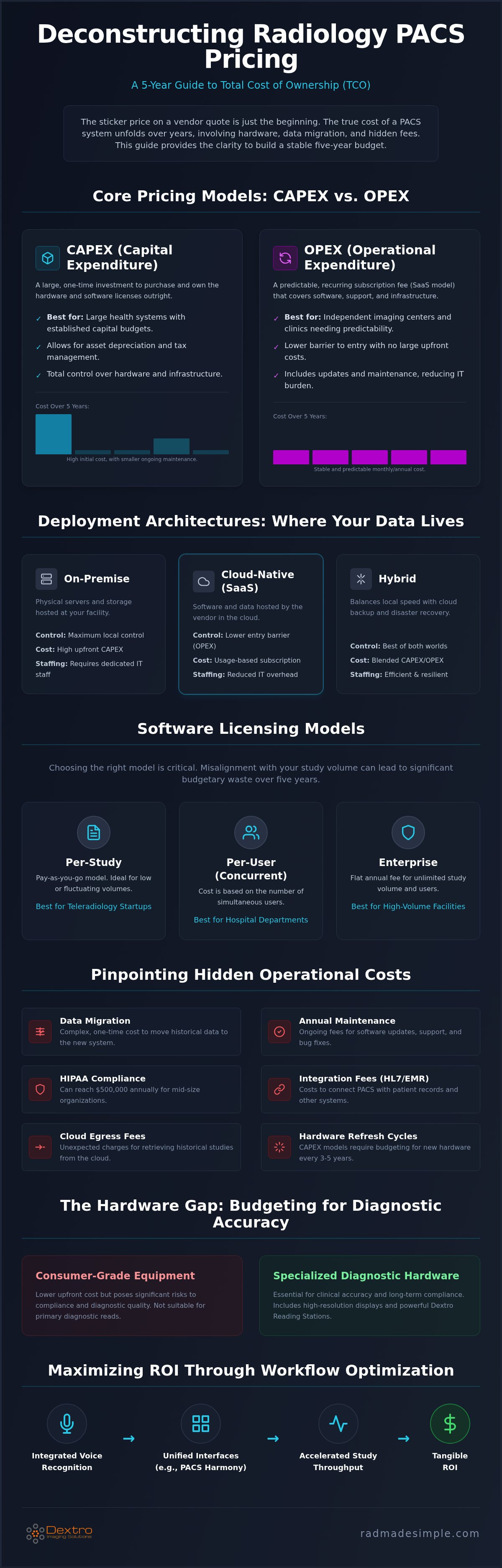
Budgeting for a Picture archiving and communication system (PACS) has evolved into a strategic exercise in long-term data management. In previous decades, facilities focused almost exclusively on the initial software purchase. Today, radiology PACS pricing encompasses the full lifecycle of the diagnostic ecosystem, including acquisition, implementation, and the continuous management of massive data volumes. Modern 2026 systems prioritize scalability over fixed storage limits, ensuring that your infrastructure grows alongside your study volume without triggering massive penalty fees.
The integration of Vendor Neutral Archives (VNA) has fundamentally changed how facilities view these costs. By decoupling the storage layer from the viewing application, solutions like PACS Harmony allow for more transparent pricing structures. This modularity means you aren't paying for redundant features or proprietary file formats that make future migrations expensive. It's about building a flexible foundation rather than buying a static product.
On-Premise vs. Cloud vs. Hybrid Costs
On-premise deployments require significant upfront investment in physical servers and climate-controlled storage rooms. While this offers maximum local control, it demands a dedicated IT staff for maintenance and hardware refreshes. Cloud-native solutions provide a lower entry barrier through Software as a Service (SaaS) models, where you pay based on usage metrics. Hybrid configurations often provide the most efficient balance; they maintain high-speed local access for large imaging files while leveraging the cloud for secure, off-site disaster recovery.
Capital vs. Operational Expenditure
Understanding the shift in radiology PACS pricing helps administrators avoid the "low-cost" trap that often ignores hardware refresh cycles. Capital Expenditure (CAPEX) models involve large, one-time payments that allow hospitals to manage tax structures through asset depreciation. This is often preferred by large health systems with established capital budgets. Conversely, Operational Expenditure (OPEX) models provide the predictability independent imaging centers need by turning costs into a steady monthly subscription. The Total Cost of Ownership for a five-year PACS lifecycle represents the sum of all software licensing, hardware procurement, data migration, and ongoing maintenance required to sustain clinical operations without interruption.
Software Licensing: Per-Study, Per-User, or Enterprise?
Selecting the right licensing model is a critical decision that directly shapes your radiology PACS pricing strategy. Vendors typically offer three distinct structures, each designed to address specific clinical volumes and operational workflows. Scholarly research into the Costs and benefits of PACS shows that misaligning your volume with your licensing model can lead to significant budgetary waste over a five-year period.
- Per-Study Pricing: This pay-as-you-go approach is highly effective for teleradiology startups or clinics with fluctuating volumes. It minimizes upfront risk but can become expensive as your practice grows.
- Per-User or Concurrent Seat: This model is preferred by hospital departments with consistent staffing levels. It charges based on how many radiologists or technicians are logged into the system simultaneously.
- Enterprise Licensing: For high-volume facilities, enterprise models provide unlimited study volume for a flat annual fee. This offers the highest level of financial predictability and usually becomes the most cost-effective choice once a facility exceeds a specific monthly study threshold.
Beyond the base license, integration fees for HL7 and EMR connectivity are essential to consider. These fees cover the technical work required to ensure your PACS communicates seamlessly with your patient records and scheduling systems. While often billed as a one-time setup cost, they frequently carry annual maintenance requirements to keep the interfaces updated with new software releases.
The True Cost of Cloud Storage
Cloud storage involves more than just a monthly subscription. Many providers pass through infrastructure costs from major hosts like AWS or Azure, which often include ingress and egress fees. While moving data into the cloud is typically free, retrieving historical studies (egress) can incur unexpected charges if not managed correctly. Efficient systems utilize tiered storage to mitigate these expenses. Active cases stay in 'hot' storage for immediate access, while older studies transition to 'cold' archives where storage costs are significantly lower.
Add-on Software Modules
Modern diagnostic environments require specialized tools that often sit outside the base license. RadVoice integrated voice recognition is a primary example; it drastically reduces reporting turnaround time by allowing radiologists to dictate directly into the system. Other add-ons include advanced visualization for 3D rendering and specialized mammography tools. You should also account for the emerging trend of 'AI-as-a-Service,' where automated algorithms for image analysis are billed on a per-use basis within the workflow. Evaluating a unified platform like PACS Harmony can help consolidate these modules into a more manageable financial structure.
The Hardware Gap: Budgeting for Diagnostic Accuracy
Software quotes often present an incomplete picture of your total investment. While the digital interface is vital, the physical infrastructure determines how quickly and accurately your radiologists can work. Many facilities fall into the trap of using consumer-grade displays to save on upfront radiology PACS pricing, only to face clinical inaccuracies and compliance failures later. Professional diagnostic hardware is a non-negotiable component of a reliable imaging ecosystem.
High-performance radiology reading workstations serve as the engine for your entire operation. These systems utilize specialized graphics processing units (GPUs) designed specifically to handle massive 3D datasets and multi-planar reconstructions without lag. When image loading takes even a few extra seconds per study, the cumulative loss in productivity can cost a practice thousands in billable time every month. Investing in the right hardware ensures that your software's advanced capabilities aren't throttled by outdated local processing power.
Diagnostic Monitors and DICOM Compliance
Budgeting for Jusha medical monitors is essential for maintaining DICOM Part 14 compliance. Unlike standard office screens, these displays offer the high luminance and contrast ratios required to visualize subtle pathologies. The cost varies significantly based on resolution; 3MP models are standard for general radiology, while 5MP or 12MP displays are required for specialized mammography and high-resolution breast imaging. Modern Jusha units include integrated front-panel sensors that automate the calibration process. This feature removes the need for manual IT intervention, ensuring your fleet remains compliant and consistent 24/7.
Workstation Infrastructure
Your hardware strategy should also account for the physical environment and network demands. Portable Radiology Workstations offer the flexibility needed for teleradiology or bedside consults, while fixed stations provide a more robust, ergonomic setup for high-volume reading rooms. Beyond the computer itself, your facility's 10Gbps network "backbone" is a critical hidden cost. Large imaging sets require massive bandwidth to move from the archive to the workstation without delay. Finally, always budget for hardware redundancy. Maintaining a backup workstation ensures that a single hardware failure doesn't halt your clinical workflow, protecting both your patient care standards and your daily revenue.
Hidden Costs: Support, Maintenance, and Compliance
Beyond the initial acquisition, annual maintenance fees typically account for 15% to 20% of the original software cost. These fees are a standard component of radiology PACS pricing, funding the continuous development required to keep your system compatible with evolving OS versions and security patches. Implementation and training represent the "people cost" of any transition. If your staff isn't properly trained on a new system, the resulting drop in throughput can quickly eclipse the savings of a cheaper license.
Data migration is often the most underestimated factor in radiology PACS pricing. Moving terabytes of legacy images from a proprietary archive to a modern system requires specialized tools and significant time to ensure DICOM header integrity. Cybersecurity and HIPAA compliance also demand dedicated investment. You must budget for high-level encryption, robust firewalls, and detailed audit logs that can withstand a federal audit without incurring heavy penalties.
Ongoing Technical Support
Radiology doesn't stop at 5:00 PM. A system failure on a Friday night can paralyze an entire emergency department, making 24/7/365 technical support a non-negotiable requirement rather than a luxury. When reviewing contracts, clarify whether major software releases are included in your support agreement or if they're billed as separate upgrades. Operating on unsupported legacy PACS software exposes your facility to catastrophic data loss and unmitigated security vulnerabilities that insurance providers may not cover.
Regulatory and Calibration Costs
Maintaining diagnostic integrity requires ongoing regulatory investment. Annual DICOM Part 14 testing ensures your monitors meet the specific luminance standards required for accurate interpretation. While external consultants can perform these tests for a fee, many facilities save money long-term by using Quality Assurance (QA) software licenses to manage their monitor fleets internally. Finally, ensure any system you consider has FDA 510(k) clearance. Cheaper, uncertified systems may lack the necessary clinical validations, putting your practice at significant legal and medical risk.
To ensure your facility remains compliant and efficient without hidden surprises, explore our full diagnostic stack solutions.
Strategic Budgeting: Maximizing ROI in 2026
Strategic budgeting requires shifting your focus from the initial expenditure to the long-term yield of your diagnostic environment. In 2026, the most effective way to optimize radiology PACS pricing is to prioritize tools that directly increase study throughput. A unified interface like PACS Harmony eliminates the "click fatigue" associated with switching between disparate systems, allowing radiologists to process more cases with higher accuracy. When you integrate RadVoice, the ROI becomes even more apparent. Reducing reporting turnaround time translates directly into faster billing cycles and improved referring physician satisfaction.
The "Cost of Inaction" is perhaps the most significant hidden line item in a legacy budget. While the upfront radiology PACS pricing for a new system might seem significant, older systems often suffer from frequent downtime and lack the robust security features required to prevent modern cyber threats. Considering that HIPAA violation penalties can reach $1.5 million per year for each violation category, the financial risk of maintaining an outdated system far outweighs the cost of a modern upgrade. Furthermore, utilizing Portable Radiology Workstations can reduce teleradiology overhead by providing flexible, high-performance reading capabilities without the need for multiple fixed-site installations.
Building Your PACS RFP
A well-structured Request for Proposal (RFP) is your best defense against unexpected costs. When evaluating vendors, ask for absolute transparency regarding "locked-in" fees that might prevent you from migrating your data in five years. Demand a comprehensive demo that showcases both software agility and hardware performance simultaneously. This ensures you aren't buying a high-end software license only to find it underperforms on your existing workstations. Specifically, ask about data egress fees and the long-term costs of storage scaling to ensure your budget remains predictable as your archive grows.
The Dextro Advantage: Integrated Solutions
Dextro Imaging Solutions acts as a "simplifier" by providing the full diagnostic stack in a single, cohesive package. By bundling software like PACS Harmony with high-performance hardware such as Dextro Reading Stations and Jusha Diagnostic Monitors, you can significantly lower your total acquisition costs compared to sourcing components individually. This integrated approach also streamlines your operational support. Instead of managing multiple vendors for monitors, workstations, and PACS software, you have a single point of contact for every technical requirement. To secure your facility's future, contact Dextro Imaging Solutions for a customized 2026 pricing roadmap.
Securing Your Facility's Financial and Clinical Future
Building a sustainable imaging department in 2026 requires looking far beyond the initial software quote. We've explored how radiology PACS pricing is fundamentally tied to your choice of licensing models, the necessity of DICOM-calibrated hardware, and the proactive mitigation of hidden maintenance fees. By prioritizing a "Diagnostic Ecosystem" approach, you can eliminate the operational friction of fragmented systems and protect your practice from unexpected compliance penalties. The goal is to transform your imaging infrastructure from a cost center into a high-performance asset that supports both radiologist productivity and patient care.
Dextro Imaging Solutions acts as your primary partner in this transformation by providing a completely integrated diagnostic stack. As specialists in DICOM-calibrated hardware, we deliver seamless workflows featuring PACS Harmony and RadVoice, all supported by our global technical maintenance teams. You don't have to navigate these complex financial waters alone. Request a Transparent PACS & Hardware Quote from Dextro to establish a clear, five-year roadmap for your facility's success. We're ready to help you achieve the streamlined, reliable operations your team deserves.
Frequently Asked Questions
What is the average cost of a PACS for a small imaging center in 2026?
A small imaging center processing roughly 300 studies per month can expect cloud subscription fees between $200 and $800 per month. This baseline usually covers 2TB of storage but excludes the initial setup fee, which typically starts at $1,500. It's essential to factor in these variables when calculating radiology PACS pricing to ensure the model supports your specific clinic volume and growth targets.
Are cloud PACS cheaper than on-premise systems over a 5-year period?
Cloud systems generally offer a lower total cost of ownership over five years by eliminating the need for expensive local server hardware and dedicated IT maintenance. While on-premise systems have a fixed cost after the initial purchase, they require hardware refreshes and manual security patches that add significant expense. Cloud models shift these costs into predictable monthly operating expenses that include automated updates and disaster recovery.
What are the most common hidden fees in PACS vendor contracts?
The most frequent hidden costs include data egress fees for study retrieval and annual maintenance contracts, which usually run 15% to 20% of the software price. Vendors often bill separately for HL7 interface configurations and EMR integration. Reviewing your contract for these specific line items ensures your radiology PACS pricing remains transparent and helps you avoid unexpected budgetary spikes after the system is implemented.
Do I need to pay for data migration when switching PACS vendors?
Most facilities must pay a specialized migration fee when moving historical images from a legacy archive to a new system. Industry rates in 2026 typically range from $0.05 to $0.50 per study, depending on the complexity of the proprietary formats involved. This process ensures DICOM header integrity across your entire archive, so it's vital to clarify if these services are bundled or billed as professional hours.
How much does DICOM monitor calibration software cost?
Calibration software is often bundled with professional displays like Jusha monitors, though enterprise licenses for large fleets are sometimes billed as a separate Quality Assurance (QA) expense. These tools automate DICOM Part 14 compliance testing, which drastically reduces manual IT labor costs. Investing in automated calibration prevents the financial risks associated with clinical inaccuracies and potential regulatory fines during state or federal inspections.
Can I use consumer monitors to save money on my PACS setup?
Using consumer monitors is not a viable way to save money because they lack the luminance and contrast required for DICOM Part 14 compliance. While the upfront cost is lower, these screens fail to reveal subtle pathologies and increase the risk of misdiagnosis. Professional diagnostic monitors protect your practice from legal liability and include specialized sensors that maintain consistent performance, making them the only compliant choice.
Is voice recognition software like RadVoice usually included in the PACS price?
Advanced dictation tools like RadVoice are typically offered as integrated add-on modules rather than being part of the base license. While this represents an additional software cost, the efficiency gains provide a rapid return on investment by significantly reducing reporting turnaround times. Bundling these tools with your primary software often results in more favorable pricing structures compared to sourcing a separate, third-party dictation system.
What happens to my data costs if my imaging volume increases suddenly?
Your cost impact depends entirely on your licensing model. Per-study models will see an immediate, proportional increase in monthly fees, whereas enterprise licenses generally remain flat regardless of volume growth. Cloud-based systems might also trigger higher storage tier charges once you exceed your initial terabyte limits. It's important to select a scalable plan that anticipates your facility's expansion to maintain a predictable budget.


