

Ripping and replacing legacy imaging infrastructure won't solve enterprise clinical silos; real operational efficiency hinges on precise metadata governance and intelligent workflow orchestration. For clinical IT directors and imaging teams, confronting common PACS integration challenges often means battling delayed report turnaround times, proprietary metadata tags that corrupt archive migrations, and network bandwidth throttling during remote CT dataset retrieval. You already know the daily friction that occurs when disjointed viewer interfaces force radiologists to constantly context-switch, draining focus and slowing critical diagnostic decisions across your health system.
Eliminating these bottlenecks does not require operational disruption. In this technical guide, you will master the technical and operational complexities of PACS integration to streamline imaging workflows and eliminate clinical downtime. We explore practical strategies to establish seamless bidirectional communication across your PACS, RIS, and EHR platforms, preserve historical archives during transitions, and deploy a unified viewing interface built for high-throughput diagnostic reading.
Key Takeaways
- Bridge protocol translation gaps across HL7 messaging, DICOM imaging tags, and modern FHIR APIs to prevent order-matching failures and clinical data silos.
- Protect historical archive integrity during legacy migrations by isolating non-standard private tags and enforcing automated checksum verifications.
- Eliminate network bandwidth bottlenecks throttling heavy multi-slice CT and MRI datasets with modern streaming and server-side rendering protocols.
- Solve common PACS integration challenges by replacing multi-system logins with a consolidated workflow orchestration layer that unifies disparate viewer interfaces.
- Adopt vendor-neutral enterprise frameworks to align your imaging software and diagnostic hardware without resorting to disruptive rip-and-replace deployments.
Core Interoperability Friction: Bridging DICOM, HL7, and FHIR Standards
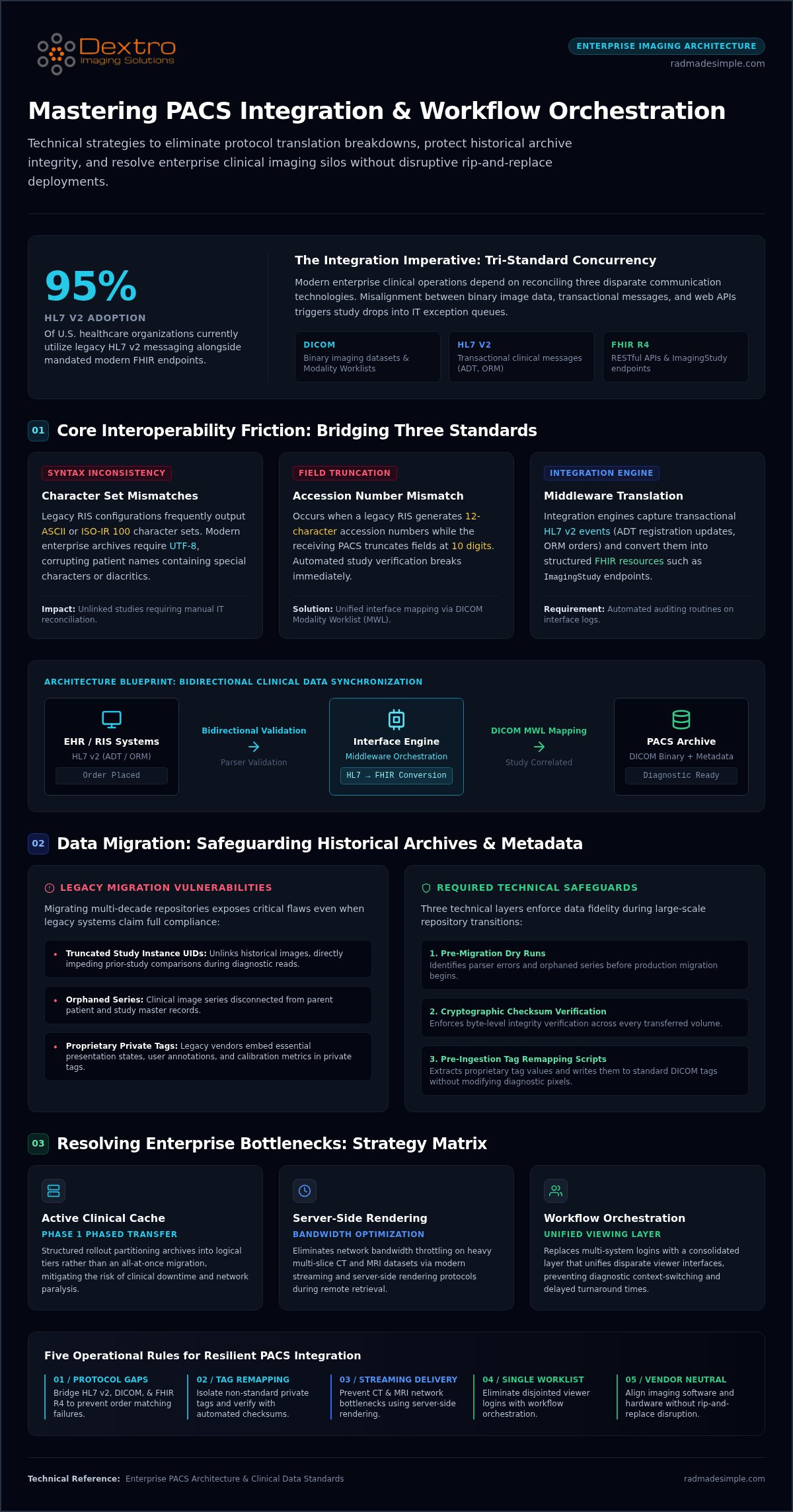
Mismatched messaging protocols between clinical systems degrade turnaround times by generating unlinked imaging studies that require manual IT reconciliation before a radiologist can issue a diagnostic report. Modern enterprise imaging depends on three fundamentally distinct communication standards: DICOM for binary imaging datasets, HL7 v2 for transactional clinical messaging, and RESTful FHIR APIs for modern health record exchange. Connecting these disparate technologies highlights the common PACS integration challenges facing clinical IT teams. When a Picture archiving and communication system (PACS) doesn't accurately correlate an incoming DICOM query with an HL7 order message, studies drop into exception queues. With HL7 v2 utilized by 95% of U.S. healthcare organizations alongside mandated FHIR R4 endpoints, translation failures happen easily unless interface engines enforce strict bidirectional data validation rules.
Syntax and Data Field Inconsistencies Across Systems
Data fidelity breaks down when adjacent systems interpret fields differently. Older RIS installations frequently output ASCII or ISO-IR 100 character sets, whereas modern enterprise archives expect UTF-8, corrupting patient names containing special characters or diacritics. Accession number truncations present an equally disruptive hurdle; if a legacy RIS generates twelve-character accession numbers and the receiving PACS truncates fields at ten digits, automated study verification breaks immediately. Standardizing DICOM Modality Worklist (MWL) feeds through unified interface mapping eliminates these formatting conflicts, stopping duplicate patient record creation at the modality console before image acquisition even begins.
Bridging Legacy HL7 Feeds with Modern Web APIs
Connecting legacy hospital infrastructure with modern web frameworks requires intelligent middleware orchestration. Integration engines must capture transactional HL7 v2 event triggers, like ADT registration updates or ORM orders, and convert them into structured FHIR resources such as ImagingStudy endpoints. Clinical engineering teams must maintain continuous synchronization between EHR databases and vendor-neutral systems like aycan PACS to prevent state drift between clinical notes and stored studies. Establishing automated auditing routines on all interface logs catches unhandled parsing exceptions and malformed segment delimiters, mitigating common PACS integration challenges before protocol failures cascade into daily reading operations.
Data Migration Bottlenecks: Safeguarding Historical Archives and Metadata
Migrating multi-decade imaging repositories exposes severe vulnerabilities in data integrity, transforming routine system upgrades into critical operational bottlenecks. Even when legacy repositories report complete DICOM compliance, extracting terabytes of clinical history routinely uncovers non-standard syntax, truncated study instance UIDs, and orphaned series. These inconsistencies represent some of the most disruptive common PACS integration challenges, because an unlinked historical image directly impedes prior-study comparisons during diagnostic reads. Industry analyses of data migration challenges confirm that basic extraction utilities fail unless teams implement strict pre-migration dry runs paired with cryptographic checksum verification across every transferred volume.
Handling Proprietary DICOM Header Tags
Legacy vendors frequently embed essential clinical context inside proprietary, private metadata tags rather than standardized public elements. These non-standard groups often house crucial presentation states, user annotations, and calibration metrics. If an incoming archive cannot parse these tags, it drops the metadata, potentially rendering advanced reconstructions unreadable. Clinical engineers must deploy pre-ingestion automated remapping scripts. These scripts identify vendor-specific tags, extract the underlying values, and write them into standard DICOM tags without modifying diagnostic pixel data.
Phased Transfer Strategies for Large Volume Archives
Executing an all-at-once migration invites network paralysis and clinical downtime. A structured, phased rollout delivers far safer outcomes by partitioning archives into logical tiers:
- Phase 1: Active Clinical Cache: Migrate studies from the previous 12 to 24 months first, ensuring radiologists have immediate access to high-probability priors.
- Phase 2: Dual-Routing Operation: Configure modalities and interface engines to send new incoming acquisitions to both the legacy archive and your replacement platform simultaneously.
- Phase 3: Deep Archive Ingestion: Ingest inactive historical files in controlled background batches during off-peak network hours, using scalable storage software like aycan PACS to manage archive volume efficiently.
Before launching a large migration project, clinical teams should evaluate infrastructure requirements and project boundaries by reviewing our radiology PACS pricing guide to align storage architecture with realistic operational costs. To plan a smooth transition without risking archive corruption, connect with the enterprise specialists at radmadesimple.com for structured migration guidance.
Network Bandwidth Constraints and Latency in Heavy Imaging Studies
High-resolution imaging datasets routinely overwhelm wide area network connections, causing diagnostic latency that disrupts remote interpretation. Multi-phase CT scans, high-channel cardiac MRIs, and multi-gigabyte digital breast tomosynthesis (DBT) files generate immense data loads. When clinical facilities route these dense datasets across off-site links without adequate infrastructure, remote radiologists face buffering delays that compromise productivity. Bottlenecks of this nature rank among the most frustrating common PACS integration challenges, particularly for healthcare networks transitioning to decentralized reading models. Solving this bottleneck requires a coordinated strategy combining modern web protocols, edge caching, and purpose-built hardware capable of handling demanding throughput.
Managing Large File Delivery for Teleradiology
Legacy file-transfer methods download full DICOM studies before a diagnostician can open them. This sequential approach causes extreme lag when reading remote studies. Modern transmission frameworks solve this by combining intelligent background workflows with modern web standards:
- Progressive Web Streaming: Modern zero-footprint viewers stream initial display-grade rendered frames instantly via server-side rendering while full-fidelity diagnostic data caches continuously in the background.
- Rule-Based Pre-Fetching: Interface engines monitor HL7 scheduling feeds to push relevant prior imaging and new accessions to local edge caches well before a radiologist opens the examination.
- Specialized Edge Hardware: Utilizing dedicated mobile appliances like Radcom Compact provides the local processing power and stable routing required for high-volume diagnostic throughput outside primary hospital facilities.
Maintaining Compliance and Display Fidelity at the Endpoint
Compressing imaging data reduces network overhead, but clinical teams must manage the trade-off carefully. Aggressive, lossy compression algorithms risk altering pixel values and stripping fine diagnostic detail from subtle microcalcifications or subtle ischemic strokes. Primary diagnostic interpretation requires strictly lossless or mathematically reversible compression during transfer. Transmitted image bit depth must remain intact from the central archive all the way to client monitors. To evaluate hardware setups capable of displaying these heavy datasets without performance degradation, consult our guide to radiology reading workstations. Ensuring your displays maintain precise luminescence and grayscale consistency also requires regular calibration checks, detailed in our radiology equipment compliance support guide.
Workflow Disruption: Overcoming Multi-PACS Worklist Fragmentation
Operating across multiple distinct hospital platforms fragments the diagnostic reading room, creating cognitive fatigue and dragging down diagnostic throughput. Radiologists contracting across regional networks frequently manage separate viewer windows, distinct shortcut configurations, and isolated logins for every facility they cover. This friction represents one of the most operationally draining common PACS integration challenges facing modern practices. When clinicians spend significant portions of their shift navigating disparate applications, report turnaround times slow down and enterprise clinical visibility evaporates. Solving this issue requires an intelligent orchestration layer rather than forcing readers to adapt to broken interfaces.
Mitigating Cognitive Load and Context Switching
Every time a radiologist switches from one PACS viewer to another, focus breaks. Different user interfaces place windowing tools, measurement callouts, and multi-planar reformatting toggles in completely different locations. These micro-delays accumulate rapidly, increasing fatigue and elevating the risk of diagnostic oversight during high-volume shifts. Clinical departments can resolve this fragmentation by implementing PACS Harmony to overlay disparate feeds with a single, vendor-neutral viewing interface. This approach standardizes diagnostic hanging protocols across all inbound hospital archives, automatically arranges prior comparison studies, and eliminates redundant credential logins across separate hospital portals.
Integrating Structured Reporting and Voice Dictation
Fragmented viewer deployments create severe friction for reporting engines. When dictation software doesn't synchronize bi-directionally with the active imaging window, radiologists must manually verify patient identifiers and accession numbers, inviting transcription errors. Healthcare organizations can resolve these breakdowns by adopting cohesive reporting strategies:
- Bi-Directional Context Sharing: Connect speech recognition tools directly to an orchestration layer so opening an imaging study instantly populates the correct patient template and clinical history across all connected backends.
- Voice Engine Optimization: Consult our voice recognition for radiologists guide to align specialized vocabularies and voice tools like RadVoice across diverse hospital networks.
- Centralized SLA Tracking: Consolidate report sign-offs into a single operational queue to monitor turnaround time compliance across all contracted imaging sites simultaneously.
Eliminate disjointed reading environments and reclaim your diagnostic efficiency today. Explore how to unify multi-facility worklists by scheduling an architecture assessment at radmadesimple.com.
Modern Integration Frameworks: Unifying Enterprise Architecture for 2026
Decommissioning operational legacy archives through disruptive rip-and-replace overhauls creates substantial clinical downtime and unnecessary capital expense. Forward-thinking healthcare organizations are taking an architectural approach that decouples the diagnostic viewer, the workflow orchestration engine, and the underlying storage tiers. This modular strategy resolves the most stubborn common PACS integration challenges by creating a vendor-neutral operational ecosystem. By deploying integrated architecture alongside cloud-based radiology platforms from providers like One Health Connect, clinical IT departments can unify disparate hospital endpoints and bridge isolated legacy systems without destabilizing routine patient care.
Consolidating Workflows with PACS Harmony
Managing multi-facility reading requirements doesn't require forcing remote facilities onto an identical backend platform. Deploying PACS Harmony allows radiology groups to overlay multiple disparate hospital archives with a single, consolidated reading interface. Clinicians interact with one unified worklist and one set of diagnostic tools, eliminating repetitive portal logins and disparate user profiles. Individual hospitals retain full administrative control over their local archives and RIS configurations, while reading physicians enjoy a consistent, high-efficiency reading cockpit across every facility in the network.
Scalable Archival Management with aycan PACS
Long-term operational resilience depends on reliable, vendor-neutral storage capable of expanding alongside surging study volumes. Implementing aycan PACS establishes an adaptable storage framework that effortlessly accommodates high-throughput clinical demands across hybrid and on-premise deployments. This scalable architecture prevents storage bottlenecks, accelerates study retrieval across enterprise sites, and cleanly isolates archive functions from proprietary hardware dependencies.
Achieving peak diagnostic throughput also demands complete harmony between software performance and endpoint hardware. Pairing high-performance archive solutions with calibrated diagnostic displays and dedicated Dextro Imaging Solutions reading stations ensures that multi-gigabyte studies load swiftly and render with precise diagnostic compliance. When high-performance software operates on purpose-built hardware, clinical networks eliminate common PACS integration challenges, protect diagnostic accuracy, and sustain peak workflow velocity.
Streamline Your Enterprise Imaging Strategy for 2026
Overcoming common PACS integration challenges doesn't require dismantling your established clinical infrastructure. Sustainable operational gains come from resolving protocol translation gaps across HL7, DICOM, and FHIR endpoints, safeguarding historical metadata during structured migrations, and deploying unified orchestration to eliminate fragmented worklist fatigue. When your architecture handles data exchange automatically behind the scenes, clinical teams eliminate downtime and maintain uncompromised diagnostic velocity.
Building an enterprise imaging ecosystem requires seamless alignment between software performance and diagnostic endpoints. Dextro Imaging Solutions simplifies this transition through specialized integration of vendor-neutral PACS platforms including aycan PACS, workflow consolidation through PACS Harmony universal interfaces, and medical-grade hardware integration with DICOM-calibrated Jusha displays. Reclaim lost clinical productivity, empower your radiologists with consistent viewing interfaces, and discover how PACS Harmony unifies your imaging infrastructure today.
Frequently Asked Questions
What are the primary causes of order-matching errors during PACS integration?
Order-matching errors stem from misaligned field mappings between HL7 order messages (ORM/OMI) and incoming DICOM image headers. Character encoding differences, truncation of accession numbers between legacy RIS and new archives, and inconsistent Patient ID formatting cause studies to drop into exception reconciliation queues. Enforcing strict interface engine mapping rules resolves these common PACS integration challenges before mismatched records stall daily reading operations.
How do proprietary DICOM tags complicate historical data migration to a new PACS?
Proprietary DICOM tags store essential presentation states, specialized measurements, and custom display parameters inside non-standard vendor data groups. When migrating historical studies to a new archive, receiving systems that don't recognize these private elements often discard or corrupt the metadata. This strips historical comparisons of critical clinical context unless teams deploy pre-migration automated tag-mapping scripts to translate private attributes into standardized public elements.
Can a vendor-neutral overlay like PACS Harmony work with older legacy imaging systems?
Yes, PACS Harmony connects directly to older legacy imaging platforms through standard DICOM query/retrieve and HL7 communication protocols. It operates as an intelligent workflow orchestration layer above existing infrastructure, meaning hospitals don't need to retire functioning on-premise archives. Radiologists get a single, unified viewing cockpit across all connected hospital backends, eliminating repetitive logins while preserving local facility autonomy.
What network bandwidth is required to support multi-slice CT studies in teleradiology?
A stable internet connection with at least 10 Mbps upload and download speeds is the baseline requirement for cloud and remote imaging workflows. However, handling heavy multi-slice CT and tomosynthesis datasets smoothly requires additional architectural optimization. Modern setups pair this bandwidth with progressive server-side streaming, rule-based background pre-fetching, and local hardware caching to eliminate transmission lag and maintain high diagnostic throughput.
How does integrating speech recognition software like RadVoice benefit a multi-PACS setup?
Integrating RadVoice into a multi-PACS environment synchronizes diagnostic reporting across disparate viewing platforms automatically. By linking directly to an orchestration layer, the voice engine automatically loads matching patient demographics, accession numbers, and specialized report templates when an image opens. This eliminates manual dictation entry errors, cuts administrative overhead, and accelerates overall report turnaround times across contracted facilities.
Why is DICOM Part 14 calibration critical when replacing PACS hardware components?
DICOM Part 14 Grayscale Standard Display Function (GSDF) calibration ensures medical displays render consistent grayscale luminance across all diagnostic endpoints. Commercial computer monitors lack this standardized curve, which can cause subtle lesions, microcalcifications, or hairline fractures to appear invisible. Pairing integration software with medical-grade displays like Jusha Diagnostic Monitors guarantees that transmitted pixel data displays with absolute clinical fidelity and regulatory compliance.
What is the difference between HL7 and FHIR when connecting PACS to an EHR?
HL7 v2 is an event-driven, pipe-delimited messaging standard used for point-to-point transactional communication, while FHIR is a modern, RESTful API framework using web-standard JSON objects. While 95% of U.S. healthcare organizations continue using HL7 v2 for internal workflows, FHIR R4 is mandated for modern EHR interoperability. Bridging both protocols solves common PACS integration challenges by allowing legacy archives to communicate cleanly with modern web-based clinical records.


