
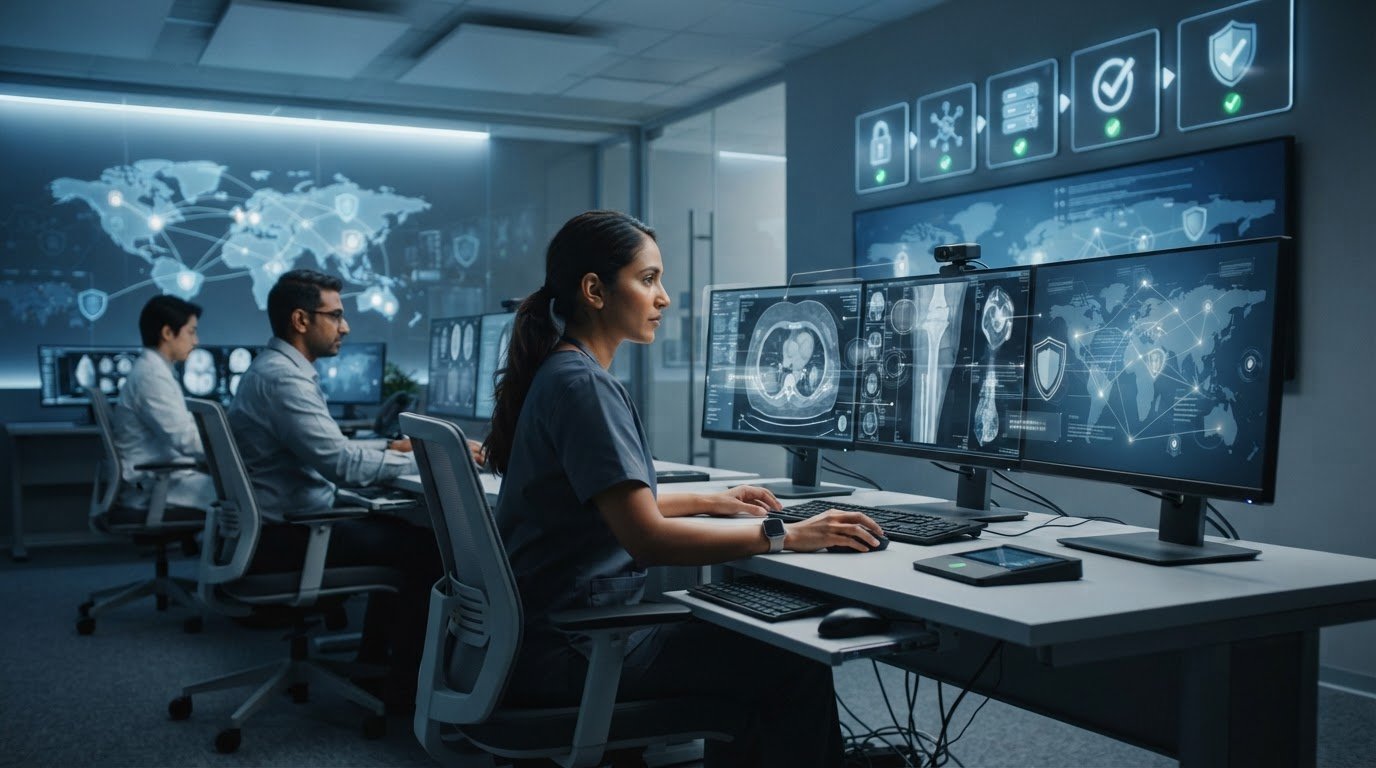
An off-the-shelf commercial display might look sharp on a home desk, but deploying consumer hardware is often the fastest route to an audit failure. Remote reading environments face intense regulatory scrutiny, and balancing evolving cross-border licensing mandates with strict HIPAA technical safeguards creates constant operational friction. If you aren't certain whether your remote workstation meets rigorous American College of Radiology standards or adequately protects diagnostic data across home networks, you aren't alone. Establishing a verified compliance checklist for teleradiology is the most direct way to eliminate guesswork and protect your practice.
This 2026 guide helps you master federal, clinical, and technical teleradiology compliance standards to safeguard remote diagnostic workflows against audits and costly penalties. We provide a structured breakdown of technical workstation specifications, automated display calibration protocols, and secure network requirements to keep your distributed reading stations fully audit-ready.
Key Takeaways
- Distinguish state-specific medical licensure and updated CMS virtual supervision mandates from basic hospital credentialing requirements.
- Identify mandatory American College of Radiology display criteria, including why automated DICOM Part 14 GSDF calibration is essential to pass technical audits.
- Harden remote workstations against severe HIPAA penalties by deploying AES-256 encryption at rest, TLS 1.3 in transit, and strict zero-trust network access.
- Implement our structured 5-stage compliance checklist for teleradiology to systematically evaluate your technical hardware, network security, and clinical workflows.
- Discover how deploying pre-configured medical reading stations and automated monitor sensors eliminates non-compliance risks and simplifies audit documentation.
Teleradiology Compliance Standards: Navigating Legal and Clinical Frameworks in 2026
True diagnostic governance spans far beyond simple administrative templates. In 2026, teleradiology compliance operates at the strict intersection of technical image fidelity, data privacy mandates, and clinical workflow standards. Establishing a defensible compliance checklist for teleradiology requires looking past generic IT policies. Professional guidelines from bodies like the American College of Radiology (ACR) and the Society for Imaging Informatics in Medicine (SIIM) set concrete technical parameters for electronic image practice. Neglecting these multidimensional standards doesn't just invite civil monetary penalties. It risks immediate malpractice liability, revoked hospital privileges, and exclusion from federal Medicare reimbursement programs.
Federal vs. State Jurisdictional Mandates
Federal frameworks set baseline cybersecurity and privacy rules, but state medical boards govern clinical practice authority. Legally, the medical act takes place at the physical location of the patient, not the reading radiologist. A physician interpreting remotely must hold an active, unrestricted medical license in the patient's state. While the Interstate Medical Licensure Compact (IMLC) accelerates the multi-state licensing process, it doesn't grant a single nationwide credential. Practitioners must maintain each state credential independently. In addition, teleradiologists must satisfy local hospital medical staff bylaws, including primary source verification and formal credentialing-by-proxy agreements, before rendering billable interpretations. Aligning these jurisdictional rules prevents billing rejections and avoids unlicensed practice allegations.
The Tripartite Risk Model: Legal, Technical, and Clinical
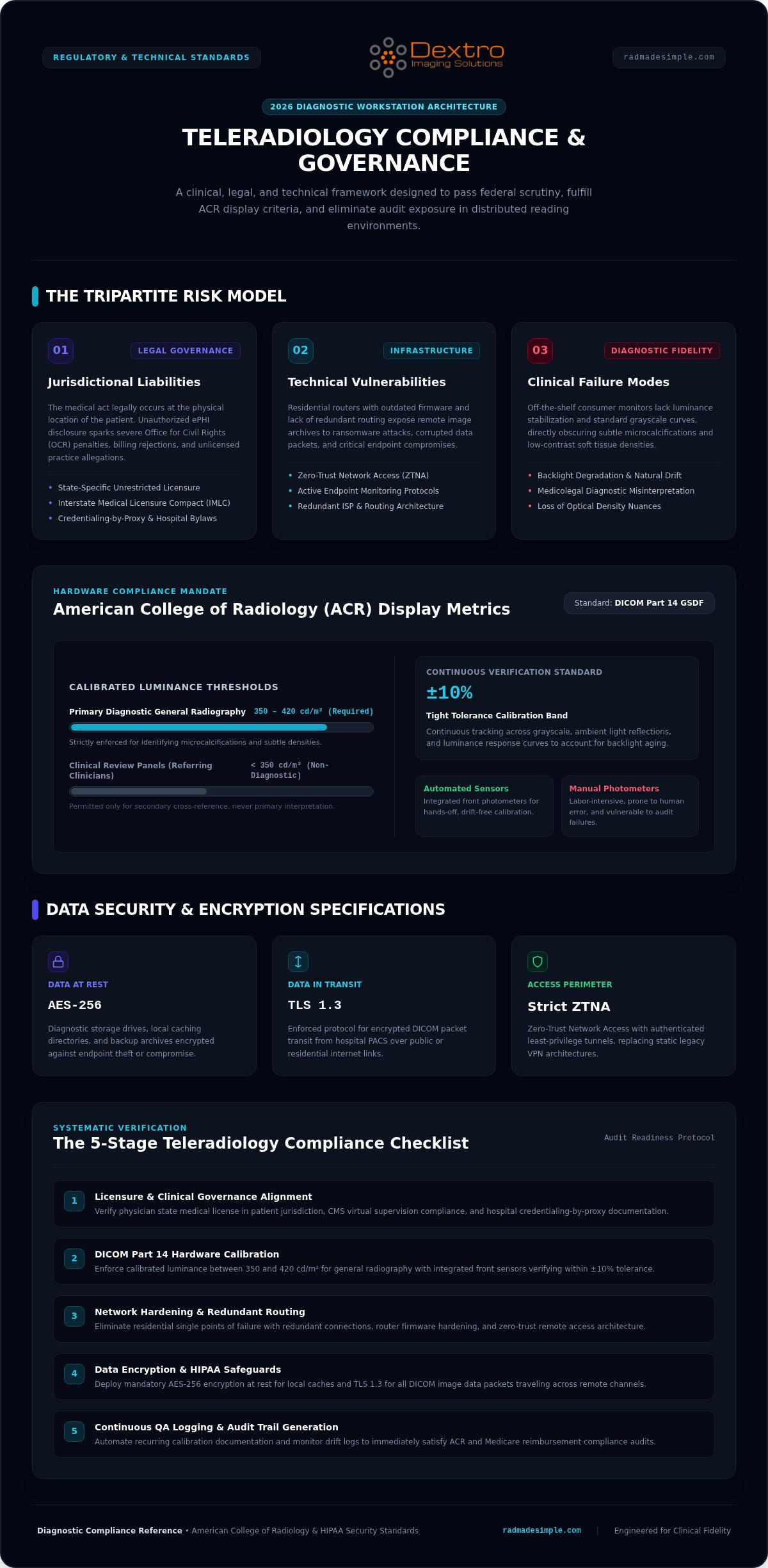
Remote diagnostic setups fail when practices treat IT security, legal exposure, and diagnostic accuracy as unrelated challenges. A sustainable architecture accounts for risks across all three areas:
- Legal liabilities: Unauthorized disclosure of electronic protected health information (ePHI) triggers mandatory breach notifications and crippling Office for Civil Rights (OCR) financial penalties.
- Technical vulnerabilities: Outdated router firmware, residential internet connections without redundant routing, and unmonitored endpoints expose image archives to ransomware attacks and corrupted data packets.
- Clinical risks: Utilizing uncalibrated commercial displays obscures subtle microcalcifications and low-contrast soft tissue densities. Consumer panels lack luminance stabilization, causing diagnostic errors and significant medicolegal liability.
A rigorous compliance checklist for teleradiology bridges these silos, systematically protecting diagnostic integrity from the PACS archive directly to the physical reading environment. Managing these domains collectively ensures high diagnostic fidelity while keeping regulatory exposures completely contained.
Diagnostic Hardware Compliance: DICOM Part 14 and Display Standards
Diagnostic displays are regulated medical devices, not standard computer peripherals. While general IT audits emphasize the technical safeguards of the HIPAA Security Rule, teleradiology oversight requires equal rigor regarding display physics. The American College of Radiology mandates strict performance parameters for electronic image interpretation. Primary diagnostic displays must comply precisely with the DICOM Part 14 Grayscale Standard Display Function (GSDF). This standard standardizes luminance steps so that subtle perceptual changes in optical density remain perceptible to the human eye across distinct viewing environments. General radiography requires a minimum calibrated luminance of 350 to 420 cd/m2, whereas clinical review monitors used by referring clinicians only meet lower thresholds. For an extensive hardware breakdown, review our 2026 radiology equipment compliance checklist.
DICOM Part 14 Calibration and Continuous QA
Displays drift naturally as backlights age. Meeting ACR guidelines demands ongoing verification rather than a one-time factory setting. Manual calibration with external photometers is labor-intensive and prone to human error. Instead, leading facilities use integrated front sensors that continuously track luminance response, ambient light reflections, and grayscale tracking within a tight 10% tolerance band. Automated software platforms log these daily, monthly, and annual tests, creating tamper-proof audit trails for hospital accreditation reviewers.
MQSA Requirements for Remote Mammography Reading
Remote breast imaging carries the strictest hardware requirements in medicine. Under FDA MQSA rules, interpreting digital mammography and digital breast tomosynthesis mandates certified 5-megapixel medical displays. These systems must deliver a minimum calibrated peak luminance exceeding 450 cd/m2 to resolve fine microcalcifications and subtle structural distortions. Facilities must also retain signed documentation from an independent medical physicist verifying that the remote workstation matches in-hospital quality control specifications.
Medical-Grade Displays vs. Off-the-Shelf Consumer Monitors
Consumer screens cannot deliver diagnostic compliance. Retail monitors use spatial-dithering algorithms and dynamic contrast curves that distort DICOM grayscale values. They also lack backlight stabilization sensors, causing luminance to degrade unevenly across the screen face. Interpreting studies on consumer hardware invites profound legal liability if missed findings lead to litigation. Upgrading to certified professional reference monitors protects reading practices by guaranteeing uniform pixel pitch, stable luminance, and autonomous calibration. A complete compliance checklist for teleradiology must verify certified display hardware before a single study is opened. To audit your practice against these strict display benchmarks, consult the imaging experts at radmadesimple.com, proudly supported by Dextro Imaging Solutions.
Data Security, Encryption, and HIPAA Safeguards for Remote Reading
Securing remote diagnostic workflows requires technical safeguards built specifically for imaging informatics. Unencrypted home networks and basic consumer cloud drives cannot handle protected health information safely. Federal enforcement mandates end-to-end cryptographic defense across the entire diagnostic lifecycle. Data at rest on reading hardware requires AES-256 encryption, while imaging studies moving over public or residential connections must use TLS 1.3 encapsulation. Clinical groups must also execute formal Business Associate Agreements (BAAs) with every software vendor, cloud host, and IT service provider touching their infrastructure. Aligning these technical controls with the ACR Teleradiology Practice Guidelines ensures full regulatory defensibility.
Securing the Remote Data Pipeline: PACS, VPN, and Direct TLS
Transmitting large imaging studies across distributed networks introduces distinct attack vectors. Generic VPNs frequently suffer from packet drops and security misconfigurations. Medical groups should establish managed site-to-site IPsec tunnels or deploy TLS-wrapped DICOM routers directly between the reading workstation and the hospital network. Systems must block local caching of unencrypted patient studies on workstation drives to eliminate physical theft liabilities. Practice managers assessing their image archive infrastructure should evaluate comprehensive workflows through resources like our guide on radiology PACS pricing to maintain end-to-end encryption without inflating support overhead.
Identity Governance, MFA, and Access Logging
Endpoint perimeter defense begins with identity verification. Remote reading stations require phishing-resistant multi-factor authentication (MFA) before granting access to imaging databases. Remote sessions must enforce automated fifteen-minute timeouts to mitigate physical exposure. Role-based access controls must restrict diagnostic access strictly to assigned patient cases. Centralized security systems must log every DICOM C-FIND, C-MOVE, and image review query in tamper-proof audit trails, making them available for federal compliance inspectors.
Physical Safeguards in the Home Reading Room
Remote physical controls are just as critical as digital protocols. The home reading suite must be a dedicated, secure room with controlled physical access to prevent unauthorized viewing by family members or visitors. Ambient illumination must remain low and uniform, eliminating surface glare that hides low-contrast lesions. Peripherals also require security reviews. Specialized microphones deployed for voice recognition for radiologists must route voice streams through local encrypted drivers rather than unvetted public cloud endpoints. Integrating these physical protocols into your operational compliance checklist for teleradiology creates an airtight reading environment that satisfies HIPAA inspectors and hospital credentialing committees alike.
The 5-Stage Teleradiology Compliance Checklist
Operating a legally sound remote reading service requires a structured, repeatable verification system. Rather than addressing regulatory requirements haphazardly, practices need an end-to-end framework that covers hardware, data transit, contracts, room design, and ongoing quality audits. This actionable five-stage compliance checklist for teleradiology gives administrators and practice managers a clear roadmap to pass hospital credentialing checks and federal inspections without operational bottlenecks.
Stages 1 & 2: Diagnostic Hardware and Network Hardening
Workstation verification begins with display and network isolation before clinical software is configured:
- Stage 1 (Hardware Certification): Inspect all diagnostic panels against ACR guidelines and FDA MQSA benchmarks. Confirm baseline photometer certificates are on file, ensure native resolution meets clinical subspecialty criteria, and verify luminance uniformity across every active panel. For mobile practitioners, align equipment with our traveling radiologist workstation setup guide.
- Stage 2 (Network Hardening): Deploy enterprise routers that physically isolate the reading station on a dedicated medical VLAN, completely separated from personal home devices. Configure zero-trust access policies, terminate all split tunneling, and enforce TLS 1.3 protocol standards for every inbound DICOM stream.
Stage 3: Legal, Vendor, and Administrative Documentation
Administrative preparation must stand up to external scrutiny. Review every third-party service relationship and ensure executed Business Associate Agreements are logged for cloud PACS hosts, dictation vendors, and IT maintenance teams. Verify that interpreting physicians hold active, unrestricted medical licenses in every jurisdiction where patients are physically scanned. Finally, document concrete incident response procedures that outline containment and notification protocols in the event of an attempted data breach.
Stages 4 & 5: Environmental Controls and Continuous Audit Readiness
Clinical accuracy depends heavily on reading room conditions and ongoing quality control:
- Stage 4 (Environmental Validation): Calibrate the physical reading suite. Use a calibrated lux meter to verify ambient room illuminance stays below the recommended 50 lux threshold, eliminating optical glare and contrast degradation.
- Stage 5 (Continuous QA & Re-Auditing): Automate routine quality assurance checks. Schedule automated daily visual tests and monthly DICOM conformance software sweeps. Consolidate daily sensor logs, annual medical physicist reviews, and licensure renewals into a centralized compliance binder.
Adopting this structured compliance checklist for teleradiology safeguards your remote interpretations against clinical error and legal challenges. To modernize your practice with audit-ready hardware and pre-configured workstations, explore compliant reading solutions at radmadesimple.com.
Streamlining Compliance with Dextro Imaging Solutions
Sourcing disparate hardware, security appliances, and calibration tools leaves dangerous operational gaps. Dextro Imaging Solutions engineers specialized medical-grade hardware and workflow software specifically designed to satisfy rigorous diagnostic criteria. Turning a demanding compliance checklist for teleradiology into an operational reality becomes simple when reading environments are purpose-built for regulatory alignment from day one.
Turnkey Hardware: Dextro Reading Stations and Jusha Monitors
Assembling custom reading setups from commercial retail components wastes clinical hours and invites audit failures. Deploying purpose-built radiology reading workstations like Dextro Reading Stations ensures your graphics pipelines, processing units, and local security configurations satisfy ACR technical benchmarks immediately. Pairing these systems with Jusha Diagnostic Monitors removes ongoing calibration headaches. Integrated front sensors automatically maintain DICOM Part 14 GSDF conformance and log historical drift without manual intervention. For mobile practitioners requiring flexible deployment, Portable Radiology Workstations deliver certified diagnostic accuracy wherever coverage is needed.
Integrated Software: PACS Harmony and RadVoice Reporting
Hardware performance requires matching software integration to protect data in transit. Disjointed hospital connections complicate compliance and compromise audit trails. PACS Harmony delivers vendor-neutral imaging integration, consolidating image streams across multiple facilities into a unified, secure interface. Clinical teams can pair this pipeline with RadVoice advanced voice recognition software to dictate structured diagnostic reports quickly while keeping voice files behind encrypted boundaries. To bridge remote sites, Radcom Compact appliances handle secure, direct DICOM routing and protocol translation without data leakage.
Technical Support and Regulatory Maintenance Agreements
Audit readiness isn't a one-time project; it demands ongoing system validation. Dextro's specialized maintenance agreements provide continuous technical support, remote hardware diagnostics, and scheduled calibration checks. These services generate automated, tamper-proof compliance logs whenever hospital credentialing boards or accreditation agencies demand proof of display performance. Working with an engineering partner ensures that your compliance checklist for teleradiology remains fully satisfied, protecting clinical workflows, patient privacy, and professional credentials year after year.
Future-Proof Your Remote Diagnostic Reading Practice
Meeting modern teleradiology mandates requires more than basic network privacy. Safeguarding your practice demands an integrated approach where certified medical hardware, secure DICOM transmission, and strict state licensing align seamlessly. Following a comprehensive compliance checklist for teleradiology prevents costly audit penalties while protecting diagnostic accuracy for every patient study.
Dextro Imaging Solutions eliminates operational friction with turnkey Dextro Reading Stations engineered to meet strict ACR technical standards straight out of the box. Deploying Jusha Diagnostic Monitors provides integrated automated DICOM Part 14 calibration, ensuring your displays maintain required luminance tolerances without manual intervention. Backed by comprehensive technical support contracts ensuring continuous audit-ready uptime, your remote reading workflows stay protected, performant, and legally sound. Equip your practice with compliant diagnostic workstations today to secure your remote reading operations for 2026 and beyond.
Frequently Asked Questions
Is a commercial 4K monitor legal for teleradiology diagnostic reading?
No, standard commercial 4K monitors don't satisfy legal and clinical criteria for primary diagnostic interpretation. The American College of Radiology mandates that primary reading displays adhere strictly to DICOM Part 14 GSDF standards and maintain a calibrated luminance of at least 350 cd/m2. Consumer screens lack integrated stabilization sensors, resulting in rapid luminance drift and hidden grayscale details. Using consumer monitors risks diagnostic error and invalidates technical compliance during hospital audits.
How often must a teleradiology diagnostic monitor be calibrated?
Diagnostic monitors should be calibrated continuously or verified on a structured monthly and annual schedule. Professional imaging guidelines recommend visual performance checks weekly, with quantitative luminance evaluations conducted monthly. Medical displays equipped with internal front sensors, like Jusha Diagnostic Monitors, perform continuous autonomous calibrations without manual intervention. Logging these automated checks creates the verifiable audit trail required by your compliance checklist for teleradiology.
Can a radiologist read studies remotely across state lines without local licensure?
No, a radiologist cannot render diagnostic interpretations across state lines without holding an active medical license in the state where the patient is physically located. State medical boards govern clinical practice based on the patient's jurisdiction. Even though the Interstate Medical Licensure Compact expedites cross-state applications, it doesn't provide a single national license. Reading studies without proper in-state credentials constitutes unauthorized medical practice and triggers billing rejections.
What ambient lighting level is legally required in a home reading room?
Clinical practice guidelines require ambient room illuminance to remain at or below 50 lux in diagnostic reading environments. Excessive ambient light creates screen reflections and washes out subtle contrast gradations in soft tissue studies. While HIPAA doesn't define lighting levels, ACR technical practice parameters mandate low, indirect illumination. Controlling room light ensures reproducible grayscale perception, preventing clinical misinterpretation and fulfilling facility quality assurance standards.
What happens if an unencrypted laptop containing teleradiology images is lost?
Losing an unencrypted device storing diagnostic imaging studies constitutes an immediate, reportable HIPAA security breach. Because the data lacks AES-256 encryption, the incident doesn't qualify for the HIPAA Breach Notification Rule safe harbor. The covered practice must notify affected patients, report the incident to the HHS Office for Civil Rights, and potentially issue public media notices. Heavy financial penalties routinely follow unencrypted device losses.
Does HIPAA require a dedicated internet connection for remote radiology reading?
HIPAA does not specifically mandate a separate physical broadband line, but it does require strict network isolation and data encryption. Practices must isolate medical workstations from standard residential traffic using managed enterprise routers, virtual local area networks, and encrypted VPNs or TLS 1.3 connections. Incorporating network segregation into your compliance checklist for teleradiology prevents unauthorized access from compromised smart home gadgets and personal devices sharing household bandwidth.
Is DICOM Part 14 calibration required for secondary clinical review monitors?
DICOM Part 14 GSDF conformance is highly recommended for clinical review monitors, but it isn't held to the strict tolerances required for primary diagnostic screens. Secondary displays used by referring clinicians for treatment review require baseline calibration so images appear consistent with the radiologist's view. However, secondary screens don't require the high luminance thresholds of 350 cd/m2 or the specialized 5-megapixel resolution required for primary mammography reading.


