

In 2026, the traditional dual-monitor workstation is no longer a sign of a high-performance reading room. It's a bottleneck to diagnostic speed. If you are searching for a 12MP diagnostic monitor for sale 2026, you've likely realized that legacy systems can't keep pace with modern imaging demands. You understand the daily frustration of bezel-induced eye fatigue and the technical struggle to maintain DICOM Part 14 compliance across multiple screens. These inefficiencies don't just slow you down. They introduce unnecessary risk into high-stakes clinical environments where precision is non-negotiable.
This guide explains why 12MP fusion displays are the 2026 benchmark for diagnostic accuracy and how to select the right medical-grade monitor for your clinical workflow. We'll examine how transitioning to a single-screen solution streamlines operations while meeting the latest FDA Quality Management System Regulations (QMSR). You'll learn how to future-proof your hardware for complex mammography and MRI using authorized Jusha technology. This ensures your practice remains compliant, efficient, and focused on superior patient outcomes.
Key Takeaways
- Understand why 12MP fusion displays have become the 2026 benchmark for multi-modality imaging, effectively replacing cumbersome dual-monitor setups.
- Identify the critical luminance and grayscale benchmarks required to maintain guaranteed DICOM Part 14 compliance in high-stakes clinical environments.
- Learn how to evaluate a 12MP diagnostic monitor for sale 2026 by auditing your existing PACS and GPU compatibility for a seamless hardware integration.
- Compare the technical advantages of Jusha diagnostic monitors against legacy systems, focusing on panel longevity and advanced cooling technologies.
- Discover ergonomic strategies and ambient light controls that reduce eye fatigue and optimize workflow efficiency for large-format medical displays.
Why 12MP Diagnostic Monitors are the 2026 Standard for Radiology
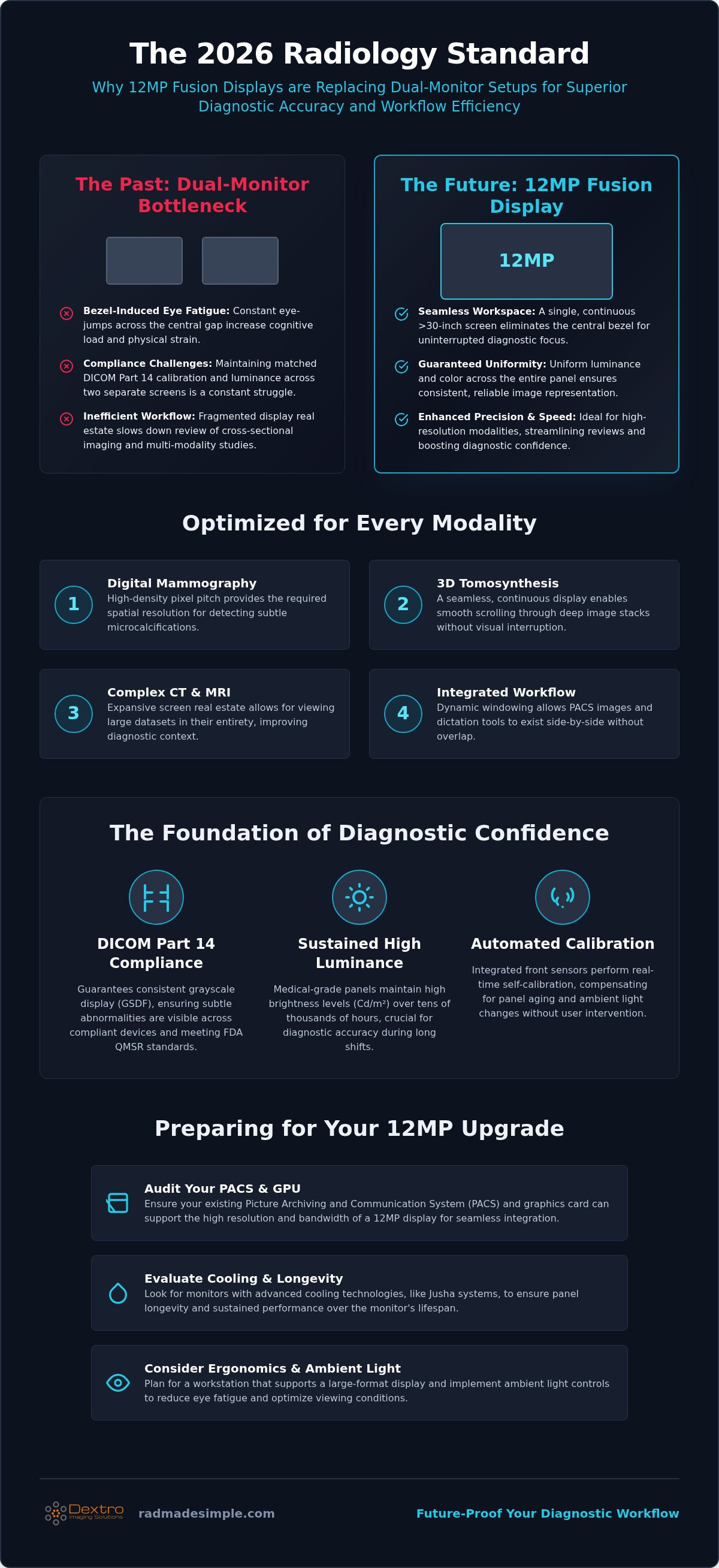
A 12MP diagnostic monitor is a high-resolution fusion display that consolidates the clinical output of traditional dual 5MP setups into a single, expansive screen. This technology represents a fundamental shift in how specialists interact with patient data. For professionals looking for a 12MP diagnostic monitor for sale 2026, the transition is driven by the need for greater diagnostic precision and streamlined operations. By moving away from fragmented displays, facilities can provide a unified environment that supports the most demanding medical imaging modalities.
Workflow efficiency isn't just about speed; it's about endurance. A single 12MP screen reduces the cognitive load associated with managing multiple display settings and calibration profiles. When you use a 12MP diagnostic monitor for sale 2026, you're investing in a system that guarantees uniform luminance across the entire viewing area. This uniformity is vital when comparing subtle tissue densities. It ensures that a pixel on the far left of the screen matches the brightness and contrast of a pixel on the far right, a feat that's difficult to achieve with two separate monitors.
The End of the Dual-Monitor Era
For decades, the dual-head configuration was the industry standard. However, this setup forces the eye to jump across a physical gap, known as the central bezel. This interruption is particularly problematic during cross-sectional imaging reviews where a seamless visual field is required for accurate tracking. A 12MP fusion display provides a continuous workspace that often covers more than 30 inches of screen real estate. This eliminates the distraction of the bezel and reduces the repetitive neck movements that lead to chronic fatigue. A fusion display is the primary 2026 architectural standard for reading rooms, offering a single, high-performance panel that eliminates mechanical interruptions.
Multi-Modality Versatility
Modern radiology demands a monitor that can handle everything from standard X-rays to 3D Tomosynthesis. The 12MP resolution offers the enhanced spatial resolution required for microcalcification detection, making it an ideal choice for breast imaging. 12MP displays are now preferred for several key applications:
- Digital Mammography: High-density pixel pitch for spotting subtle abnormalities.
- 3D Tomosynthesis: Seamless scrolling through deep image stacks.
- Complex CT and MRI: Viewing large datasets without visual interruption.
Beyond clinical imaging, 2026 software allows for dynamic windowing where PACS images and dictation tools reside side-by-side without overlapping. This level of integration is a core component of high-performance Radiology Reading Workstations: The 2026 Guide to Performance & Compliance. By centralizing these tools, radiologists can maintain their focus on the image itself rather than managing screen real estate.
Technical Benchmarks: DICOM Compliance and 12MP Resolution
DICOM Part 14 compliance is the technical foundation of modern medical imaging. It ensures that grayscale levels are displayed consistently across different devices, providing a universal language for visual data. For a 12MP diagnostic monitor for sale 2026, achieving this requires sophisticated calibration because the high pixel density demands tighter tolerances than lower-resolution screens. The DICOM international standard provides the framework for this Grayscale Standard Display Function (GSDF). Without rigorous adherence to these benchmarks, subtle abnormalities in soft tissue might remain invisible to the radiologist, compromising patient safety.
Sustained luminance is another critical benchmark that separates consumer screens from medical-grade hardware. In 2026, clinical standards require higher brightness levels, often measured in candelas per square meter (Cd/m²), to maintain diagnostic confidence over a long shift. Integrated front sensors play a vital role in this process. These sensors perform automated, real-time calibration by measuring light output directly from the panel surface. They adjust the backlight to compensate for aging or changes in ambient light. This automation removes the need for manual testing, ensuring the workstation remains compliant with the FDA's Quality Management System Regulation (QMSR) without disrupting the clinical workflow.
12MP vs. 5MP vs. 8MP: A 2026 Comparison
While 8MP (4K) monitors are common in general practice, they often lack the spatial resolution required for primary mammography reading. A 12MP display provides a resolution of approximately 4200 x 2800 pixels. This density allows for a pixel pitch that captures the finest microcalcifications that 8MP screens might blur. Choosing a 12MP diagnostic monitor for sale 2026 ensures your facility meets the highest requirements for breast imaging and complex tomosynthesis. The following tiers define the 2026 landscape:
- 5MP (2560 x 2048): Primarily utilized for general radiology and standard X-ray interpretation.
- 8MP (3840 x 2160): Suitable for clinical review and some cross-sectional viewing but lacks mammography clearance.
- 12MP (4200 x 2800): The professional benchmark for multi-modality reading and primary breast imaging.
Grayscale and Color Accuracy
Precision in soft-tissue differentiation depends heavily on bit depth. High-performance monitors utilize 10-bit or 12-bit grayscale to render thousands of shades of gray, which is essential for identifying subtle lesions in dense tissue. To maintain this level of accuracy, your display must include robust calibration software that manages the lookup table (LUT) internally. This software ensures your hardware stays compliant throughout its 5-year lifecycle. You can verify your current setup using our 2026 Radiology Equipment Compliance Checklist to ensure every component meets current regulations. If you're ready to upgrade your facility, explore our range of Jusha diagnostic monitors designed for peak performance and 100% uptime.
Evaluating 12MP Displays: Jusha Diagnostic Monitors vs. Legacy Brands
Jusha has emerged as a dominant leader in high-resolution medical imaging for 2026. While legacy brands often rely on historical market share, Jusha focuses on the specific engineering requirements of modern radiology. When you evaluate a 12MP diagnostic monitor for sale 2026, you're looking for more than just a high pixel count. You're looking for a partner that simplifies your technical environment. Jusha diagnostic monitors achieve this by integrating advanced hardware with proactive maintenance features that ensure long-term reliability.
Build quality is a primary differentiator. High-resolution panels generate significant heat, which can lead to luminance degradation over time. Jusha utilizes sophisticated cooling systems that maintain internal thermal stability, extending the panel's functional life. Their anti-glare coatings are specifically engineered for the controlled lighting of a 2026 reading room, minimizing reflections without sacrificing the sharpness of microcalcifications. This focus on longevity provides a superior return on investment. You get the same, or better, performance as legacy "big name" brands without the unnecessary price premium. Dextro supports this investment with comprehensive maintenance contracts designed to ensure 100% uptime for your clinical workflow.
Spotlight on Jusha 12MP Features
Jusha's innovation isn't just about the panel. It's about the tools that surround it. Their Smart LCG (Luminance Continuity Guide) technology ensures uniform brightness across the entire 12MP surface. This prevents the "vignetting" effect often seen in lower-quality displays where the corners appear dimmer than the center. Additionally, Jusha monitors often include integrated film clips and reading lights. These features support hybrid workflows where radiologists still need to reference physical films or documents without compromising their dark-room adaptation. For a deeper dive into these technical advantages, consult our Jusha Medical Monitors: The 2026 Professional Reference Guide.
Connectivity and Workstation Integration
Driving 12 million pixels requires significant bandwidth. To achieve a smooth 60Hz refresh rate, your workstation must utilize DisplayPort 1.4 or USB-C connectivity. Jusha diagnostic monitors are designed for seamless integration with high-performance GPUs, ensuring that image loading and scrolling remain instantaneous. Many models also support daisy-chaining. This allows you to connect a secondary clinical review display directly to the 12MP monitor, reducing cable clutter and simplifying the setup of your Dextro Reading Stations. A high-end GPU isn't optional for this resolution. It's the engine that powers the diagnostic performance your patients depend on.
Integration and Ergonomics: Setting Up a 12MP Workstation
Integrating a high-resolution display requires more than just desk space. When you invest in a 12MP diagnostic monitor for sale 2026, you must optimize the surrounding environment to protect your diagnostic accuracy. Ambient light control is the first priority. Excessive glare or bright overhead lighting can wash out the deep blacks required for 10-bit grayscale differentiation. Use dimmable LED task lighting and matte-finish walls to maintain the high contrast ratio these panels provide. This controlled setting ensures that subtle findings aren't lost to environmental interference.
Ergonomic positioning is equally vital for a large-format 30-inch+ screen. Because a 12MP monitor replaces two smaller units, you must adjust your viewing distance. Most radiologists find a distance of 20 to 30 inches ideal to capture the entire visual field without excessive eye movement. Height-adjustable stands and VESA mounting solutions allow you to align the top third of the screen with your eye level, preventing chronic neck strain. For teleradiologists, power stability is a non-negotiable requirement. A high-quality UPS protects the sensitive calibration sensors, while a fiber-optic internet connection ensures that massive 12MP image files transmit without latency.
Remote Reading with 12MP Portability
Transitioning a 12MP setup to a home office or temporary site is now feasible with specialized hardware. While the screen size is substantial, modern bezel-less designs minimize the total desk footprint. This allows you to maintain clinical-grade accuracy outside the hospital using Portable Radiology Workstations. You can learn more about these agile configurations in our guide to Traveling Radiologist Workstation Setup: The 2026 Guide to Mobile Diagnostic Accuracy.
Eye Health and Radiologist Longevity
Modern 2026 monitors incorporate blue light filters and flicker-free technology to reduce digital eye strain during long shifts. When searching for a 12MP diagnostic monitor for sale 2026, prioritize models that emphasize these protective features. The high resolution of a 12MP display inherently improves comfort by providing enough screen real estate to view multiple modalities at full resolution. This significantly reduces the need for constant zooming and panning, which can be a primary source of repetitive motion fatigue. To further protect your vision, follow the 20-20-20 rule by looking at an object 20 feet away for 20 seconds every 20 minutes to reset your eye's focal point and prevent accommodative spasms.
If you're ready to modernize your reading room, explore our high-performance Jusha diagnostic monitors for guaranteed compliance and uptime.
Buying Guide: How to Procure 12MP Diagnostic Monitors in 2026
Procuring a 12MP diagnostic monitor for sale 2026 requires a methodical approach to ensure the hardware aligns with your clinical and technical infrastructure. Start by auditing your current PACS and GPU compatibility. A 12MP display requires high-bandwidth connections and specific graphic cards to render images without latency. Next, define your primary use case. While these monitors are multi-modality, primary mammography reading demands specific luminance benchmarks that might exceed general radiology needs. Requesting a demo or evaluation unit for clinical validation is a critical third step. It allows your radiologists to test the interface and visual clarity in their specific reading environment before a full-scale rollout.
Evaluate the total cost of ownership rather than just the initial purchase price. This includes the bundled calibration software and the availability of technical support. A monitor that lacks automated calibration tools will eventually cost more in manual labor and potential non-compliance penalties. Finally, finalize your procurement through an authorized distributor like Dextro Imaging Solutions. This ensures you receive factory-certified hardware and access to specialized technical support teams who understand the nuances of medical-grade displays. Selecting a 12MP diagnostic monitor for sale 2026 is an investment in long-term diagnostic accuracy and operational efficiency.
Financing and Total Cost of Ownership (TCO)
Choosing between leasing and purchasing depends on your facility's 2026 capital budget and technology refresh cycle. Leasing often provides a more manageable path for upgrading to the latest 12MP technology while keeping monthly expenses predictable. Regardless of the acquisition method, you must factor in the cost of annual calibration and compliance audits. These recurring services are essential for maintaining DICOM Part 14 standards and passing regulatory inspections. For a detailed breakdown of these costs, consult our Diagnostic Radiology Monitors: 2026 Pricing & Guide.
Why Buy from Dextro Imaging Solutions?
Dextro Imaging Solutions acts as a highly competent guide through the complexities of medical imaging procurement. We provide expert consultation to help you choose between Jusha diagnostic monitors or a complete Dextro Reading Station setup. Our team ensures seamless integration with PACS Harmony and aycan PACS, removing the technical friction often associated with new hardware deployments. We provide ongoing technical support to protect your investment. This proactive approach ensures your hardware remains DICOM compliant and fully operational, allowing you to focus on diagnostic precision without worrying about system downtime.
Modernize Your Diagnostic Workflow with 12MP Precision
The shift toward 12MP fusion technology represents more than just a hardware upgrade. It's a strategic commitment to superior clinical outcomes and long-term radiologist well-being. By consolidating your workspace into a single high-resolution panel, you eliminate the visual interruptions inherent in legacy dual-monitor setups. This transition provides the spatial resolution necessary for complex mammography and 3D tomosynthesis while significantly reducing the physical fatigue associated with traditional reading environments.
Securing a high-performance 12MP diagnostic monitor for sale 2026 is the first step toward a more efficient and compliant reading room. Dextro Imaging Solutions simplifies this transition by acting as a competent guide through every stage of procurement and integration. As an authorized Jusha distributor, we provide hardware where DICOM compliance is guaranteed and technical support is proactive. Our expertise in teleradiology workstations ensures that your diagnostic accuracy remains uncompromised, regardless of your clinical setting.
Browse Our 2026 Inventory of Jusha 12MP Diagnostic Monitors and take the lead in diagnostic innovation today. Experience the clarity and efficiency that a unified 12MP environment provides for your practice.
Frequently Asked Questions
Is a 12MP monitor required for mammography in 2026?
12MP resolution is the current professional benchmark for primary mammography and tomosynthesis. While lower resolutions exist, 12MP displays provide the necessary pixel pitch to visualize minute microcalcifications accurately. When you look for a 12MP diagnostic monitor for sale 2026, you're investing in hardware that meets the highest spatial resolution requirements. This ensures your facility remains compliant with evolving clinical standards while providing radiologists with the visual clarity required for early breast cancer detection.
Can I use a 12MP diagnostic monitor for general CT and MRI reading?
Absolutely. These displays excel in multi-modality environments. A 12MP fusion monitor provides ample screen real estate to view large CT and MRI datasets alongside previous studies or clinical notes. This seamless workspace eliminates the distractions of a central bezel, allowing for more efficient scrolling through hundreds of image slices. It's an ideal solution for specialists who manage diverse caseloads and require a unified, high-performance display that maintains consistent grayscale accuracy across all imaging types.
What are the hardware requirements for a 12MP radiology workstation?
Driving 12 million pixels requires a workstation with a high-performance GPU equipped with DisplayPort 1.4 or USB-C outputs. You'll also need a system with sufficient processing power and RAM to handle large DICOM files without latency. For those utilizing Portable Radiology Workstations, stable power through a UPS and high-speed internet are critical for transmitting massive datasets. These components work together to ensure that image loading and scrolling remain fluid during intensive diagnostic sessions.
How often does a 12MP diagnostic monitor need calibration?
Modern medical-grade displays, such as Jusha diagnostic monitors, utilize integrated front sensors to perform automated calibration in real-time. This technology constantly monitors and adjusts luminance levels to maintain DICOM Part 14 compliance. While the internal software handles daily adjustments, most facilities conduct a formal compliance audit once per year. This proactive approach ensures the workstation remains within regulatory tolerances throughout its lifecycle without requiring manual intervention from the clinical staff or IT departments.
What is the difference between a 12MP fusion monitor and two 5MP monitors?
A 12MP fusion monitor replaces the traditional dual-head setup with a single, bezel-free panel. This design eliminates the central bezel distraction, which can hide subtle findings during cross-sectional imaging reviews. Beyond the improved ergonomics, a single 12MP unit provides more uniform luminance and color consistency across the entire viewing area. It's a more streamlined solution that reduces cable clutter and simplifies the calibration process compared to managing two separate 5MP screens.
Do 12MP diagnostic monitors come with DICOM calibration software?
Yes, medical-grade displays are bundled with specialized DICOM calibration software. This software is essential for managing the monitor's internal lookup tables and ensuring that every shade of gray is rendered according to international standards. When evaluating a 12MP diagnostic monitor for sale 2026, verify that the software is compatible with your existing PACS Harmony or aycan PACS environment. This integration allows for centralized quality assurance and automated reporting, which is vital for maintaining facility-wide compliance.
Can I use a consumer 8MP (4K) monitor instead of a 12MP diagnostic monitor?
You shouldn't use consumer 4K monitors for primary diagnostic interpretation. Consumer screens lack the sustained luminance, bit depth, and DICOM Part 14 calibration required for medical accuracy. They also fail to meet the spatial resolution benchmarks necessary for mammography. A medical-grade 12MP display is engineered with specialized cooling and sensors to prevent image degradation over time. Relying on consumer electronics introduces significant clinical risk and may lead to non-compliance with the FDA's Quality Management System Regulation.
What is the typical lifespan of a 12MP medical-grade display?
The typical lifecycle for a high-performance medical display is approximately five years. While the panel may continue to function beyond this period, its ability to maintain peak luminance and strict DICOM compliance often diminishes with age. Upgrading every five years ensures your practice benefits from the latest technological advancements and remains protected by active maintenance contracts. This cycle helps facilities maintain 100% uptime and provides radiologists with the most reliable tools for high-stakes diagnostic work.


