

How much of your diagnostic day is lost to the friction of toggling between four different logins and three separate voice recognition tools? For many radiologists, the complexity of multi-site coverage has turned the reading room into a gauntlet of IT hurdles. You likely agree that managing multiple VPNs and inconsistent reporting tools is an exhausting drain on your productivity. Implementing a robust multi-PACS integration solution is no longer a luxury, but a necessity to reclaim your clinical focus. You shouldn't have to fight your software to reach your patients.
This case study demonstrates how to transform a fragmented workflow into a "single pane of glass" experience. You'll discover how to eliminate login fatigue and unify disparate imaging interfaces into one high-performance diagnostic environment. We will explore how PACS Harmony orchestrates universal worklists to prioritize cases across all connected facilities, ensuring that urgent studies never sit idle. We also examine the critical synergy between software integration and hardware, showing how seamless connectivity with Jusha diagnostic monitors and RadVoice dictation creates a truly frictionless workspace. It's time to move beyond the limitations of siloed systems and embrace a more agile, modern way of working.
Key Takeaways
- Identify how fragmented workflows and "swivel-chair" radiology directly compromise diagnostic turnaround times in multi-facility environments.
- Discover how PACS Harmony serves as a vendor-neutral orchestration layer to deliver a seamless multi-PACS integration solution.
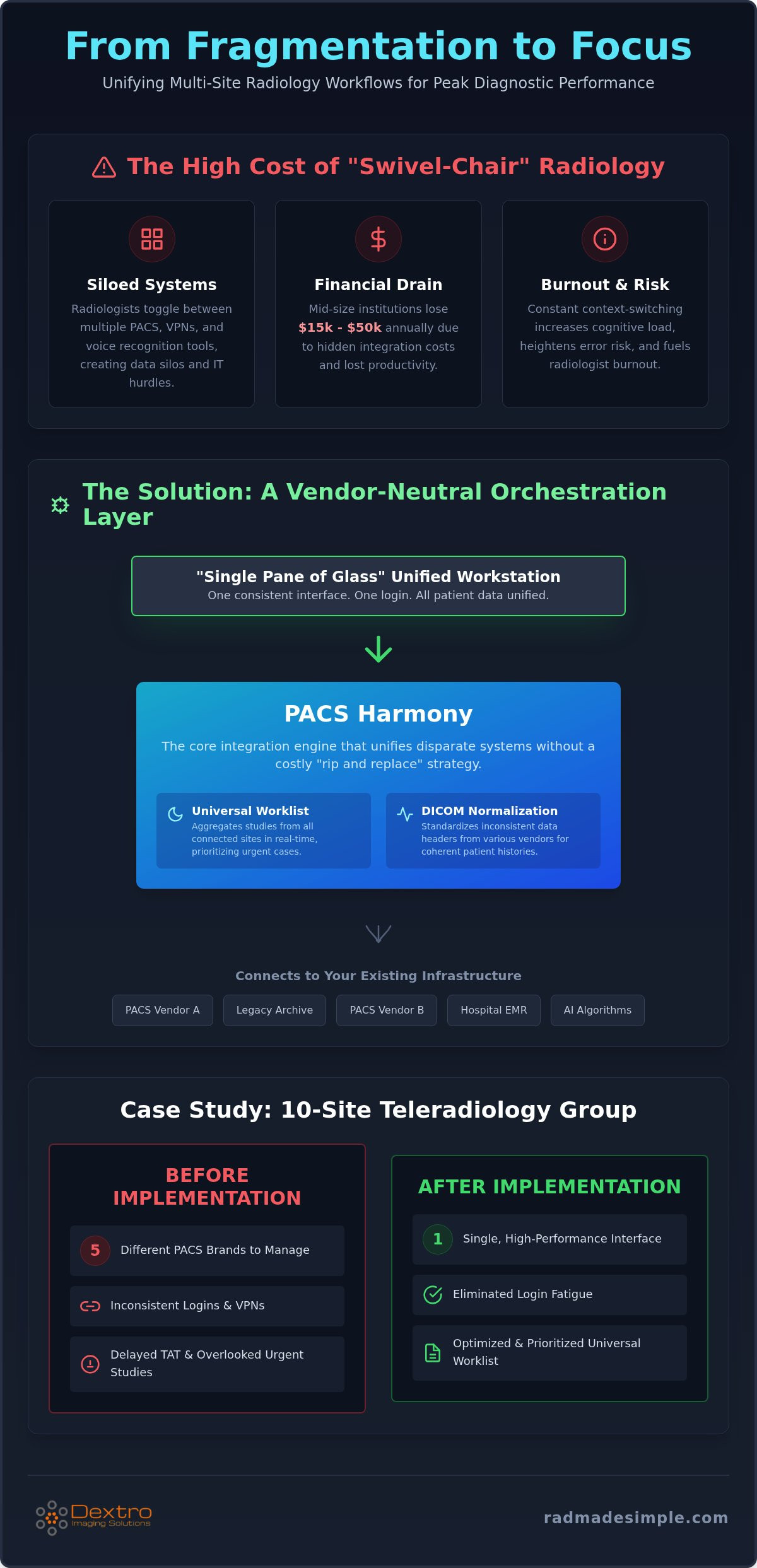
- Review a real-world case study where a 10-site teleradiology group unified five different PACS brands into one high-performance interface.
- Learn the technical requirements for a successful transition, from conducting comprehensive node audits to optimizing enterprise-wide network bandwidth.
- Understand why maximizing your ROI requires pairing sophisticated integration software with high-performance hardware like Jusha diagnostic monitors.
The Challenge of Disparate Imaging Interfaces in 2026
Teleradiology groups in 2026 often manage studies from a dozen different facilities, each with its own preferred vendor. This creates "swivel-chair" radiology, where physicians must physically or digitally pivot between isolated systems throughout their shift. A standard Picture archiving and communication system (PACS) works well for a single site, but enterprise groups face fragmented workflows that destroy diagnostic turnaround time (TAT). When every facility uses a different archive, the result is a series of data silos. These silos hide patient history and prevent a longitudinal view of care. Research indicates that mid-size institutions can lose between $15,000 and $50,000 annually due to these hidden integration costs, duplicated support, and lost productivity.
Basic connectivity is no longer sufficient to meet modern clinical demands. The DICOM 2026a release and HL7 FHIR R4 requirements demand a high level of interoperability that legacy systems simply can't provide. A simple point-to-point link doesn't meet the mandatory universal encryption and multi-factor authentication standards now required for electronic protected health information (ePHI) at rest and in transit. Your facility needs a sophisticated multi-PACS integration solution that handles complex image processing while remaining compliant with the latest HIPAA security rules. Relying on outdated connections creates security vulnerabilities and significant compliance risks.
The Cognitive Load of Multiple PACS Logins
Switching between different UI/UX environments creates significant mental friction for the reader. Each system has unique shortcuts, hanging protocols, and measurement tools. This inconsistency increases the risk of error, as a tool that behaves one way in one system might function differently in another. Radiologist burnout is often linked to these repetitive, non-clinical tasks. A comprehensive multi-PACS integration solution removes this burden by normalizing the interface and providing a consistent experience regardless of the backend source.
Technical Hurdles in Enterprise Imaging
Maintaining multiple site-to-site VPNs is an IT nightmare that drains resources and increases overhead. It often leads to latency issues during cross-site image fetching, which slows down the diagnostic process and frustrates clinicians. Many legacy systems also fail to support modern AI orchestration, leaving radiologists without the automated tools they need to stay competitive. Managing credentials for ten different sites isn't just inefficient; it's a security liability. The FDA's transition to the Medical Image Management and Processing Systems (MIMPS) category highlights the need for software that does more than just display images; it must actively optimize the entire diagnostic ecosystem.
PACS Harmony: The Architecture of a Multi-PACS Integration Solution
Traditional approaches to enterprise imaging often force a "rip and replace" strategy, requiring facilities to abandon functional legacy systems for a single-vendor platform. This is often cost-prohibitive and operationally disruptive. PACS Harmony offers a sophisticated alternative as a vendor-neutral orchestration layer. It doesn't replace your existing archives; instead, it sits above them to unify disparate imaging interfaces. By normalizing inconsistent DICOM headers from various vendors into a standardized format, it ensures that patient data remains coherent across the entire network. This architecture allows you to maintain your current infrastructure while achieving the streamlined performance of a modern, unified system.
The core of this multi-PACS integration solution is the Universal Worklist. This tool aggregates studies from every connected site in real-time, allowing radiologists to view and claim cases based on priority or sub-specialty rather than physical location. It synchronizes data between remote sites and the central hub instantly, ensuring that a stat study at a rural clinic appears on the specialist's list without delay. This level of coordination eliminates the need for manual case searching and reduces the risk of urgent studies being overlooked in a siloed queue. If you want to see how this architecture scales for your facility, you can explore our integration frameworks to find the best fit for your workflow.
Vendor-Neutral Interoperability
PACS Harmony communicates seamlessly with legacy systems by utilizing the latest DICOM 2026a standards. It protects the integrity of DICOM metadata, ensuring that critical patient history and prior studies are always accessible and correctly mapped. This interoperability prevents the data degradation often seen when moving files between incompatible platforms. Multi-PACS integration represents the definitive standard for operational efficiency in 2026 by consolidating fragmented diagnostic environments into a single, cohesive workflow.
Integrated Reporting and Voice Recognition
True efficiency requires more than just image viewing; it necessitates a unified reporting environment. By connecting RadVoice directly to the PACS Harmony interface, radiologists can dictate reports without leaving the primary diagnostic screen. This integration allows for the standardization of reporting templates across all ten sites in a group, ensuring a professional and consistent output for referring physicians. Automated HL7 patient mapping further enhances this process by pulling patient demographics and order details directly into the report. This eliminates manual data entry and significantly reduces the potential for clerical errors in high-volume environments.
Quantifying the Impact: A Case Study in Workflow Optimization
To understand the tangible benefits of a multi-PACS integration solution, we must look at the operational reality of a 10-site teleradiology group. In this scenario, the group managed imaging data across five different PACS brands, each with its own proprietary viewer and reporting tools. Before the intervention, radiologists spent a significant portion of their shift managing administrative overhead rather than performing clinical analysis. The group faced mounting pressure from referring physicians due to inconsistent turnaround times and a lack of standardized reporting quality across their diverse network.
The intervention involved deploying PACS Harmony as a vendor-neutral orchestration layer. This move didn't require the sites to replace their existing hardware; instead, it unified the disparate data streams into a single, high-performance diagnostic environment. By centralizing the workflow, the group eliminated the need for radiologists to maintain five sets of login credentials and navigate multiple VPN protocols. This shift allowed the organization to move from a site-centric model to a clinician-centric model, where the workload is distributed based on sub-specialty expertise and real-time urgency.
Baseline: The Cost of Fragmented Reading
Before integration, the group measured the time lost to system switching and found that radiologists spent nearly 15 minutes per hour on non-diagnostic tasks. Login delays and slow image fetching from legacy archives created "bottleneck" sites where TAT often exceeded four hours for non-urgent cases. These delays weren't just a productivity issue; they directly impacted referring physician satisfaction. Physicians reported frustration with the lack of access to prior studies and the inconsistent report formats coming from different facilities. The hidden costs of this fragmentation, including duplicated IT support and lost billable hours, were estimated to exceed $40,000 annually for the group.
Results: The Post-Integration Transformation
The implementation of a unified multi-PACS integration solution delivered immediate results across all key performance indicators. The group achieved a 25% reduction in average turnaround time within the first three months of operation. This improvement was driven by the Universal Worklist, which ensured that cases were read in the order of clinical priority regardless of which facility generated the study. Radiologist throughput improved significantly, with the average studies-per-hour increasing by 18% without extending shift lengths. Key results included:
- IT Overhead Reduction: Consolidating five disparate interfaces into one "single pane of glass" reduced IT maintenance requests by 35%.
- Reporting Standardization: Using RadVoice templates within the unified interface ensured that every report met the group's quality standards, regardless of the study's origin.
- Improved ROI: The group avoided the $5,000 to $30,000 cost typically associated with custom point-to-point integrations for each new site added to their network.
By removing the complexity of multi-site imaging, the group transformed their reading room into a modern, agile environment. The shift from managing logins to managing patients allowed them to scale their operations efficiently while protecting their clinicians from burnout.
Strategic Implementation: Transitioning to a Single-Pane-of-Glass Interface
Transitioning to a single-pane-of-glass interface requires more than just a software license. It demands a methodical approach to infrastructure and workflow design. The process begins with a comprehensive audit of every existing PACS and RIS node in your network. You must understand how data moves between your legacy archives and the new orchestration layer to prevent latency. Optimizing network bandwidth is equally critical for enterprise-wide image streaming. Without a robust pipeline, even the best multi-PACS integration solution will struggle to deliver the performance radiologists expect.
Security configuration forms the backbone of a successful rollout. Each site likely has unique security protocols that must be reconciled within the unified platform. You'll need to configure granular user permissions that satisfy both local facility requirements and enterprise-wide HIPAA standards. Once the technical foundation is set, pilot testing allows your team to validate diagnostic accuracy in the unified viewer. This stage ensures that image rendering remains consistent across all connected hardware before the system goes live across the entire group. A successful multi-PACS integration solution relies on this rigorous validation to protect clinical outcomes.
Infrastructure Requirements for Integration
Your server-side hardware must be capable of hosting the orchestration layer without introducing new bottlenecks. High-performance processing and memory are non-negotiable for real-time study synchronization. It's also vital to ensure your setup meets radiology equipment compliance support standards to maintain regulatory standing. For groups looking to future-proof their data management, planning for aycan PACS scalable storage provides a reliable secondary archive. This setup ensures that as your volume grows, your storage capacity and retrieval speeds remain optimized. If you're ready to modernize your infrastructure, schedule a technical consultation with our integration team today.
Training and Change Management
Technology is only effective if your team uses it correctly. Onboarding radiologists to a new unified interface requires clear communication and hands-on training. You should focus on customizing individual worklists to mirror specific subspecialty workflows, allowing neuroradiologists or musculoskeletal specialists to see the cases most relevant to them. Establishing a feedback loop during the first month of operation is essential. This allows your IT team to make continuous refinements based on real-world usage patterns. When clinicians feel empowered by their tools, adoption rates soar and burnout rates drop.
Maximizing ROI with Dextro Imaging Solutions
Software-based orchestration is only as effective as the hardware displaying the data. A high-performance multi-PACS integration solution requires a physical environment that matches its speed and precision. While some providers treat hardware as an afterthought, we recognize that diagnostic accuracy depends on the synergy between the viewer and the display. Dextro Imaging Solutions provides this total ecosystem, ensuring that your technical investment translates into clinical excellence. Our technical support team backs every installation with a commitment to 99.9% uptime, protecting your facility from the costly interruptions of system downtime.
Investing in a unified interface is a strategic move to reclaim lost time. However, the financial ROI is only fully realized when radiologists can work at peak capacity without technical bottlenecks. Dextro removes the complexity of multi-vendor environments by providing a single point of accountability for both your software orchestration and your diagnostic hardware. This holistic approach simplifies procurement and maintenance, allowing your IT department to focus on growth rather than troubleshooting disparate connections.
The Synergy of Hardware and Software
Dextro Reading Stations are engineered to handle the high-throughput demands of multi-PACS data streaming without lag. These systems work in concert with Jusha medical monitors to maintain the highest levels of diagnostic accuracy. DICOM-calibrated Jusha displays reduce eye strain by providing consistent luminance and contrast across every study, regardless of its origin. This is vital when viewing images from disparate sources with varying metadata quality. For those managing remote sites, a proper traveling radiologist workstation setup ensures that mobile integrators maintain the same diagnostic standards as the central hub. Optimizing your environment with ergonomic radiology reading workstations further protects radiologist health and productivity during long shifts.
Future-Proofing Your Imaging Enterprise
Scalability is a core requirement for any modern imaging group. PACS Harmony allows you to add new sites and disparate PACS nodes without friction, avoiding the expensive cycles of total system replacement. As your enterprise grows, the unified interface remains a stable foundation for the next generation of AI-driven diagnostic tools. These algorithms can be integrated directly into the orchestration layer, providing automated insights without disrupting the established workflow. This forward-thinking approach ensures that your multi-PACS integration solution remains a high-performance asset as clinical technology evolves. You can schedule a demo of PACS Harmony with Dextro Imaging Solutions to see how this unified ecosystem can transform your practice today.
Optimizing the Future of Enterprise Imaging
The transition from fragmented, site-centric reading to a unified diagnostic environment is a critical step for teleradiology groups in 2026. By implementing a robust multi-PACS integration solution, your facility can eliminate the friction of multiple logins and inconsistent reporting tools. This case study highlights how the specialized PACS Harmony orchestration layer unifies disparate imaging interfaces into a single, high-performance workspace. When you pair this software with hardware that features full DICOM Part 14 compliance, you protect both diagnostic accuracy and radiologist productivity.
Streamlining your reading room doesn't just improve turnaround times; it secures your operations against the complexities of multi-site management. With global technical support for teleradiology groups, Dextro Imaging Solutions ensures your integrated systems maintain peak performance around the clock. It's time to reclaim your focus and lead your practice toward a more efficient, contemporary way of working. Request a Professional Consultation for Your Multi-PACS Integration and discover how our total solution approach can transform your clinical workflow today. We look forward to helping you build a more manageable and high-performing diagnostic environment.
Frequently Asked Questions
What is a multi-PACS integration solution?
A multi-PACS integration solution is an orchestration layer that unifies disparate imaging platforms into a single, high-performance interface. It allows radiologists to access studies from multiple facilities without logging into separate systems. PACS Harmony serves as this vendor-neutral bridge, aggregating data into a "single pane of glass" view. This approach eliminates the inefficiency of "swivel-chair" radiology and ensures that clinicians can focus on diagnostic tasks rather than navigating complex IT hurdles.
Does integrating multiple PACS systems require replacing my current software?
No, you don't need to replace your current software. PACS Harmony is designed to sit on top of your existing infrastructure as a vendor-neutral layer. It communicates with your current archives and RIS nodes without requiring a "rip and replace" strategy. This allows your facility to maintain its legacy investments while gaining the streamlined workflow of a modern system. It's a cost-effective way to modernize your reading room without operational disruption.
How does PACS Harmony improve radiologist turnaround time?
PACS Harmony improves turnaround time by centralizing all studies into a Universal Worklist. Radiologists no longer waste time switching between different VPNs and measurement tools. By prioritizing cases across all connected sites in real-time, the system ensures that urgent studies are read first. As seen in recent implementations, this orchestration can lead to a 25% reduction in average turnaround time. It also increases studies-per-hour by removing the administrative friction of multiple logins.
Can a unified PACS interface handle different DICOM standards from legacy systems?
Yes, a unified interface is specifically built to normalize disparate DICOM headers from legacy systems. It ensures that metadata remains consistent and patient histories are correctly mapped across different platforms. PACS Harmony adheres to the latest DICOM 2026a standards, which is essential for maintaining interoperability in medical imaging. This normalization prevents data degradation and ensures that radiologists have a longitudinal view of patient care regardless of the original study source.
What hardware is required to run a multi-PACS integration effectively?
Effective integration requires hardware that can handle high-throughput data streaming. We recommend using Dextro Reading Stations to host your multi-PACS integration solution. These stations provide the processing power needed to avoid latency. Additionally, Jusha diagnostic monitors are necessary to ensure DICOM Part 14 compliance. These displays provide the consistent luminance and contrast needed to interpret images from various sources accurately, ensuring your software investment delivers clinical results.
Is a multi-PACS solution secure for HIPAA compliance across different networks?
Yes, modern solutions are built to exceed current HIPAA Security Rule requirements. They utilize universal encryption for electronic protected health information (ePHI) both at rest and in transit. Multi-factor authentication (MFA) is mandatory for all access points, ensuring that patient data remains secure across disparate networks. PACS Harmony also supports the restoration of critical data within the mandated 72-hour window, providing a secure and resilient environment for enterprise-wide imaging groups.
How does integrated voice recognition like RadVoice work with multiple PACS?
RadVoice integrates directly with the PACS Harmony orchestration layer to provide a seamless reporting experience. It uses automated HL7 patient mapping to pull demographics and order details into the report, eliminating manual data entry. This allows radiologists to use standardized templates across all connected facilities, ensuring a consistent professional output. Because the voice recognition tool is unified with the viewer, clinicians can dictate reports without ever leaving the primary diagnostic screen.
What is the typical implementation timeline for a unified PACS interface?
The implementation timeline varies based on the number of PACS and RIS nodes being unified. It typically begins with a comprehensive audit of your existing infrastructure followed by network optimization. Once the technical foundation is set, we move into pilot testing to validate diagnostic accuracy. This methodical approach ensures that your team is fully trained and the system is stable before a full rollout. Most groups can expect a phased transition that prioritizes minimal operational downtime.


