

In 2026, the traditional reading room is no longer a fixed destination. It's a mobile capability that directly dictates your practice's bottom line. You're likely facing the reality of the 33.4009 dollar Medicare conversion factor and the persistent threat of radiologist burnout. Maintaining high overhead for physical office space while managing non-standard home setups creates unnecessary compliance risks and financial leakage. We understand that every minute of technical friction or workflow disruption costs you money.
This strategic guide demonstrates how the ROI of portable radiology workstations transforms these operational challenges into a measurable competitive advantage. By investing in professional grade mobile solutions, you drive higher returns through increased RVU production, reduced facility costs, and improved radiologist retention. We'll examine how specialized hardware like the Radcom Compact and Jusha diagnostic monitors provide hospital grade precision in any environment. You'll discover how to optimize your diagnostic workflow and maintain strict compliance while protecting your margins in an increasingly demanding clinical landscape. We'll also explore how integrating tools like RadVoice can further accelerate your reporting speed and overall profitability.
Key Takeaways
- Learn how Dextro Reading Stations reduce diagnostic fatigue to accelerate RVU throughput and improve turnaround times.
- Discover how to significantly lower facility overhead by replacing expensive fixed-room infrastructure with high-performance decentralized models.
- Evaluate the comprehensive ROI of portable radiology workstations by weighing the high cost of radiologist turnover against the benefits of flexible, premium reading environments.
- Mitigate compliance risks by integrating medical-grade Jusha Diagnostic Monitors that ensure strict DICOM Part 14 standards for remote interpretation.
- Master a strategic rollout plan using Radcom Compact and Dextro units to seamlessly bridge the gap between hospital and home.
Defining the ROI of Portable Radiology Workstations in 2026
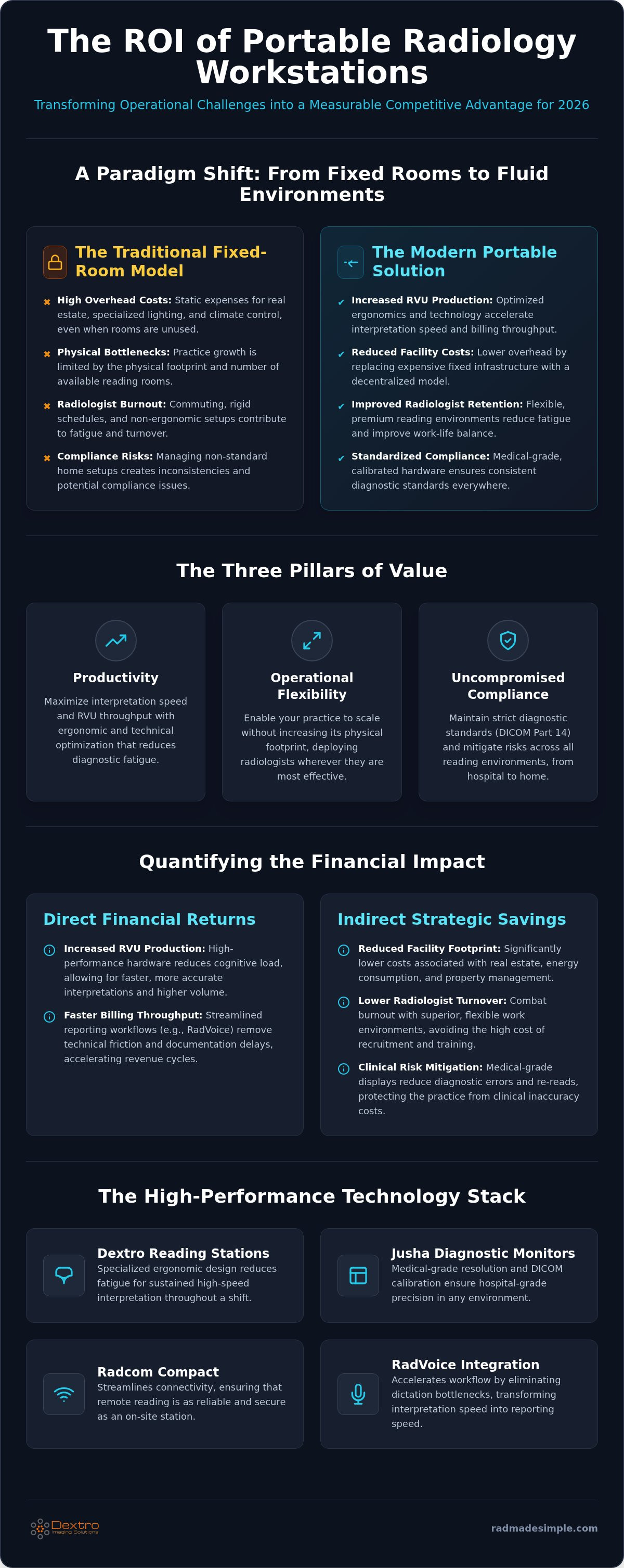
In 2026, a portable workstation is no longer a secondary backup. It's a high-performance hub where medical-grade display technology meets extreme mobile processing power. Traditional fixed-room models require significant capital expenditure for real estate, specialized lighting, and climate control. These costs remain static even when the room is empty. By contrast, the ROI of portable radiology workstations stems from their ability to decentralize the reading room, turning any secure environment into a high-throughput diagnostic center.
The Dextro standard for portable diagnostic accuracy ensures that radiologists don't sacrifice precision for mobility. This standard is built upon three specific pillars:
- Productivity: Maximizing interpretation speed through ergonomic and technical optimization.
- Operational Flexibility: Allowing practices to scale without increasing their physical footprint.
- Compliance: Maintaining strict diagnostic standards across all reading environments.
When you move away from fixed-room constraints, you remove the physical bottlenecks that limit your practice's growth. High-performance hardware allows for a seamless transition between the hospital and the home office without a drop in diagnostic confidence.
The Shift from Fixed to Fluid Reading Environments
The "Reading Room Anywhere" philosophy is a response to the logistical inefficiencies of 20th-century radiology. By utilizing Teleradiology, practices can now deploy their most valuable assets, the radiologists, wherever they are most effective. This flexibility reduces idle time and mitigates the impact of commuting on a physician's daily schedule. A portable workstation is a strategic clinical asset that empowers radiologists to maintain peak performance across varied physical locations. As hybrid work models become the industry standard, providing a consistent, high-fidelity environment is essential for maintaining a stable and available workforce.
Direct vs. Indirect Financial Returns
Calculating the financial impact requires looking at both direct and indirect revenue drivers. Direct returns are found in increased RVU production. When using Dextro Reading Stations, radiologists benefit from specialized ergonomic designs that reduce fatigue, allowing for sustained high-speed interpretation throughout a shift. Faster billing throughput follows naturally when technical friction is removed from the workflow.
Indirect returns often provide the most significant long-term savings. Transitioning to portable models allows facilities to reduce their physical footprint, leading to lower energy consumption and decreased property management costs. Improving the ROI of portable radiology workstations also involves clinical risk mitigation. The use of Jusha Diagnostic Monitors ensures that even in a portable setup, the image quality remains at a medical-grade standard. These monitors provide the high resolution and DICOM calibration necessary to reduce re-reads and diagnostic errors, which protects the practice from the high costs of clinical inaccuracy. Integrating the Radcom Compact further streamlines connectivity, ensuring that remote reading is as reliable as an on-site station.
Quantifying Productivity: RVUs and Turnaround Time (TAT)
Productivity in a diagnostic setting is often reduced to a simple question of volume, but the financial reality is more complex. High-performance hardware directly influences how quickly a radiologist can process complex image stacks. When evaluating the ROI of portable radiology workstations, you must look beyond the initial purchase price and analyze the revenue generated through improved efficiency. High refresh rates and medical-grade resolutions on Jusha monitors don't just provide clarity; they reduce the cognitive load required to interpret subtle findings. This technical optimization allows for faster decision-making without compromising clinical accuracy.
Integrating RadVoice into these mobile environments further accelerates the workflow by eliminating dictation bottlenecks. Traditional manual entry or lag-heavy voice recognition software can add minutes to every study. By streamlining the reporting phase, you ensure that the speed of interpretation is matched by the speed of documentation. This synergy is what transforms a portable setup from a simple tool into a high-yield financial asset.
Maximizing Relative Value Units (RVUs)
Radiologists often face significant eye strain during 8 to 10 hour shifts, which leads to a natural slowdown in the final hours of the day. Using DICOM-calibrated displays within a Dextro Reading Station maintains a consistent visual environment that preserves the reader's pace. A 10% increase in daily study volume, achieved through reduced visual fatigue and faster image loading, significantly impacts the practice’s monthly billing. To understand the technical requirements for these results, you can explore our radiology reading workstations guide. Investing in ergonomic excellence ensures that your team stays productive from the first study to the last.
Reporting Efficiency and Turnaround Metrics
Turnaround time (TAT) is a critical metric for hospital contracts and urgent care partnerships. Technical lag when switching between modalities in PACS Harmony can accumulate into hours of lost time over a month. The Radcom Compact solves this by providing specialized connectivity that ensures stable, high-volume data transfer even in remote or home environments. This "zero-downtime" approach is vital for maintaining the throughput required for emergency reads. Consider how a modest 5% improvement in TAT across your entire team scales. For a mid-sized practice, this small efficiency gain can translate into dozens of additional studies per week, directly boosting the bottom line. If you're looking to optimize your current setup, you might consider how modernizing your hardware interface can remove these hidden delays. By focusing on the intersection of hardware reliability and software integration, you protect your margins while delivering faster results to patients.
Operational Cost Mitigation: Facilities and Retention
Beyond immediate productivity gains, the ROI of portable radiology workstations is found in the significant reduction of fixed operational expenses. Traditional facility models require dedicated square footage, specialized lighting, and high-capacity HVAC systems to maintain an on-site reading room. These expenses represent a permanent drain on capital, regardless of daily study volume. By decentralizing these operations, practices can eliminate the high cost per square foot associated with physical office space.
Standardizing your hardware with portable units also simplifies your technical ecosystem. When every remote radiologist uses a Radcom Compact or a Dextro station, your IT department manages a single, predictable configuration. This uniformity drastically reduces the volume of support tickets compared to troubleshooting "bring-your-own-device" home setups. It's a proactive approach that protects your technical staff's time and ensures your radiologists stay online.
Reducing Real Estate and Infrastructure Overhead
Comparing a fixed reading room to a home-based Dextro setup reveals a stark contrast in long-term liabilities. A fixed room requires ongoing maintenance, property taxes, and significant energy for cooling high-performance servers and monitors. Modern, compact imaging hardware is designed for energy efficiency, pulling less power while delivering superior diagnostic clarity. These savings accumulate, especially when scaled across a large group. To understand the full financial picture, it's helpful to review radiology PACS pricing and how it integrates with your hardware strategy. Shifting to a decentralized model transforms fixed real estate costs into a flexible, scalable equipment investment.
Radiologist Retention and Burnout Prevention
The financial burden of replacing a specialized radiologist is immense, involving months of lost revenue, high recruitment fees, and extensive credentialing costs. In a competitive 2026 labor market, equipment quality acts as a silent recruiter. Teleradiology groups that provide premium, ergonomic portable stations demonstrate a commitment to their staff's health and career satisfaction. Providing "The Best Tools" isn't just a perk; it's a retention strategy that prevents burnout by reducing eye strain and physical fatigue. A Dextro Reading Station serves as a tangible investment in the physician's daily comfort. When you weigh the cost of a premium workstation against the massive expense of physician turnover, the financial choice becomes clear. High-performance hardware creates a professional environment that keeps your most valuable assets engaged and productive for the long term.
The Compliance Dividend: Avoiding the Cost of Non-Compliance
Compliance is often viewed as a cost center, but in radiology, it's a critical revenue protector. Using consumer-grade monitors for diagnostic interpretation introduces significant legal and financial risks that can jeopardize a practice's standing. These consumer displays lack the luminance consistency and grayscale accuracy required for medical standards. The ROI of portable radiology workstations includes the avoidance of these hidden liabilities and the protection of your professional reputation. Jusha Diagnostic Monitors ensure DICOM Part 14 compliance for portable use, providing a standardized environment that matches the hospital reading room. This level of consistency is essential for maintaining diagnostic confidence in decentralized models.
Specialized radiology hardware also offers a "built-in" cybersecurity ROI. Unlike general consumer electronics, these units are designed to handle sensitive medical data with enterprise-grade protection. By centralizing your fleet on a professional platform, you ensure that every remote endpoint adheres to your practice's security protocols, reducing the likelihood of expensive technical oversights.
DICOM Compliance and Diagnostic Accuracy
Diagnostic errors are the leading cause of medical malpractice claims in radiology. A single missed finding can cost a practice hundreds of thousands in legal fees and settlements, not to mention the impact on patient outcomes. This massive liability far outweighs the investment in medical-grade hardware. Automatic calibration features in Jusha displays save hours of manual IT work annually by ensuring the monitor remains within regulatory specifications without human intervention. You can find more details in our radiology equipment compliance support guide. High-resolution clarity isn't just about comfort; it's a financial shield against the high cost of clinical inaccuracy.
Data Security and HIPAA in Remote Environments
Teleradiology expands the attack surface for data breaches, which can lead to massive HIPAA fines and permanent reputational damage. Specialized portable workstations protect patient data at the edge by integrating hardware-level encryption and secure boot protocols. Dextro systems utilize a security-first architecture to maintain data integrity across all endpoints. This built-in security reduces the need for expensive third-party software layers that often slow down the diagnostic workflow and increase technical complexity. By investing in professional hardware, you secure your patient data and your practice’s financial stability simultaneously. It's a proactive measure that prevents the catastrophic costs associated with cyber incidents. Explore our compliant workstation solutions to see how we prioritize your practice's security and regulatory adherence.
Implementation Strategy: Optimizing Your Investment
Transitioning to a decentralized model works best through a structured, phased rollout. Start by identifying high-volume teleradiologists who benefit most from a hybrid setup. This approach allows you to validate the ROI of portable radiology workstations on a smaller scale before a full practice conversion. Integrating PACS Harmony across these units ensures a unified interface. Your team won't lose time adjusting to different software behaviors between locations, which keeps interpretation speed consistent.
Training and support are essential components of this strategy. Radiologists must be fully comfortable with the efficiency features of their new hardware to maximize their output. A well-executed implementation plan removes technical friction and ensures that your investment begins paying for itself through increased throughput from day one.
Selecting the Right Hardware Configuration
Selecting the right equipment depends on the specific mobility needs of your staff. The Radcom Compact is ideal for extreme portability. It provides specialized connectivity for radiologists who move between multiple clinical sites or travel frequently. For those requiring a more permanent home setup that still allows for occasional relocation, full Dextro Reading Stations offer a complete desktop replacement experience. Consider these factors when configuring your fleet:
- Monitor size vs. portability: Larger Jusha displays provide more screen real estate but require more space during transit.
- Multi-monitor requirements: Complex cases often benefit from a dual-monitor portable configuration to maintain hospital-level diagnostic speed.
- Clinical environment: Review our guide on traveling radiologist workstation setup to understand the specific mobile accuracy standards required for different modalities.
Long-Term Maintenance and Software Synergy
Hardware is only one part of the financial equation. To fully capture the ROI of portable radiology workstations, you must integrate efficiency-boosting software like RadVoice. This tool significantly accelerates report generation. It allows radiologists to close cases faster and increase their daily RVU output without increasing their hours. When software and hardware work in synergy, the diagnostic workflow becomes a streamlined revenue engine.
Reliability is the final pillar of your investment strategy. Utilizing technical support contracts ensures 99.9% uptime, which is vital for maintaining consistent billing cycles. A single day of downtime for a high-volume reader can cost more in lost revenue than the annual price of a premium support plan. By combining high-performance hardware with integrated software and reliable support, you create a sustainable, high-yield diagnostic environment. Optimize your radiology workflow with Dextro Imaging Solutions to start your transition toward a more profitable and flexible future.
Future-Proofing Your Practice Revenue
The transition to decentralized diagnostic environments is a financial necessity in the 2026 clinical landscape. By investing in professional grade mobile solutions, you eliminate the high costs of physical office space and static infrastructure. High-performance hardware, such as industry-leading Jusha medical monitors and Radcom Compact units, ensures that your team maintains peak productivity regardless of location. These tools don't just provide flexibility; they drive measurable growth in RVU throughput and turnaround times.
Standardizing your fleet with DICOM Part 14 compliant portable solutions also mitigates significant compliance risks and malpractice liabilities. When your radiologists work with the best available tools, you're investing in their long-term retention and career satisfaction. This comprehensive approach maximizes the ROI of portable radiology workstations by aligning clinical precision with operational efficiency. Our expert technical support ensures seamless PACS integration to protect your daily workflow from technical friction.
Take the first step toward a more agile and profitable practice today. Request a Tailored ROI Analysis for Your Radiology Practice and discover how modernized workstations can transform your bottom line. Your practice's future depends on high-performance mobility, and we're ready to help you achieve it.
Frequently Asked Questions
What is the typical payback period for a portable radiology workstation?
The payback period is typically measured through increased RVU production and the immediate elimination of physical office overhead. Most practices observe a return on investment within the first year as radiologists interpret more studies with fewer technical delays. By replacing static facility costs with high-performance mobile hardware, you shift capital toward assets that generate revenue every hour they're in use. This efficiency makes the ROI of portable radiology workstations a primary driver for modern practice growth.
Can a portable workstation really match the diagnostic accuracy of a fixed hospital station?
Yes, a portable workstation can match hospital-grade accuracy when equipped with medical-grade Jusha Diagnostic Monitors. These displays provide the necessary luminance and contrast ratios required for precise interpretation. Dextro Reading Stations are designed to replicate the hospital environment, ensuring that radiologists don't sacrifice diagnostic confidence for mobility. This technical parity allows for a seamless transition between clinical settings without compromising the quality of patient care or increasing the risk of misdiagnosis.
How does DICOM compliance affect the ROI of my equipment?
DICOM Part 14 compliance is essential for protecting your practice from regulatory fines and malpractice liabilities. Medical-grade monitors feature automated calibration that ensures the display remains within diagnostic specifications over time. Using non-compliant consumer screens risks missed findings and legal exposure, which can devastate your financial margins. Investing in compliant hardware creates a compliance dividend by avoiding the massive costs associated with clinical errors and regulatory non-adherence in teleradiology environments.
Does a portable setup require specialized PACS software integration?
Portable setups perform best when integrated with unified interfaces like PACS Harmony to ensure a consistent experience across all locations. While standard PACS can often be accessed remotely, specialized integration reduces latency and ensures that high-volume image data transfers securely. This seamlessness is critical for maintaining turnaround times. Using aycan PACS or similar robust systems ensures that the radiologist's workflow remains uninterrupted, regardless of their physical proximity to the hospital's central servers.
What are the maintenance costs associated with portable diagnostic monitors?
Maintenance costs are primarily managed through technical support contracts that cover software updates and hardware troubleshooting. Professional portable monitors often include remote calibration tools that reduce the need for on-site IT intervention. By standardizing your fleet with Dextro stations, you lower the overall cost of ownership through predictable service agreements. These contracts ensure 99.9% uptime, which protects your revenue stream from the expensive interruptions common with unmanaged, consumer-grade home reading setups.
How does high-resolution hardware impact radiologist turnaround time?
High-resolution hardware significantly reduces turnaround time by lowering the cognitive load required to identify subtle pathologies. When images are clear and correctly calibrated, radiologists spend less time zooming or adjusting window levels. This clarity allows for faster decision-making and sustained interpretation speeds throughout a long shift. Technical optimization through tools like RadVoice further eliminates dictation bottlenecks, ensuring that the entire reporting cycle remains efficient and highly productive for the practice.
Is it more cost-effective to buy or lease portable radiology equipment in 2026?
The choice between buying or leasing in 2026 depends on your practice's tax strategy and capital availability. Buying provides long-term asset ownership and avoids interest fees, while leasing can transform equipment costs into predictable operational expenses. Many groups find that purchasing high-performance hardware like the Radcom Compact offers a better long-term ROI by avoiding recurring monthly payments. Regardless of the financing model, the focus should remain on selecting hardware that maximizes radiologist uptime and diagnostic accuracy.
Can portable workstations help reduce radiologist burnout and turnover costs?
Portable workstations are a powerful tool for reducing burnout by providing radiologists with greater control over their professional environment. Ergonomic stations like those from Dextro minimize physical fatigue and eye strain, which are leading contributors to physician turnover. In a competitive labor market, offering premium hardware acts as a recruitment advantage. By reducing the massive costs associated with replacing specialized staff, these workstations pay for themselves through improved physician retention and long-term career satisfaction.


