

How much of your clinical day is lost to correcting transcription errors or waiting for a sluggish PACS interface to sync with your microphone? By 2026, the traditional dictation model is no longer just a bottleneck; it’s a liability to your productivity and well being. You’ve likely felt the mounting pressure of rising study volumes and the exhaustion of managing disjointed reporting tools. It’s a common frustration in modern radiology where the technology meant to help often creates more friction than flow. Manual errors and high turnaround times shouldn't be the price you pay for a digital workflow.
This guide introduces you to RadVoice, the intelligent engine designed to turn voice into structured diagnostic data. You'll discover how RadVoice streamlines diagnostic workflows and integrates with systems like PACS Harmony to reduce reporting turnaround times for modern radiologists. We'll examine the technical shift toward browser-based, AI-enhanced reporting and show you how to achieve a seamless, high-accuracy environment. From image acquisition to the final signed report, you can finally automate the steps that lead to burnout and reclaim your focus for what matters most: diagnostic precision.
Key Takeaways
- Understand how browser-based, AI-driven platforms like RadVoice replace traditional speech-to-text with context-aware clinical reporting.
- Learn how modality-specific templates for CT, MRI, and X-ray terminology accelerate routine workflows while maintaining diagnostic precision.
- Discover the operational synergy gained by integrating dictation software directly with PACS Harmony and high-performance Dextro Reading Stations.
- Evaluate the measurable impact of AI on reducing reporting turnaround times and mitigating radiologist burnout.
- Follow a structured implementation plan to assess your IT infrastructure and pilot new reporting tools with minimal disruption.
What is RadVoice? Redefining Radiology Dictation in 2026
RadVoice represents the next generation of clinical documentation. It isn't just a dictation tool; it's a browser-based, AI-driven platform that transforms how radiologists interact with their daily worklist. By 2026, the industry has shifted away from simple transcription toward context-aware clinical reporting. This means the system doesn't just hear words; it understands the clinical intent behind them. Whether you're reporting on a complex PET/CT or a routine X-ray, the platform provides a specialized environment for CT, MRI, Ultrasound, and more. 2026 is the tipping point because the volume of diagnostic data has finally outpaced the capacity of manual entry. Radiologists need a partner that simplifies the workflow rather than adding another layer of complexity.
The Evolution of Voice Recognition in Medicine
The transition from legacy, server-based systems to agile, browser-based AI has been a decade in the making. Traditional tools often required heavy local installations and constant manual updates that disrupted the reading room. Modern AI voice recognition technology has solved these friction points by moving the processing power to the cloud. Today's deep learning models understand complex anatomical relationships and medical syntax with a level of nuance that was impossible a few years ago. This evolution is critical for reducing clerical errors and typos that often plague high-speed reporting environments. By identifying the difference between "hilar" and "hilarity" or "pedicle" and "pedal" within the context of a spine study, the system ensures your reports remain professional and accurate without constant manual correction.
Core Capabilities of the RadVoice Engine
The engine behind RadVoice focuses on three pillars: speed, adaptability, and structure. It delivers real-time transcription using a medical-grade vocabulary that's updated constantly to include the latest pharmacological and anatomical terms. You don't have to change the way you speak because the system uses adaptive learning to adjust to your specific accent and cadence over time. This personalization happens in the background, making the software feel more intuitive the more you use it. Beyond just capturing words, the engine handles auto-formatting for structured reports. It automatically maps your findings to DICOM standards, ensuring that every piece of data is formatted correctly for downstream clinical systems. This level of automation turns a simple voice memo into a high-quality diagnostic record in seconds, allowing you to focus on interpretation rather than data entry.
Key Features of RadVoice for Modern Diagnostic Workflows
RadVoice optimizes the diagnostic environment by removing the physical barriers often found in legacy software. Its browser-based architecture allows you to transition from a hospital workstation to a home-office teleradiology setup without losing a single custom preference or user profile. This flexibility is essential. It's a critical component for maintaining productivity during peak hours across different environments. The ability to sync your profile across multiple devices means that whether you're at the hospital or a satellite clinic, your workflow remains identical and uninterrupted. The platform also offers modality-specific templates that prepopulate standard findings for routine CT, MRI, or X-ray exams. By automating the repetitive skeleton of a report, you save valuable minutes on every study. Security remains a non-negotiable priority; the platform utilizes integrated encryption protocols that exceed HIPAA and GDPR standards to ensure patient data remains secure regardless of your location.
AI-Powered Contextual Intelligence
Modern reporting requires more than just converting sound to text. The engine utilizes Natural Language Processing (NLP) to extract findings automatically and flag potential discrepancies in real-time. If your dictation mentions a "left-sided" finding while the study metadata indicates the right, the system provides an immediate alert. This functionality aligns with the rigorous standards expected of FDA-regulated AI-enabled medical devices. By catching these slips at the point of entry, the software significantly reduces the cognitive load during high-volume shifts. You can maintain a high pace without sacrificing the quality of your diagnostic output or risking patient safety through avoidable errors.
Workflow Automation and Macro Tools
Efficiency in the reading room often depends on the number of clicks and keystrokes saved throughout a shift. RadVoice empowers you to create custom voice commands for repetitive reporting tasks. A single spoken phrase can insert a complex negative-finding paragraph for a multi-phase CT abdomen or a standard PET/CT summary. This automation extends to the final step of the reporting process. Once a report is finalized, the system handles automated distribution to referring physicians, closing the loop on patient care faster than traditional methods. Integrating these tools with advanced voice recognition for radiologists ensures that your technical setup works as a unified, high-performance ecosystem. Pairing these software capabilities with the right radiology reading workstations creates a seamless bridge between your hardware and your voice.
Seamless Integration: RadVoice, PACS, and Dextro Reading Stations
High performance in the reading room isn't just about fast software; it's about how that software communicates with your physical environment. The "toggle tax," or the mental energy spent switching between your dictation window and your PACS viewer, is a significant drain on productivity. RadVoice eliminates this friction by operating as a unified layer within your reporting ecosystem. When you use radiology reading workstations, you need a frictionless loop where your eyes never have to leave the images. By integrating directly with platforms like PACS Harmony and aycan PACS, the system ensures your voice and visuals are perfectly synced. This synergy allows you to drive the PACS interface using voice commands, effectively turning your dictation tool into a secondary controller for study navigation.
Optimizing the Hardware Interface
High-fidelity audio is the foundation of accurate AI transcription. We recommend specific noise-canceling microphone and headset configurations that filter out ambient hospital noise. This clarity allows the engine to process your clinical findings with surgical precision. Viewing your reports on Jusha medical monitors provides the crystal-clear visual feedback necessary to spot transcription nuances or formatting issues instantly. The goal is simple. To maintain this speed, we utilize cloud-hybrid setups that optimize local-network bandwidth. This architecture processes the bulk of the audio data locally while leveraging cloud intelligence for complex contextual analysis. It reduces latency to near-zero levels, ensuring your words appear on the screen as quickly as you speak them.
PACS and RIS Interoperability
True efficiency requires a deep connection between your reporting tool and your patient data. RadVoice standardizes data exchange via HL7 and DICOM protocols, allowing it to pull patient metadata directly from the PACS interface. This eliminates the need for manual data entry and reduces the risk of misidentifying studies or patient IDs. This level of technical sophistication follows the latest FDA guidelines on AI/ML-enabled medical devices, ensuring your workflow remains compliant and safe. You log in once. A single-sign-on (SSO) experience further simplifies the process, making your entire suite of tools ready for immediate use. By unifying these disparate systems into a single interface, we help you reclaim the focus needed for complex diagnostic tasks.
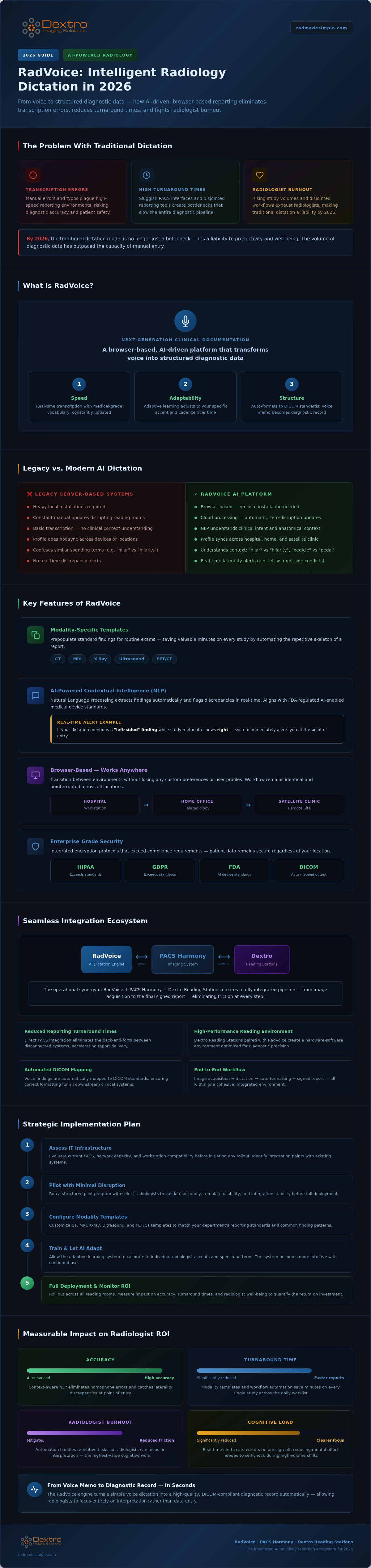
Quantifying the Impact: Accuracy, TAT, and Radiologist ROI
Manual dictation is no longer a viable standard for high-volume radiology departments. It creates a cumulative delay that affects every stage of patient care. RadVoice replaces this outdated method with an intelligent engine that processes data in real-time. When you compare traditional speech-to-text with an AI-driven platform, the return on investment (ROI) becomes clear through increased throughput and reduced operational overhead. Radiologists often face mounting pressure from rising study volumes, leading to burnout. By automating the clerical aspects of reporting, you reclaim time for complex diagnostic analysis. This shift improves job satisfaction while ensuring the department maintains high standards of care without exhausting its staff.
Reducing Turnaround Time (TAT)
Speed is a critical metric in diagnostic medicine. Recent case studies demonstrate that implementing specialized AI dictation can lead to a 30% to 40% reduction in reporting time. This efficiency stems from removing the "middleman" in the reporting process. RadVoice removes the lag between dictation and final sign-off by eliminating the need for external transcription services. This acceleration is most impactful in emergency settings. Delivering urgent or STAT reports faster allows clinical teams to initiate life-saving treatments without waiting hours for a transcribed document. The result is a more responsive diagnostic environment that directly supports better patient outcomes.
Improving Diagnostic Accuracy
Accuracy goes beyond correct spelling; it involves the integrity of the entire diagnostic record. Structured reporting through AI ensures that findings are organized logically, which improves clarity for referring clinicians. Statistical data indicates a significant reduction in transcription-related medical errors when using context-aware software. AI validation prevents misdiagnosis by cross-referencing dictated findings with study metadata to flag lateralization errors or anatomical inconsistencies in real-time. This proactive error-trapping ensures that a "left" never becomes a "right" in the final report. You can contact Dextro Imaging Solutions to learn how these accuracy gains translate to your specific modality mix.
Calculating the Total Cost of Ownership (TCO) for your reporting software requires a broad perspective. You aren't just paying for a license; you're investing in the future capacity of your reading room. When you factor in the eliminated costs of third-party transcription and the ability to handle higher study volumes with existing staff, the financial benefits are substantial. This modernization protects your facility from the hidden costs of medical errors and staff turnover, positioning you as a leader in diagnostic excellence for 2026 and beyond.
Implementing RadVoice: A Strategic Rollout Plan
Deploying a modern dictation platform requires a methodical approach to ensure minimal disruption to clinical operations. You should begin by assessing your current IT infrastructure, specifically focusing on network bandwidth and hardware compatibility. While RadVoice is designed for high performance, a stable connection is essential for real-time AI processing. A phased rollout allows your team to adapt without the pressure of a department-wide transition. We suggest initiating a pilot program within a single modality, such as X-ray, to establish a baseline for speed and accuracy. This controlled environment provides the opportunity to fine-tune settings before scaling to more complex studies like PET/CT or MRI.
Technical Readiness and Setup
Your technical team must verify browser compatibility and update security certificates to maintain a secure reporting environment. This ensures that the software operates within the parameters of your existing radiology equipment compliance support protocols. Configuring remote access is another priority, especially for teleradiology teams who require the same level of performance from home offices as they do in the hospital. By standardizing these settings early, you create a reliable foundation that supports both local and remote radiologists with equal efficiency.
Training represents the most critical phase of the implementation process. Radiologists need to understand how to optimize their voice profiles and customize macros for their specific reporting styles. These shortcuts are the key to reducing clicks and accelerating the reporting cycle. Regular compliance audits and technical maintenance ensure the system continues to meet regulatory standards while evolving alongside your department's needs. This proactive management prevents technical debt and keeps your workflow at peak performance.
Support and Scaling
Moving from a small clinic to a multi-hospital network is a logical progression once the initial pilot succeeds. The browser-based architecture makes scaling straightforward, as new users can be onboarded without complex local installations. You can leverage Dextro technical support for software troubleshooting and performance optimization throughout this growth phase. If you're ready to see how this technology fits into your specific environment, you can contact Dextro Imaging Solutions for a custom RadVoice demo. Having a dedicated partner ensures that your transition to AI-enhanced reporting is both secure and highly productive.
Modernizing Your Diagnostic Future
The 2026 shift toward AI-enhanced reporting isn't just about speed; it's about creating a sustainable environment for diagnostic excellence. You've seen how integrating RadVoice with high-performance Dextro Reading Stations removes the friction that leads to radiologist burnout. By utilizing specialized terminology for CT, MRI, and PET/CT, you ensure that every report is both accurate and structured for better clinical communication. This browser-based approach provides the flexibility needed for modern teleradiology without compromising on security or performance.
Dextro Imaging Solutions acts as your partner in this transformation, providing 24/7 technical support to ensure your software and hardware remain in perfect sync. You can now move beyond the limitations of legacy dictation systems and embrace a workflow that prioritizes your expertise over administrative tasks. This transition protects your productivity and ensures your department stays at the forefront of medical imaging technology.
Request a RadVoice Demo and Workflow Consultation today to experience the future of radiology reporting firsthand. We're here to help you build a more efficient, accurate, and rewarding practice.
Frequently Asked Questions
Is RadVoice compatible with all PACS systems?
RadVoice is designed for broad interoperability through standard HL7 and DICOM protocols. It offers direct, seamless integration with PACS Harmony and aycan PACS platforms. This ensures that radiologists can pull patient metadata and drive the viewer interface without switching applications. While it's built to work with most modern imaging systems, we recommend a technical consultation to verify the specific integration path for legacy or proprietary PACS environments.
How does RadVoice handle complex medical terminology?
The platform uses advanced Natural Language Processing (NLP) specifically trained on vast datasets of diagnostic imaging reports. RadVoice is specialized for CT, MRI, X-ray, and PET/CT terminology, allowing it to understand clinical intent rather than just phonetic sounds. This contextual intelligence helps the engine distinguish between similar sounding anatomical terms based on the modality being reported. This level of specialization significantly reduces the need for manual corrections and improves report integrity.
Can I use RadVoice for remote radiology or teleradiology?
Yes, the browser-based architecture of the software makes it an ideal solution for teleradiology and remote reporting. Radiologists can access their personalized voice profiles and custom macros from any location with a secure internet connection. Because it doesn't require heavy local software installations, it's easy to deploy across distributed teams. This ensures a consistent reporting experience whether you're working from a hospital workstation or a home office.
What hardware is required to run RadVoice effectively?
To achieve peak performance, we recommend running the software on Dextro Reading Stations equipped with Jusha Diagnostic Monitors. A high-fidelity, noise-canceling microphone is essential to ensure the AI engine receives clear audio input. Since the platform is browser-based, it requires a workstation with sufficient RAM and a stable network connection to handle real-time data processing. Using optimized hardware prevents latency and ensures that your dictation appears on the screen instantly.
How secure is RadVoice with patient data (HIPAA)?
Security is built into the core of the platform through integrated encryption protocols that meet or exceed HIPAA and GDPR standards. All voice data and patient metadata transmitted through the system are protected to ensure total confidentiality. Dextro Imaging Solutions maintains rigorous compliance audits to protect sensitive healthcare information. This proactive approach ensures that your facility remains compliant with federal regulations while providing a secure, reliable environment for diagnostic reporting.
Does RadVoice require extensive training for radiologists?
The software is designed to be intuitive, requiring minimal formal training for most radiologists. Most users become proficient within their first few shifts as the AI utilizes adaptive learning to adjust to their specific dictation style. We provide initial guidance on setting up modality-specific templates and custom macros to maximize efficiency. Dextro also offers ongoing technical support to help your team optimize their workflow as they become more familiar with the system's advanced features.
What is the typical reduction in turnaround time with RadVoice?
Facilities implementing this technology typically see a 30% to 40% reduction in reporting turnaround times. This improvement is achieved by eliminating the need for external transcription services and reducing the time spent switching between systems. By automating the formatting of structured reports and providing real-time transcription, radiologists can sign off on studies immediately after interpretation. This acceleration is particularly valuable for urgent or STAT cases in emergency department settings.
How does RadVoice handle different accents and speech patterns?
The AI engine features sophisticated adaptive learning algorithms that specifically account for diverse accents and individual speech patterns. Instead of requiring a lengthy voice training session, the system learns and refines its accuracy in the background as you work. It analyzes your corrections to better understand your unique cadence and pronunciation over time. This ensures that the transcription remains highly accurate regardless of the speaker's native language or specific speaking style.


