

What if the most expensive component in your imaging department isn't the MRI machine, but the hidden minutes lost to inefficient reading stations? You know that justifying a high-end hardware refresh to the board often feels like an uphill battle, especially when "productivity" feels like a vague concept rather than a line item. When you're calculating ROI for radiology equipment, the traditional focus on upfront costs often ignores the massive financial drain of radiologist burnout and compliance risks.
It's frustrating to see clinical excellence stalled by consumer-grade monitors that lack DICOM precision or software that fragments the workflow. We'll show you how to transform these technical hurdles into a solid financial case that resonates with your CFO. This guide provides the exact formulas and metrics needed to prove the value of high-performance tools like Jusha diagnostic monitors and Radcom Compact stations. You'll gain a clear roadmap for workflow-based savings and the data points required to secure C-suite approval for a modernized, 2026-ready imaging environment.
Key Takeaways
- Learn why the initial purchase price represents only a fraction of the total cost of ownership for modern imaging departments.
- Master a data-driven framework for calculating ROI for radiology equipment that focuses on billable minutes and workflow optimization.
- Discover how to quantify the productivity gains from high-performance tools like RadVoice and PACS Harmony software.
- Identify the financial risks associated with non-compliance and the long-term savings gained from DICOM-standard Jusha monitors.
- Create a persuasive business case using the Cost of Inaction (COI) to demonstrate the immediate need for technological upgrades.
Understanding the Radiology ROI Framework in 2026
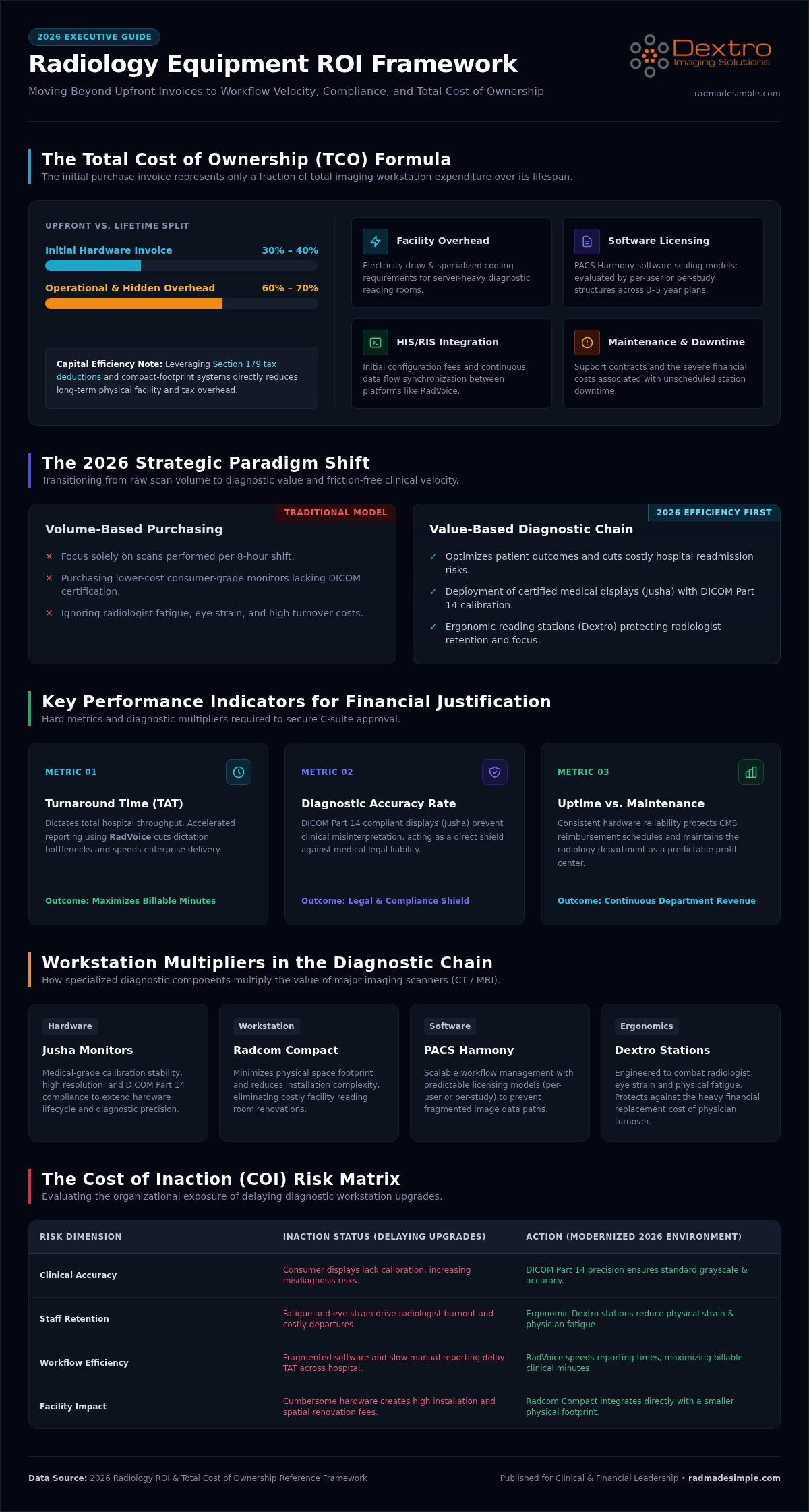
In 2026, the traditional return on investment calculation for imaging departments has evolved. It's no longer just about how many scans you can perform in an eight-hour shift. True ROI now balances clinical accuracy, operational speed, and long-term financial stability. When you're calculating ROI for radiology equipment, you must look beyond the initial invoice to understand how a tool impacts the entire diagnostic chain.
The industry is moving rapidly from volume-based metrics to value-based imaging. This means your financial justification needs to account for how equipment improves patient outcomes and reduces the likelihood of costly readmissions. The 2026 Efficiency First model prioritizes hardware and software that removes friction from the radiologist's day. If your department isn't calculating ROI for radiology equipment through this lens, you're likely overestimating the value of cheap, consumer-grade hardware that lacks specialized medical certifications.
Tangible vs. Intangible Assets in Imaging
Large systems like CT and MRI units are direct revenue generators, but their performance depends on operational multipliers. Jusha Diagnostic Monitors and PACS Harmony software act as these multipliers. They ensure that the high-resolution data from a scanner is interpreted quickly and accurately. While revenue is a tangible asset, radiologist retention is an intangible one that carries a heavy price tag. Ergonomic Dextro Reading Stations help combat the rising costs of radiologist burnout. Replacing a specialized physician is far more expensive than investing in a workstation that prevents fatigue and eye strain.
Key Performance Indicators (KPIs) for Financial Approval
To secure C-suite approval, you need punchy, data-driven KPIs. Turnaround Time (TAT) is the most critical metric because it dictates hospital throughput. If a radiologist can use RadVoice to cut reporting time, the entire facility moves faster. Diagnostic accuracy rates also serve as a financial shield. High-performance monitors that ensure DICOM Part 14 compliance reduce the risk of misdiagnosis and subsequent legal liability. Finally, compare equipment uptime against maintenance costs. Reliable hardware reduces the expense of unscheduled downtime, ensuring your department remains a consistent profit center for the organization.
Step 1: Calculating Total Cost of Ownership (TCO)
A common financial pitfall in imaging procurement is focusing solely on the initial invoice. In reality, the purchase price often represents only 30% to 40% of the true cost of an asset over its lifespan. When calculating ROI for radiology equipment, you must account for the full spectrum of ownership. This includes predictable expenses like technical support and maintenance contract fees, as well as operational overhead such as electricity and specialized cooling for server-heavy reading rooms.
Predicting revenue requires looking at CMS radiology reimbursement rates alongside your internal volume projections. However, revenue is only half the equation. You also need to factor in software licensing for tools like PACS Harmony. Whether you choose a per-user or per-study model, these costs scale with your department and must be included in your three-year and five-year projections.
Hardware Longevity and Depreciation
The lifecycle of your hardware significantly impacts your bottom line. While consumer-grade displays might seem cost-effective initially, they lack the durability and calibration stability of professional medical grade equipment. Investing in Jusha medical monitors ensures a longer operational life and consistent DICOM compliance. This longevity reduces the frequency of replacement cycles, directly improving your long-term return.
Financial officers should also leverage tax incentives like Section 179 deductions for capital equipment. Solutions like the Radcom Compact offer a distinct advantage here. By minimizing the physical footprint and installation complexity, you reduce the "hidden" facility costs associated with larger, more cumbersome reading stations. It's about finding equipment that integrates into your existing space without requiring expensive renovations.
Software and Integration Hidden Fees
Connecting new tools to your existing HIS/RIS environment often carries unexpected integration fees. For example, deploying RadVoice requires seamless data flow between platforms to realize its full efficiency gains. Budgeting for these upfront configuration costs prevents mid-project financial strain. Additionally, consider the high price of unplanned downtime. Comprehensive radiology hardware maintenance contracts essentially pay for themselves by guaranteeing uptime and protecting against hardware failure. If you want to see how integrated hardware and software can streamline your budget, explore our latest Dextro reading stations for a complete view of modern imaging efficiency.
Step 2: Quantifying Productivity and Turnaround Time (TAT)
Moving from ownership costs to operational output is where the financial case for new technology becomes most compelling. To start, you must establish a clear baseline. Review your current logs to determine exactly how many studies are read per hour on your legacy systems. This number often hides significant inefficiencies caused by slow loading times, especially for high-slice CT and MRI studies. When calculating ROI for radiology equipment, these seconds of latency aggregate into hours of lost billable time every month.
The "RadVoice" effect provides a concrete example of how modern tools drive revenue. By implementing AI-driven reporting, departments often reduce dictation and reporting time by 20% to 30%. You can translate these gains into a hard financial figure using a simple formula: (Minutes Saved per Study x Hourly Radiologist Rate) x Annual Volume. This equation transforms the abstract concept of "efficiency" into a specific dollar amount that resonates with the C-suite.
Workflow Optimization via PACS Harmony
Workflow friction is a primary driver of physician fatigue and operational bottlenecks. PACS Harmony addresses this challenge by unifying disparate interfaces into a single, streamlined view. This integration reduces "click-fatigue" and eliminates the need to toggle between multiple windows to find patient history or prior images. In multi-site facilities, the ROI of a Vendor-Neutral Archive (VNA) is particularly high. It centralizes data access, which reduces clerical errors and ensures that radiologists spend their time interpreting images rather than managing software hurdles.
Monitor Resolution and Reading Speed
Hardware quality directly influences how quickly a physician can confidently sign off on a study. High-resolution diagnostic radiology monitors increase diagnostic confidence by providing superior anatomical detail and contrast. This clarity leads to fewer "second looks" and faster decision-making. When a radiologist doesn't have to second-guess what they see on a screen, the entire department moves faster.
Lower-quality displays also contribute to significant eye strain, causing productivity to drop during the final hours of a shift. When calculating ROI for radiology equipment, compare the cost of a Jusha upgrade against the astronomical expense of a missed diagnosis or a legal settlement. Precision hardware isn't just a clinical preference; it's a financial safeguard that protects the organization's reputation and bottom line.
Step 3: Measuring Compliance and Risk Mitigation
Risk mitigation is often the most overlooked component when calculating ROI for radiology equipment. While productivity gains are easily visible, the financial protection provided by compliance is what secures long-term stability. Non-compliance with DICOM Part 14 standards carries a heavy price, ranging from regulatory fines to increased legal vulnerability. When images aren't displayed with absolute precision, the risk of misdiagnosis rises. This leads to costly litigation and settlements that can dwarf the initial cost of a hardware upgrade.
Cybersecurity ROI is another critical factor in your financial framework. Protecting patient data within the PACS environment prevents the astronomical costs associated with data breaches and system ransoms. Additionally, many malpractice insurance carriers offer premium reductions for facilities that utilize certified diagnostic hardware. This certification proves a commitment to quality that lowers the insurer's risk profile. High-performance monitors also reduce study rejection rates. Every time a study is rejected due to poor image quality, the facility loses money on redundant staff time and wasted equipment utility.
DICOM Compliance and Diagnostic Accuracy
Your 2026 radiology equipment compliance checklist must include consistent display calibration. Many facilities fall into the "Consumer Monitor Trap" by using retail displays that lack necessary grayscale accuracy. This creates a massive legal liability if a diagnosis is ever challenged in court. Professional monitors include automatic calibration features that maintain performance over thousands of hours. This automation saves IT departments significant labor costs every year, providing a measurable return through reduced manual maintenance.
Remote Reading and Teleradiology ROI
The ability to attract and retain top-tier talent is a major financial advantage in a competitive market. Providing portable radiology workstations allows you to recruit specialists regardless of their physical location. This flexibility enables you to expand facility hours and increase study volume without the overhead of physical office space. The Radcom Compact is specifically designed for this purpose. It gives home-based radiologists the same diagnostic confidence they would have on-site, ensuring that quality never suffers for the sake of convenience. To protect your department from unnecessary regulatory risk, view our DICOM-compliant Jusha monitor range today.
Step 4: Building the Persuasive Business Case
The final stage of calculating ROI for radiology equipment involves synthesizing your data into a narrative that compels action. You need to present more than just a list of technical features; you must provide a 3-year and 5-year financial projection. These timelines allow the C-suite to see the transition from initial capital expenditure to sustained operational profit. To create immediate urgency, utilize the "Cost of Inaction" (COI) model. This demonstrates the specific financial losses the facility will incur if it continues to operate with outdated, inefficient hardware that slows down the diagnostic pipeline.
Aligning your request with broader hospital goals is essential for securing approval. Modern imaging equipment doesn't just help the radiology department; it improves patient satisfaction by reducing wait times and accelerates bed turnover by providing faster diagnostic answers to clinical teams. When you're calculating ROI for radiology equipment, focus on the payback period and the Internal Rate of Return (IRR). These metrics provide the board with a clear benchmark for how quickly the investment will pay for itself through increased throughput and reduced errors.
The Executive Summary for the CFO
When addressing the CFO, prioritize Total Cost of Ownership (TCO) and risk mitigation over hardware specs. They want to know how an investment protects the organization's bottom line and reduces liability. Highlighting the radiology PACS pricing benefits of modern, scalable licensing models can illustrate long-term cost control. Use visual data to contrast current TAT bottlenecks against the projected revenue growth from increased study volume. This makes the financial benefit of a hardware refresh undeniable and easy to digest during a budget meeting.
Final Checklist for Equipment Approval
Before submitting your proposal, verify the vendor's support infrastructure and uptime guarantees. Reliability is a financial asset that prevents the high cost of unscheduled downtime. Ensure that all selected hardware, such as diagnostic monitors and reading stations, is "future-proofed" for upcoming AI integration. This prevents your equipment from becoming obsolete before the end of its depreciation cycle. If you're ready to build your department's financial future, contact Dextro for a customized ROI assessment. We'll help you map out the exact metrics needed to justify your next technology upgrade.
Securing Your Department's Financial Future
Mastering the process of calculating ROI for radiology equipment is the first step toward building a high-performance imaging environment. By shifting your focus from upfront costs to the total cost of ownership, you uncover the true value of your technology investments. Every minute saved through faster report generation or streamlined PACS Harmony integration directly impacts your organization's bottom line. These efficiencies aren't just clinical preferences; they're financial imperatives.
We're here to help you bridge the gap between clinical needs and financial approval. As a specialized Jusha medical display distributor, we're trusted by leading imaging centers to ensure DICOM compliance and operational excellence. Our team provides expert support for PACS Harmony integration to keep your department efficient and secure. Don't let outdated hardware stall your facility's growth. Take the guesswork out of your next capital request and prove the value of your modernization efforts today.
Request a Customized ROI Analysis for Your Facility and start transforming your workflow into a measurable financial asset. Your path to a more profitable and precise imaging department starts here.
Frequently Asked Questions
What is the typical payback period for a radiology workstation upgrade?
Typical payback periods for a workstation upgrade often range between 12 and 24 months. This timeline depends on your facility's study volume and the specific inefficiencies you're addressing. By calculating ROI for radiology equipment like the Radcom Compact, you'll see gains from reduced technical downtime and faster study processing. High-performance hardware minimizes the lag that typically plagues older systems; this ensures your radiologists stay productive throughout their entire shift without technical interruptions.
How do I calculate the ROI of moving to a unified PACS system?
Calculating the ROI for a unified system like PACS Harmony involves measuring the reduction in "click-fatigue" and interface switching. You should track the average time saved per study after consolidating disparate databases. When radiologists can access all prior images and reports through a single, seamless interface, the cumulative time saved translates directly into higher daily study volumes. This streamlined workflow eliminates the hidden costs of managing multiple logins and fragmented patient data.
Does DICOM compliance actually impact the bottom line?
DICOM compliance is a critical financial safeguard rather than just a technical requirement. Non-compliant displays increase the risk of misdiagnosis; this leads to expensive legal settlements and potential regulatory fines that far exceed the cost of a hardware upgrade. Jusha Diagnostic Monitors maintain strict DICOM Part 14 standards through automatic calibration. This accuracy reduces study rejection rates and prevents the operational waste associated with performing redundant re-scans on patients.
What are the hidden costs of refurbished radiology equipment?
Refurbished equipment often carries hidden costs that erode initial savings. These units frequently lack modern energy-efficient components, leading to higher electricity and cooling expenses in the reading room. Additionally, older hardware may not support the latest security protocols or AI-driven tools like RadVoice. The increased frequency of repairs and the absence of comprehensive manufacturer warranties can result in unscheduled downtime, which quickly becomes more expensive than investing in new, reliable hardware.
How does voice recognition software like RadVoice affect ROI?
Voice recognition software like RadVoice dramatically improves ROI by cutting reporting time by approximately 20% to 30%. This allows radiologists to finalize studies faster and move to the next patient without manual typing or clerical delays. When you're calculating ROI for radiology equipment and software, you must factor in this increased throughput. Faster reporting also improves hospital-wide turnaround times, which supports better bed management and higher overall facility revenue.
Can I justify the cost of high-end diagnostic monitors for home use?
You can justify high-end monitors for home use by focusing on talent retention and diagnostic consistency. Providing home-based radiologists with Jusha medical-grade displays ensures they maintain the same accuracy standards as on-site staff. This flexibility allows your facility to offer 24/7 coverage without the overhead of physical office space. It also helps you attract top-tier specialists who demand professional-grade tools like Portable Radiology Workstations to perform their high-stakes work effectively.
What is the difference between ROI and TCO in medical imaging?
TCO represents the total amount you spend on an asset, while ROI measures the financial gain produced by that asset. Purchase price is typically only 30% to 40% of the TCO; the rest includes maintenance, licensing, and energy. ROI is the ratio of the net profit to that total investment. Understanding this difference is essential for building a persuasive business case that accounts for both long-term expenses and operational revenue gains.
How do ergonomic reading stations reduce long-term operational costs?
Ergonomic Dextro Reading Stations reduce costs by preventing radiologist burnout and repetitive strain injuries. Replacing a specialized physician is a massive financial burden; it's much more cost-effective to provide a workstation that supports long-term health. These stations feature adjustable heights and optimized monitor positioning to reduce eye strain and fatigue. This keeps your team focused and productive, lowering the risk of expensive errors that often occur during the final hours of a shift.


