

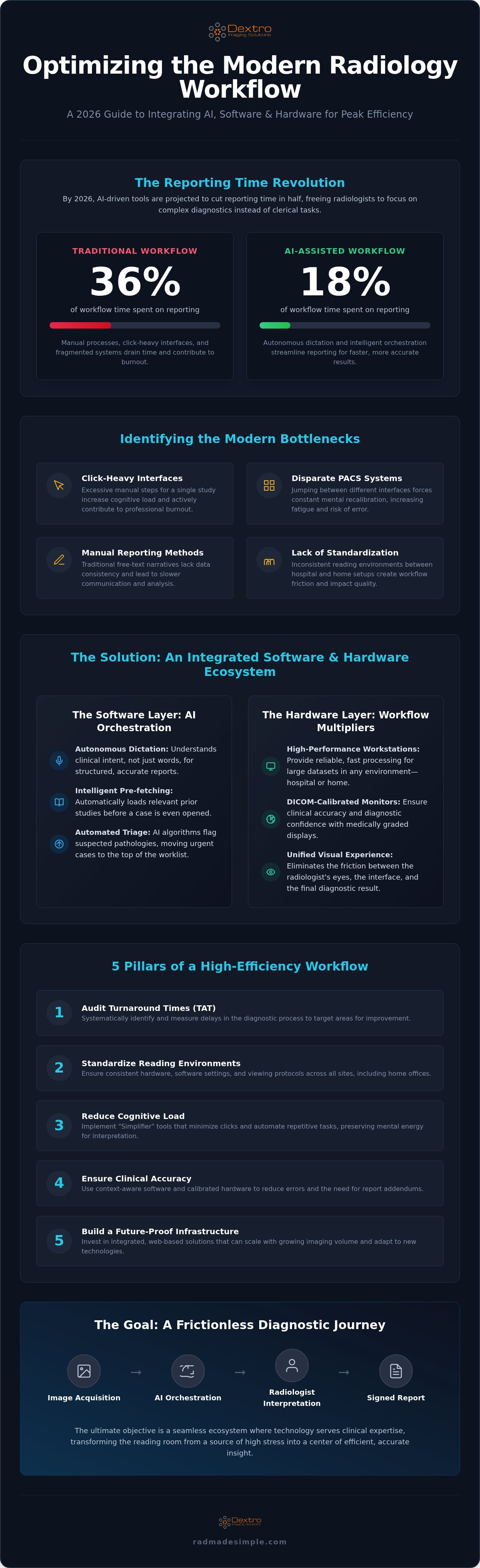
By 2026, AI-assisted structured reporting is projected to slash the time radiologists spend on reporting from 36% down to just 18% of the workflow stage. While this efficiency is a massive leap forward, many practices still struggle with high report turnaround times because their digital tools and physical hardware aren't aligned. You likely feel the daily pressure of an imaging volume that outpaces your current infrastructure, leading to fatigue and a cluttered workspace. Optimizing radiology workflow isn't just about adding a single new application; it's about ending the friction between your eyes, your interface, and your final diagnostic results.
You deserve a reading room that supports your expertise rather than draining your energy. Discover how the latest advancements in AI-driven reporting software and high-performance diagnostic hardware are eliminating the bottlenecks that cause burnout. This guide explores the shift toward seamless integration between PACS and reporting tools, the role of DICOM-calibrated monitors in boosting diagnostic confidence, and how to build a future-proof workstation that performs reliably in both hospital and home environments.
Key Takeaways
- Learn how optimizing radiology workflow requires a precise alignment between AI reporting software and DICOM-calibrated hardware to eliminate operational friction.
- Discover how modern voice recognition has transitioned into autonomous dictation, significantly reducing the cognitive load on busy radiologists.
- Understand the impact of high-performance workstations and diagnostic monitors on clinical accuracy and long-term professional health.
- Gain a clear five-step framework for auditing turnaround times and standardizing reading environments across all locations.
- See how integrated solutions like PACS Harmony and Radcom Compact create a unified, future-proof infrastructure for modern departments.
The 2026 Radiology Workflow Crisis: Burnout vs. Automation
True progress in optimizing radiology workflow is defined by the total removal of friction between the moment an image is acquired and the second the final report is signed. As we move through 2026, the industry focus has shifted toward "cognitive load management." This trend acknowledges that a radiologist's mental bandwidth is a finite, critical asset. Protecting this bandwidth is essential. When software requires dozens of clicks for a single study, it doesn't just slow down the process; it actively contributes to the global burnout crisis.
Traditional, click-heavy interfaces are no longer just an inconvenience. They are a primary driver of diagnostic delays. The modern "Simplifier" approach focuses on reducing the number of manual steps required to reach a diagnostic conclusion. By streamlining the digital environment, we allow clinicians to focus on the image rather than the interface. This shift transforms the reading room from a place of high-stress navigation into a center of efficient clinical insight.
Identifying Modern Bottlenecks
This focus on digital efficiency and the removal of manual friction is also a key driver in the development of advanced transaction simulation systems; you can learn more about how specialized software teams are optimizing these complex environments.
The rise of multi-site reading has exposed significant flaws in older infrastructure. Radiologists often find themselves jumping between disparate PACS interfaces, each with its own set of shortcuts and viewing protocols. This lack of standardization forces the brain to constantly recalibrate. This mental context-switching increases the risk of fatigue and error. Manual reporting methods further exacerbate these delays, pushing turnaround times (TAT) to unsustainable levels. Workflow friction is the hidden cost of hospital inefficiency.
Effective management of these systems requires a deep understanding of Imaging informatics, which provides the framework for how data moves through a facility. Without a unified strategy, even the most talented team will struggle against a fragmented digital environment. High TAT isn't just a metric; it's a symptom of a disconnected system.
The Shift Toward AI Orchestration
In 2026, the focus has moved from simple digital worklists to sophisticated AI orchestration. This technology doesn't just list cases; it uses intelligent, priority-based routing to ensure the right study reaches the right sub-specialist at the right time. This proactive model eliminates the "cherry-picking" of cases and ensures that urgent findings are addressed immediately.
Key features of this modern orchestration include:
- Intelligent Pre-fetching: AI identifies and loads relevant historical images before the radiologist even opens the current study.
- Zero-Footprint Access: Web-based viewers allow for instant image loading without the need for local software installations.
- Automated Triage: Algorithms flag suspected pathologies, moving them to the top of the queue for immediate review.
By integrating these tools, departments can achieve a level of optimizing radiology workflow that was previously impossible. This creates a seamless transition from data to diagnosis, ensuring that the technology serves the physician rather than the other way around.
The Software Layer: AI-Driven Radiology Reporting Software
In 2026, the software layer has moved beyond being a mere utility to becoming an active participant in the diagnostic process. Modern voice recognition for radiologists has evolved from simple speech-to-text into fully autonomous dictation. These systems don't just transcribe; they understand clinical intent. By transitioning from free-text narratives to structured reporting, departments ensure data consistency and faster downstream communication. This structured approach allows AI to populate reports based on image metadata, suggesting findings before the radiologist even begins to speak. This level of automation is a cornerstone of optimizing radiology workflow, as it allows clinicians to focus on high-level interpretation rather than clerical data entry.
Context-aware reporting software now acts as a digital safety net. It cross-references findings with patient history and current imaging protocols in real-time. If a finding contradicts historical data or metadata, the system flags the discrepancy immediately. This proactive error correction ensures that reports are accurate the first time they are generated. By reducing the need for addendums and revisions, software integration directly impacts the speed at which referring physicians receive actionable results.
RadVoice and AI: Slashing Dictation Time
Efficiency gains in optimizing radiology workflow often hinge on the speed of the reporting cycle. Using RadVoice for remote radiology, clinicians can maintain high throughput from any location without sacrificing accuracy. The software utilizes specialized medical-grade vocabularies to virtually eliminate transcription errors. This reduces the time-consuming correction rate that often plagues legacy systems. When your software corrects errors in real-time, you spend less time editing and more time analyzing complex cases. This is especially vital for teleradiology environments where speed and precision are equally weighted.
PACS Harmony: Unifying the Interface
Many departments suffer from "swivel-chair" medicine, where radiologists must log into multiple, disconnected PACS systems throughout a single shift. This fragmentation is a major barrier to productivity. PACS Harmony solves this by unifying disparate interfaces into a single point of truth. It streamlines communication with referring physicians and ensures that patient history is always accessible. This unified approach is a core part of broader ergonomic workstation strategies, as it reduces the mental and physical strain of navigating multiple logins. To see how these tools integrate into a complete solution, you can explore the latest integrated radiology platforms designed for modern efficiency.
The Hardware Layer: Why Workstations are Workflow Multipliers
Software optimization is ultimately wasted on sub-par hardware. Even the most advanced AI reporting tools cannot compensate for a workstation that stutters during complex 3D reconstructions. In 2026, the benchmark for radiology reading workstations includes dedicated GPU acceleration. This hardware capability allows for the instantaneous rendering of massive datasets, moving from slice-by-slice viewing to immersive 3D analysis without lag. When your hardware keeps pace with your clinical intuition, you achieve a state of flow that is critical for optimizing radiology workflow.
High-performance hardware also addresses the physical reality of the reading room. Specialized monitors with high refresh rates and optimized luminance levels reduce eye fatigue. This allows for longer, more accurate reading sessions without the cognitive decline associated with physical strain. If the hardware is slow, the radiologist is slow. By investing in high-performance processing and display technology, departments create an environment where software can actually perform at its peak potential.
Jusha Diagnostic Monitors and DICOM Precision
Precision starts at the pixel level. Using Jusha medical monitors is essential for maintaining strict compliance with the DICOM PS3.14 2026c standard. A significant workflow benefit of these displays is "Auto-Calibration." This feature ensures the monitor remains within diagnostic tolerances without requiring manual adjustments or technical downtime. High-luminance displays also help radiologists spot subtle pathologies, such as faint pulmonary nodules or microcalcifications, much faster. This clarity translates directly into higher diagnostic confidence and reduced interpretation time per case.
The Rise of the Portable Diagnostic Workstation
The demand for teleradiology and remote reading options continues to expand. Optimizing radiology workflow now requires maintaining diagnostic integrity outside the hospital walls. Systems like the Radcom Compact provide full diagnostic capability in a portable format. This allows for seamless transitions between the hospital, home, or satellite clinics. This flexibility ensures that a radiologist’s environment is standardized regardless of their physical location. Portable diagnostic accuracy is the new benchmark for teleradiology in 2026. By deploying these high-performance mobile units, departments can maintain high-quality coverage without tethering their best talent to a single physical reading room.
5 Steps to Implement a High-Efficiency Workflow
Implementing a high-efficiency environment requires a methodical transition from fragmented tools to a unified ecosystem. The first step in optimizing radiology workflow is a comprehensive audit of your current report turnaround time (TAT). You must pinpoint exactly where seconds are lost. Is it the initial image loading, the dictation process, or the final signing phase? Once these bottlenecks are identified, you can apply technical solutions to eliminate them.
Follow these five steps for a successful implementation:
- Audit Your TAT: Use timestamps to identify if delays are hardware-based (loading) or software-based (dictating).
- Standardize Hardware: Ensure every reading location, whether in the hospital or a home office, uses identical diagnostic monitors and processing power to maintain consistency.
- Deep Software Integration: Integrate tools like RadVoice directly into your PACS environment to avoid context-switching.
- Automate QA: Deploy AI-driven checks that flag missing measurements or lateral discrepancies before the report is signed.
- Manage System Latency: Coordinate with IT to ensure PACS storage speeds don't throttle your workstation's GPU performance.
Ergonomics as an Efficiency Strategy
Physical comfort is a direct multiplier of clinical output. Sub-optimal lighting or incorrect desk heights lead to fatigue, which inevitably slows down interpretation. Aligning multiple monitors to minimize neck rotation is essential for maintaining focus during an eight-hour shift. These traveling radiologist workstation setup principles are just as critical for static offices as they are for mobile units. A comfortable radiologist is a more accurate and productive radiologist.
Continuous Workflow Auditing
The process of optimizing radiology workflow is never truly finished. It requires continuous monitoring through real-time analytics to spot individual workstation lag or software hanging. Regular firmware patches for hardware and software updates for AI modules ensure the system remains at peak performance. Training your team on the latest AI shortcuts within your reporting software can further reduce the time spent on routine tasks. For a tailored roadmap to modernization, you can request a workflow efficiency audit from our technical specialists.
Future-Proofing Your Department with Dextro Solutions
Dextro Imaging Solutions operates on a core philosophy of removing complexity through integrated design. We recognize that a fragmented department is an inefficient one. By positioning Radcom Compact workstations and Jusha Diagnostic Monitors as your technological foundation, you eliminate the compatibility issues that often plague multi-vendor environments. Investing in medical-grade hardware provides a superior long-term ROI compared to consumer alternatives. Professional equipment is engineered for the rigorous 24/7 demands of a clinical setting. This ensures the precision and reliability required for optimizing radiology workflow over the life of the system.
Consumer-grade electronics often fail to maintain the strict calibration needed for diagnostic confidence. In contrast, our medical-grade solutions are built to last. They provide the stable performance your team needs to stay productive. You can consult with one of our "Simplifier" experts to conduct a custom workflow audit. This process identifies specific areas where your current setup is underperforming and provides a roadmap for modernization. Our goal is to move your department away from cumbersome, traditional methods toward more agile and contemporary ways of working.
Seamless Integration Services
Our commitment to your success extends beyond hardware delivery. Dextro handles the end-to-end setup of PACS Harmony and RadVoice, ensuring these tools work in perfect unison from day one. We offer technical support and maintenance contracts that guarantee 99.9% uptime. This level of reliability is vital for high-volume departments where every minute of downtime directly impacts patient care. Choosing a single-vendor solution for hardware and software licenses simplifies your procurement and support chain. You'll have one point of contact for your entire reading room ecosystem, ensuring that high-stakes professional requirements are met with precision.
Scaling for the Future
As your facility expands, your infrastructure must adapt without creating new bottlenecks. Adding portable workstations like the Radcom Compact allows you to grow your teleradiology team with ease. These units provide the same diagnostic integrity as your primary reading room, regardless of location. You can upgrade legacy systems in stages to avoid total workflow disruption. This modular approach protects your initial investment while allowing for rapid expansion as clinical demands increase. It's time to build a reading environment that empowers your clinicians and protects your productivity. Optimize your radiology workflow today with Dextro Imaging Solutions and ensure your department is ready for the challenges of 2026 and beyond.
Building the Future of Diagnostic Precision
The path to optimizing radiology workflow in 2026 requires a unified strategy that bridges the gap between digital tools and physical reading environments. You've seen how AI-powered RadVoice dictation software can drastically reduce reporting times while structured data improves clinical accuracy. However, these software gains only reach their full potential when paired with DICOM Part 14 compliant Jusha monitors and high-performance workstations. By removing the friction of lag and physical fatigue, you empower your team to focus on the high-stakes decisions that define patient care.
Dextro Imaging Solutions provides the foundation for this modernization. With our global technical support and maintenance, your department maintains the 99.9% uptime necessary for continuous excellence. It's time to replace cumbersome, legacy systems with a streamlined ecosystem designed for the modern radiologist. Streamline your diagnostic environment with Dextro's specialized workstations and reclaim your productivity. We're here to help you navigate these technological shifts with confidence and ease.
Frequently Asked Questions
What is the most common bottleneck in radiology workflow today?
The most common bottlenecks are manual reporting processes and the need to navigate disparate PACS interfaces. These issues force radiologists to context-switch constantly, which increases cognitive load and slows down diagnostic speed. By optimizing radiology workflow through unified platforms like PACS Harmony, departments can eliminate these digital silos. Reducing the number of clicks required to reach a conclusion is essential for maintaining high throughput in high-pressure environments.
How does radiology reporting software reduce report turnaround time?
Radiology reporting software reduces turnaround time by automating the transcription and formatting stages of the workflow. AI-driven tools like RadVoice allow for real-time dictation with high accuracy, eliminating the need for manual typing or external transcription services. Structured reporting further accelerates the process by using templates that AI can pre-populate with image metadata. This shift is projected to reduce the time spent on the reporting stage from 36% to 18% by late 2026.
Can I use a consumer-grade monitor for diagnostic radiology reading?
You shouldn't use consumer-grade monitors for diagnostic reading because they lack the calibration required for clinical accuracy. Diagnostic monitors, such as Jusha models, are specifically engineered for DICOM Part 14 compliance. This ensures that grayscale images are displayed consistently and accurately across different devices. Consumer screens often have uneven backlighting and lack the high-luminance levels necessary to spot subtle pathologies, which can lead to diagnostic errors and increased eye strain.
What are the benefits of integrating voice recognition with PACS?
Integrating voice recognition directly into the PACS environment removes the need for "swivel-chair" medicine. It allows radiologists to dictate findings while keeping their eyes on the images, rather than switching between different software windows. This seamless integration is a core component of optimizing radiology workflow. It reduces the risk of data entry errors and ensures that clinical intent is captured immediately, leading to faster report finalization and better communication with referring physicians.
Is teleradiology hardware as secure as hospital-based workstations?
Yes, professional teleradiology hardware is designed with the same security standards as hospital-based stations. Systems like the Radcom Compact utilize secure, encrypted connections and zero-footprint viewers to protect patient data. These portable workstations ensure that diagnostic integrity is maintained regardless of the location. By using hardware specifically built for medical use, remote radiologists can access high-performance processing and compliant displays without compromising the cybersecurity protocols required by modern healthcare facilities. To bolster these defenses, many providers rely on CyberOne for managed detection and response services tailored to complex medical environments.
DICOM Part 14 compliance ensures that every monitor in your network displays images with identical grayscale values. This consistency is vital for workflow efficiency because it allows radiologists to move between different workstations without needing to recalibrate their eyes. Features like "Auto-Calibration" in Jusha monitors maintain these standards automatically. This eliminates the downtime associated with manual adjustments and ensures that every diagnostic decision is based on a clear, standardized representation of the imaging data.
What is PACS Harmony and how does it unify disparate systems?
PACS Harmony is a unified interface designed to consolidate multiple disparate PACS systems into a single point of truth. It allows radiologists to view studies from different sites and vendors within a standardized viewer. This eliminates the need for multiple logins and reduces the mental fatigue caused by navigating different user interfaces. By creating a vendor-neutral environment, it streamlines data access and ensures that patient history is always available to the clinician without clinical delays.
How much time can AI dictation actually save a radiologist daily?
AI dictation can save radiologists significant time by cutting the reporting phase of the workflow in half. Research indicates that AI-assisted structured reporting can reduce the time spent on this stage from 36% to 18%. For a radiologist reading high volumes daily, this translates into hours of reclaimed productivity. By using RadVoice, clinicians spend less time correcting transcription errors and more time on high-level interpretation, which directly reduces overall report turnaround times.


