

In 2026, the primary bottleneck in diagnostic efficiency isn't monitor resolution; it's the communication bridge connecting the radiologist to the clinical data stream. You've likely experienced the mounting frustration of connectivity latency or a workstation cluttered with disparate dongles while trying to maintain high-volume output. It's a professional challenge that demands a technological answer, especially as remote reading becomes the industry standard.
Integrating a dedicated compact radiology communication device into your workflow is now a technical necessity for meeting the permanent CMS virtual direct supervision rules. This guide provides a comprehensive technical breakdown of the hardware designed to streamline your operations and secure your PACS connectivity. You'll learn how a medical-grade hardware bridge eliminates security vulnerabilities, ensures compliance with the May 2026 HIPAA Security Rule updates, and facilitates the seamless voice recognition integration required for modern teleradiology.
Key Takeaways
- Identify how a medical-grade compact radiology communication device acts as a secure hardware bridge between remote workstations and hospital networks.
- Evaluate essential technical specifications, such as Thunderbolt 5 and 10Gb Ethernet, to maintain high-performance throughput for large DICOM datasets.
- Compare the total cost of ownership between consumer hubs and professional hardware to reduce technical downtime during high-volume shifts.
- Follow a structured implementation guide to assess remote network bandwidth and configure secure PACS tunneling for teleradiology compliance.
- Optimize your workflow by integrating specialized communication hardware with software ecosystems like PACS Harmony for seamless voice recognition and diagnostic efficiency.
Defining the Compact Radiology Communication Device
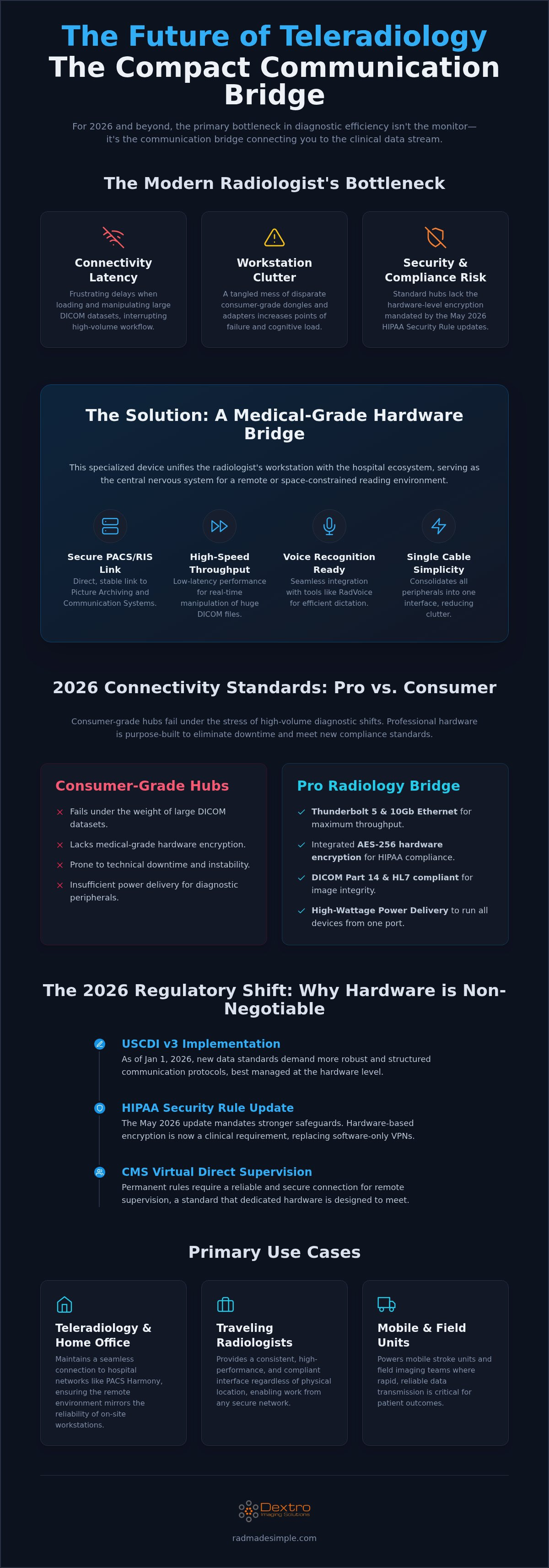
A compact radiology communication device functions as a specialized hardware bridge designed to unify the radiologist's workstation with the broader hospital ecosystem. Unlike standard peripheral hubs, these devices are engineered to handle the bidirectional flow of massive DICOM datasets while maintaining strict medical-grade security protocols. They serve as the central nervous system for a remote or space-constrained reading environment, facilitating a direct link to the Picture Archiving and Communication System (PACS) and Radiology Information System (RIS).
Traditional consumer-grade networking gear often fails under the weight of high-volume diagnostic shifts. A dedicated communication bridge, such as the Radcom Compact, provides the low-latency throughput and port stability necessary for real-time image manipulation. Its core functions extend beyond simple connectivity. It manages secure data transmission, integrates voice recognition tools like RadVoice, and consolidates disparate cables into a single, efficient interface. This removes the complexity of managing multiple dongles, allowing the clinician to focus entirely on diagnostic accuracy.
The Evolution of Radiology Connectivity in 2026
The landscape of connectivity shifted significantly on January 1, 2026, with the implementation of USCDI v3 and new CMS rules for virtual direct supervision. These regulations made dedicated hardware encryption a necessity rather than an option. While software-based VPNs were once sufficient, the May 2026 HIPAA Security Rule update mandates more robust safeguards. Professionals in Teleradiology now require portable, compliant bridges that ensure multi-factor authentication and encryption are hard-coded into the hardware layer. The "compact" form factor has become a clinical requirement because modern workstations must remain agile and clutter-free to reduce cognitive load during high-pressure cases.
Primary Use Cases: Teleradiology and Mobile Units
These devices are indispensable for the traveling radiologist who requires a consistent, high-performance interface regardless of their physical location. By utilizing a compact radiology communication device, clinicians maintain a seamless connection to PACS Harmony software from any secure network. This technology also powers mobile stroke units and field imaging teams, where rapid data transmission can dictate patient outcomes. In a home office environment, the bridge manages the high-bandwidth requirements of modern diagnostic monitors. It ensures that technical downtime doesn't interrupt critical reporting windows during high-volume shifts. This reliability is essential for practitioners who balance multiple site connections simultaneously.
Technical Specifications and Connectivity Standards
High-performance imaging demands high-performance hardware. A compact radiology communication device must support the latest data transfer protocols to handle multi-gigabyte studies without frustrating delays. Thunderbolt 5 and USB-C 4.0 are essential for 2026 workstations, providing the massive throughput required for instant image rendering. For local network stability, a 10Gb Ethernet port is no longer a luxury; it's a technical requirement for modern hospital backbones and high-speed home offices.
Security isn't an afterthought; it's baked into the silicon. Integrated AES-256 encryption ensures that data remains protected during transit, meeting the strict requirements of the electronic practice of medical imaging. Additionally, these devices must support high-wattage Power Delivery (PD). This allows a single cable to power high-end diagnostic peripherals, ensuring that specialized monitors receive consistent voltage while reducing the clutter of disparate power bricks. If you're looking to optimize your setup, you can explore our technical configurations for 2026 workflows.
Integration with PACS and RIS Protocols
Seamless integration requires more than just a physical connection. The bridge must ensure full HL7 and DICOM Part 14 compliance to maintain image integrity across the network. This hardware layer is what enables the "PACS Harmony" ecosystem, allowing radiologists to toggle between different hospital systems without losing monitor calibration or session data. It provides a stable anchor for platforms like aycan PACS, ensuring that remote reading environments mirror the reliability of on-site workstations. By offloading the communication processing to a dedicated device, the primary workstation's CPU remains free for intensive 3D rendering and AI-assisted case prioritization.
Voice Recognition and Dictation Hardware Support
Reporting speed depends on clear, uncompressed audio. Modern communication bridges optimize signal processing for tools like RadVoice, virtually eliminating the latency that often plagues cloud-based dictation. By managing specialized dictation microphones and foot pedals through a dedicated controller, the device prevents the "audio lag" that disrupts clinical focus. You'll find that hardware-level processing reduces the time spent correcting speech-to-text errors, which is critical during high-volume shifts. This dedicated support ensures that your dictation peripherals remain responsive, even when the network is under heavy load from large dataset transfers.
Comparing Compact Communication Solutions for 2026
Selecting the right compact radiology communication device requires a shift in perspective from simple connectivity to long-term operational stability. While high-end consumer hubs might appear sufficient on a spec sheet, they lack the specialized firmware and medical-grade certifications required for high-stakes diagnostic environments. Evaluating the Total Cost of Ownership (TCO) reveals that the expense of a single hour of technical downtime during a high-volume shift far outweighs the initial investment in purpose-built hardware. Professional-grade solutions are engineered to minimize the cognitive load on radiologists by ensuring that every peripheral works correctly the first time, every time.
Reliability in a clinical setting is non-negotiable. When a radiologist can trust that their connection to PACS Harmony will remain stable, they can maintain a higher diagnostic velocity. High-performance devices also reduce the mental fatigue associated with intermittent technical glitches. Firmware longevity is another critical factor; medical-grade devices receive long-term support cycles, whereas consumer electronics are often discontinued within 18 months. This long-term reliability protects your infrastructure investment and ensures that remote reading stations remain as secure as on-site departments.
Medical-Grade vs. Consumer-Grade Hardware
Consumer-grade hubs are designed for intermittent use and generic data types. In contrast, medical-grade devices are built for a high Mean Time Between Failures (MTBF) under constant, heavy load. These specialized bridges adhere to the Technical Specifications and Connectivity Standards established by the American College of Radiology. Consumer gear often fails to meet HIPAA and DICOM audit requirements because it lacks hardware-level encryption and port-specific security controls. Professional hardware is also backed by radiology hardware maintenance contracts, ensuring that technical support is available to maintain 2026 compliance during high-pressure shifts.
Performance Benchmarks for 2026
Performance in a radiology context is measured by how quickly a compact radiology communication device moves massive datasets without thermal throttling. A 2026-compliant device must handle 3D mammography and multi-slice CT studies with zero latency spikes. During a typical 12-hour intensive reading shift, consumer hubs often experience heat-induced performance drops. This increases radiologist frustration and slows down the reporting workflow. Effective thermal management in a compact form factor ensures that data transfer remains consistent from the first case to the last. This stability is what allows specialized hardware to outperform generic alternatives in real-world clinical testing.
Implementation and Compliance in Teleradiology
Deploying a compact radiology communication device requires a methodical approach to ensure both technical performance and regulatory adherence. Implementation begins with a rigorous assessment of the remote network environment. You must verify that your bandwidth supports the rapid transfer of large studies, typically requiring a stable connection to handle the throughput demands of 2026 imaging standards. Once the network is verified, the second step involves configuring the device for secure PACS tunneling. This creates an encrypted hardware-to-hospital bridge that isolates medical data from general internet traffic, protecting patient privacy at the source.
The third step focuses on visual integrity. You must calibrate the end-to-end signal to ensure medical display calibration remains consistent with DICOM Part 14 standards. After establishing the visual baseline, integrate RadVoice or your preferred dictation software to streamline the reporting process. This integration ensures that your speech-to-text tools operate with minimal latency. Finally, establish a routine maintenance and update schedule. This ensures that firmware remains current and your hardware continues to meet evolving security standards throughout 2026.
Cybersecurity Best Practices for Remote Reading
Security protocols have become more stringent following the May 2026 HIPAA Security Rule update. It's now mandatory to implement multi-factor authentication (MFA) at the hardware level to prevent unauthorized access. Your compact radiology communication device should secure the "last mile" of data transmission between the bridge and your diagnostic monitor. This prevents potential interceptions within the home or satellite office environment. To ensure your entire setup is current, refer to the 2026 Radiology Equipment Compliance Checklist for a full audit of your remote workstation.
Ergonomics of the Compact Workstation
A cluttered workspace leads to cognitive distraction and physical fatigue. Position your communication device to allow easy access to peripherals like dictation microphones and programmable mice without creating a tangle of cables. Smart cable management is essential for maintaining focus during long shifts. Additionally, ensure your hardware bridge supports the extreme high-resolution requirements of Jusha medical monitors. If you need assistance with your rollout, you can schedule a technical consultation with our implementation team to optimize your remote reading environment.
The Radcom Compact Advantage
The Radcom Compact represents the pinnacle of specialized hardware engineering for modern imaging. It functions as the critical link in high-performance radiology reading workstations, providing a level of reliability that generic alternatives cannot match. By integrating directly with PACS Harmony software, this compact radiology communication device ensures that your diagnostic environment remains consistent, whether you're in a hospital office or a remote home station. This seamless interplay allows for automated case prioritization and case-specific monitor calibration without manual intervention.
Dextro’s specialized technical support provides a layer of security that consumer manufacturers don't offer. Our team understands the nuances of DICOM protocols and the high-stakes nature of your work. When you choose the Radcom Compact, you aren't just buying hardware; you're securing a partnership dedicated to maintaining your uptime during the most demanding shifts. This proactive support model is designed to resolve technical friction before it impacts your diagnostic throughput.
Built for Teleradiology Professionals
The Radcom Compact features a travel-ready design that fits into any mobile setup without compromising connectivity. It offers plug-and-play compatibility with all major hospital RIS and PACS interfaces, removing the need for complex software configurations. In real-world clinical environments, users report significant efficiency gains. Some industry professionals report that the Radcom Compact helped reduce report turnaround times by 15%, primarily by eliminating the peripheral lag and connectivity drops common with standard hubs. This allows you to process more cases with greater focus and less technical frustration.
Securing Your Professional Future
Investing in your hardware today protects your career tomorrow. The Radcom Compact is built for longevity, featuring full Thunderbolt 5 support to handle the next generation of multi-slice imaging data. This ensures your home office remains compliant with evolving standards well beyond 2026. Every device is backed by a medical-grade hardware warranty, providing the peace of mind necessary for high-volume professional reading. It's the final piece of the technical puzzle for clinicians who demand precision, security, and reliability. View Radcom Compact Specifications and Pricing
Optimizing Your Diagnostic Workflow for 2026 and Beyond
The evolution of teleradiology demands hardware that matches the precision of your clinical expertise. Implementing a specialized compact radiology communication device is no longer just about convenience; it's about ensuring your remote reading environment meets the rigorous security and performance standards of 2026. By centralizing your connectivity through a medical-grade bridge, you eliminate the technical friction that leads to cognitive fatigue and reporting delays.
You've seen how dedicated hardware encryption and DICOM-compliant throughput protect your practice while streamlining communication with PACS Harmony. This technical foundation allows you to focus on what matters most: accurate and timely diagnosis. With features like advanced AES-256 hardware encryption and DICOM Part 14 compliant connectivity, your setup remains secure and efficient during even the highest volume shifts. Our team provides 24/7 technical support to ensure your transition is seamless and your compliance is guaranteed.
Explore the Radcom Compact for Your Radiology Workflow and take the final step toward a modernized, clutter-free professional environment. Your success depends on reliable tools that stay ahead of industry shifts.
Frequently Asked Questions
What is a compact radiology communication device?
A compact radiology communication device is a purpose-built hardware bridge that manages the secure transmission of medical imaging data between a workstation and hospital networks. Unlike generic hardware, it is engineered specifically for the high-bandwidth requirements of DICOM datasets. It serves as a central hub for diagnostic peripherals, ensuring that voice recognition tools and high-resolution monitors operate within a unified, medical-grade ecosystem for maximum clinical efficiency.
How does a communication bridge differ from a standard USB hub?
A communication bridge provides hardware-level encryption and specialized firmware that standard USB hubs lack. While consumer hubs focus on generic connectivity, a medical-grade bridge ensures low-latency throughput for massive multi-slice CT studies. It also includes specific port configurations for diagnostic monitors and dictation tools. These devices prioritize data integrity and security, meeting the strict requirements of the May 2026 HIPAA Security Rule updates that consumer-grade gear cannot satisfy.
Is the Radcom Compact compatible with all PACS systems?
Yes, the Radcom Compact is designed for universal compatibility with major hospital RIS and PACS interfaces through standard DICOM and HL7 protocols. It is specifically optimized for seamless interplay with PACS Harmony and aycan PACS. This ensures that radiologists can transition between disparate hospital systems without losing their customized workstation settings or monitor calibrations. The device acts as a vendor-neutral anchor for any modern teleradiology environment.
Does this device support 4K and 5MP diagnostic monitors?
The Radcom Compact fully supports the high-resolution requirements of 4K and 5MP diagnostic monitors, including Jusha diagnostic monitors. By utilizing Thunderbolt 5 and USB-C 4.0 connectivity, the device provides the necessary bandwidth to drive multiple high-performance displays without signal degradation. This ensures that radiologists maintain the spatial resolution and luminance standards required for accurate diagnostic interpretation during intensive, high-volume reading shifts.
Can I use the Radcom Compact for home-based teleradiology?
This compact radiology communication device is ideal for home-based teleradiology and mobile reading units. Its travel-ready design allows you to maintain a consistent, secure interface regardless of your physical location. By establishing a secure hardware-to-hospital bridge, it ensures that your home office workstation adheres to the same clinical and security standards as an on-site hospital department, facilitating seamless remote workflows even on non-hospital networks.
What security protocols are standard in these devices for 2026?
In 2026, standard security protocols include integrated AES-256 hardware encryption and multi-factor authentication (MFA) at the hardware level. These devices are engineered to comply with the May 2026 HIPAA Security Rule update, which transitioned encryption and vulnerability scanning from addressable to required safeguards. By securing the "last mile" of data transmission, the device prevents unauthorized access to sensitive patient information across private internet connections.
How does the device integrate with voice recognition software like RadVoice?
The device features specialized audio signal processing to minimize latency for voice recognition software like RadVoice. By managing dictation microphones and foot pedals through a dedicated hardware layer, it prevents the audio lag that often disrupts reporting speed. This integration ensures that speech-to-text tools remain responsive even when the network is under heavy load, allowing radiologists to maintain high diagnostic velocity without the frustration of technical interruptions.
Is technical support included with the Radcom Compact?
Dextro provides specialized technical support for the Radcom Compact to ensure 2026 compliance and operational stability. Support packages often include comprehensive maintenance contracts and 24/7 access to technical experts who understand the nuances of radiology workflows. This proactive approach helps reduce technical downtime during high-volume shifts, providing peace of mind that your communication hardware will remain functional and secure throughout its professional lifecycle.


