

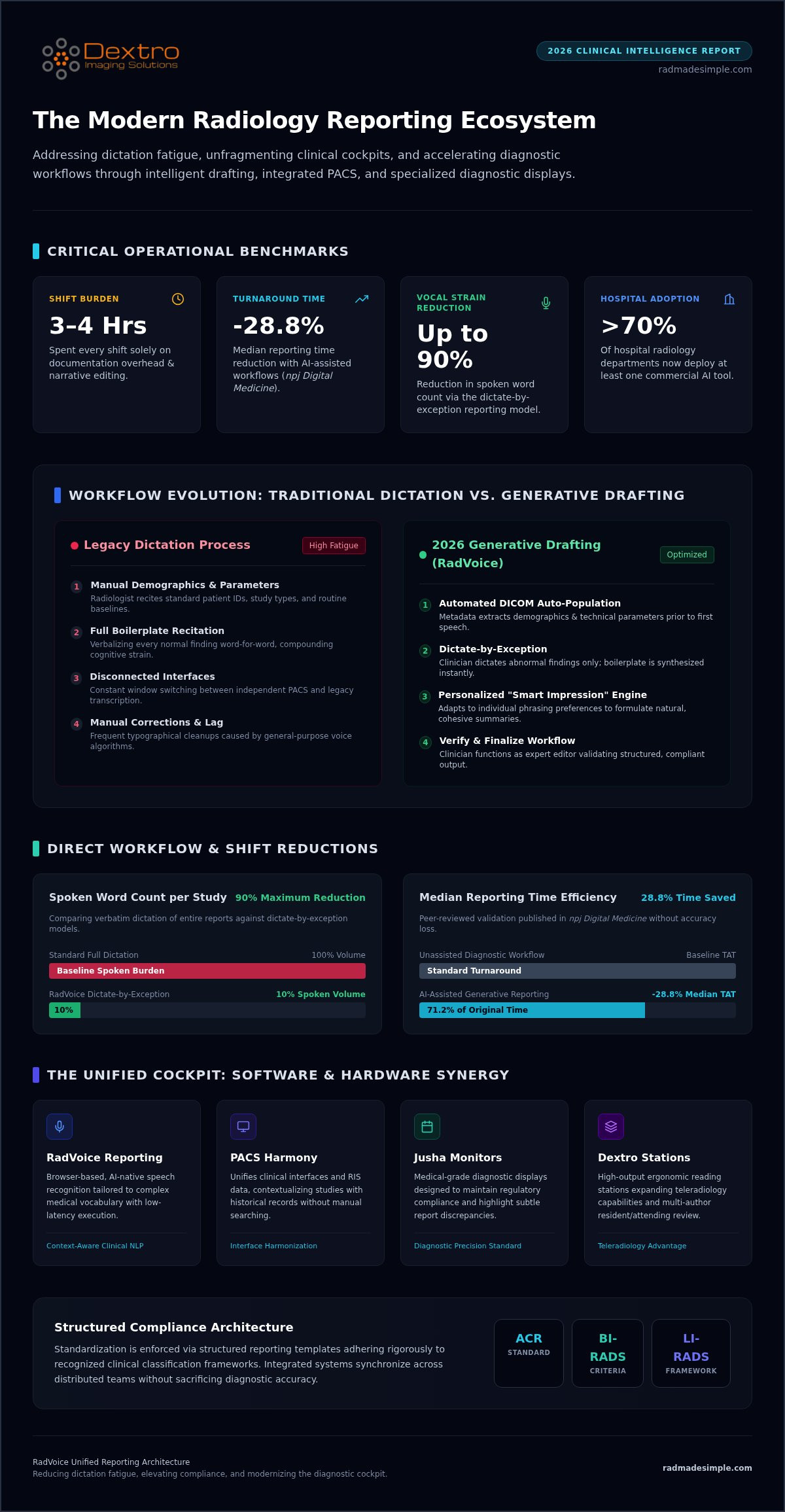
By 2026, radiologists are spending an estimated three to four hours of every working shift exclusively on documentation overhead and narrative report editing. This relentless administrative burden creates a level of dictation fatigue that threatens both diagnostic precision and professional well being. You likely feel the daily friction of jumping between disconnected PACS interfaces and legacy transcription tools that simply can't keep pace. Modernizing your workflow requires more than just a faster microphone; it demands advanced radiology reporting software that understands clinical context. Transitioning to AI-native, browser-based systems like RadVoice has become the standard for clinics looking to reclaim their time and focus on high-stakes interpretation.
We agree that the current state of fragmented diagnostic cockpits is unsustainable for modern practices. This article explains how the latest advancements in software and hardware integration are slashing turnaround times by up to 28.8 percent while significantly reducing radiologist burnout. You'll discover how tools like PACS Harmony and Jusha diagnostic monitors create a seamless environment where you only need to dictate findings that deviate from the norm. We provide a comprehensive look at generative impression summarization and show you how to build a reporting ecosystem that improves both compliance and diagnostic confidence.
Key Takeaways
- Learn how modern radiology reporting software has evolved into an intelligent drafting partner that cuts median reporting times without compromising diagnostic precision.
- Discover how unifying your clinical interfaces with PACS Harmony removes the complexity of jumping between disconnected systems for a more focused workflow.
- Understand why high-performance software requires the support of Jusha diagnostic monitors to maintain compliance and catch subtle report discrepancies.
- Explore the teleradiology advantage of combining RadVoice with Dextro Reading Stations to expand your practice's reach and reduce daily dictation fatigue.
- Identify how a single-vendor ecosystem simplifies your technical infrastructure and builds a more resilient, high-output diagnostic environment.
The Evolution of Radiology Reporting Software in 2026
Modern radiology reporting software has transitioned from a standalone transcription tool into a unified diagnostic engine. In 2026, this software functions as the connective tissue between voice recognition, artificial intelligence, and Picture Archiving and Communication Systems (PACS). The industry has reached a critical tipping point. Data from 2026 indicates that over 70% of hospital radiology departments now utilize at least one commercial AI workflow tool. This shift is driven by the need to manage massive datasets while maintaining accuracy. By integrating directly with radiology information systems, these platforms automate the flow of patient data, allowing clinicians to focus on interpretation rather than data entry.
From Dictation to Generative Drafting
Addressing Radiologist Burnout
Documentation overhead consumes three to four hours of a radiologist's daily shift. This mechanical burden is the primary driver of dictation fatigue. High-performance radiology reporting software like RadVoice addresses this by enabling a "dictate-by-exception" model. You only speak the abnormal findings while the system handles the boilerplate narrative. This approach can reduce spoken word counts by as much as 90%.
Smart software also learns your specific phrasing preferences and reporting style. This personalization ensures the "Smart Impression" engine generates summaries that sound like you, not a generic algorithm. By streamlining the "verify and finalize" stage, these platforms remove the click-burden that slows down turnaround times. You're no longer fighting the interface. You're working within a seamless environment that protects your cognitive energy for complex cases.
Essential Features of High-Performance Reporting Platforms
Selecting the right radiology reporting software requires looking beyond basic transcription. A high-performance platform acts as a command center, unifying PACS Harmony with the Radiology Information System (RIS) to provide real-time patient data. This integration ensures that every study is contextualized with historical records and lab values without manual searching. For collaborative environments, multi-author workflow support allows residents and attendings to interact seamlessly within the same report. Cloud-based synchronization further empowers these teams, providing the flexibility needed for teleradiology and remote interpretation. If your practice is evaluating full-feature imaging and PACS solutions, learn more about SMAART Medical Systems, Inc. to see how modern platforms streamline clinical operations.
Voice Recognition and NLP Precision
General-purpose voice software lacks the specialized vocabulary required for diagnostic imaging. It often fails when confronted with complex anatomical terms or specific pathology. In high-volume departments, low-latency processing is vital to prevent dictation lag that disrupts the radiologist's flow. Utilizing advanced voice recognition for radiologists ensures that AI-driven accuracy handles intricate medical terms with ease. This precision reduces the need for manual corrections, allowing you to maintain a steady pace during heavy shifts. If you are looking to upgrade your current setup, exploring the capabilities of RadVoice can provide the technical edge your practice needs.
Structured Reporting and Compliance
Standardization is no longer optional in modern medicine. High-performance platforms utilize structured reporting templates to ensure compliance with ACR, BI-RADS, and LI-RADS criteria. Adhering to structured reporting standards reduces variability across large radiology groups, ensuring every report meets the same rigorous quality benchmarks. This consistency doesn't just benefit the department; it significantly improves downstream communication with referring physicians who rely on clear, standardized data for patient management. By automating clinical guidelines, the software prevents the omission of critical findings. This protects the practice from regulatory risks and medical malpractice exposure.
Implementing high-performance radiology reporting software is the most effective way to turn every report into a valuable asset for the health system. Structured data facilitates easier auditing and research while ensuring that every diagnostic impression is backed by standardized, actionable evidence. The software must act as a safeguard, protecting both the clinician's time and the patient's safety.
The Critical Link Between Reporting Software and Hardware
High-performance radiology reporting software requires a robust hardware foundation to deliver on its promise of efficiency. If a workstation suffers from processing lag, even the most advanced AI dictation engine will feel sluggish. This latency disrupts the cognitive flow of the radiologist, leading to frustration and decreased throughput. A balanced ecosystem ensures that the text appears as quickly as it is spoken, maintaining a brisk diagnostic pace. When software and hardware work in tandem, the technical friction that often leads to burnout begins to disappear.
Visual Accuracy and Diagnostic Confidence
Diagnostic clarity starts with medical-grade displays. Jusha Diagnostic Monitors provide the high resolution and contrast ratios necessary to verify findings drafted by your software. These monitors ensure strict DICOM Part 14 Grayscale Standard Display Function (GSDF) compliance. This standard is critical for accurate image-to-report correlation. When a monitor is properly calibrated, it reduces eye strain and allows for faster interpretation of subtle findings. Using consumer-grade electronics for professional reporting often leads to unnecessary re-reads and decreased diagnostic confidence. High-luminance displays assist in spotting minute pathologies that might be overlooked on standard screens.
The Ergonomics of the Reporting Station
The physical layout of the environment directly impacts reporting speed. Dextro Reading Stations are designed to optimize the relationship between the radiologist, the monitors, and the input devices. Proper positioning of microphones is essential for voice recognition accuracy. Ambient noise and poor room acoustics can introduce errors into the transcript, forcing the clinician to spend more time on manual edits. Medical-grade noise-cancelling microphones are essential for mitigating ambient reading-room noise and preventing recognition latency. A well-designed station includes:
- Adjustable monitor arms to maintain ideal viewing angles and reduce neck strain.
- Integrated cable management to keep the workspace clean and focused.
- Acoustic considerations that minimize background interference for clearer dictation.
- Ergonomic desk heights that reduce physical fatigue during long shifts.
Integrating RadVoice with a Dextro station creates a turnkey solution for both hospital and home-office environments. It simplifies the transition from interpretation to final signature by removing the physical and technical barriers that slow you down. By investing in a unified hardware and software stack, you protect your productivity and ensure that your radiology reporting software operates at its full potential.
Evaluating ROI: Beyond Simple Turnaround Times
Evaluating the return on investment for radiology reporting software requires a shift from measuring speed alone to assessing clinical value and practice sustainability. While report turnaround time remains a baseline metric, the true value lies in the reduction of medical malpractice exposure and the preservation of clinician cognitive energy. By 2026, high-performing departments are prioritizing software that integrates real-time quality assurance tools to catch internal report discrepancies before they are signed. This proactive error reduction directly impacts the bottom line by preventing billing rejections and minimizing legal risks.
Measuring Radiologist Productivity
Traditional metrics often overlook the "click-burden" that occurs between interpretation and the final signature. Modern analytics now track the entire lifecycle of a study, identifying bottlenecks in template navigation or narrative editing. Referring physicians report higher satisfaction when reports are not only fast but structured and consistently formatted. The ROI of an integrated hardware-software ecosystem is realized through the seamless transition from diagnostic interpretation to structured output without the need for manual data entry. By reducing the documentation overhead that consumes three to four hours of every shift, practices can significantly extend the career longevity of their staff.
Teleradiology and Remote Implementation
The shift toward home-based reading has transformed the requirements for radiology reporting software. Teleradiologists need a setup that mirrors the hospital environment without the burden of complex on-site IT support. Portable Radiology Workstations paired with zero-install, browser-native dictation engines like RadVoice enable immediate access on any workstation. This flexibility allows practices to expand service hours and attract top-tier talent regardless of geography. It's no longer necessary to maintain expensive on-premise servers for dictation when cloud-native architectures provide the same level of performance.
Distributed environments present unique challenges for security and maintenance. Unified platforms like PACS Harmony reduce IT overhead by centralizing multi-interface unification. This allows for streamlined software updates and hardware monitoring across a distributed fleet of remote readers. Ensuring HIPAA compliance across disparate home networks is simplified when the reporting engine functions as an upstream drafting tool without the need for local Protected Health Information (PHI) storage. To see how these integrated tools can transform your practice's ROI, explore our turnkey radiology solutions today.
Future-proofing your department means choosing software that evolves alongside AI advancements. As the FDA continues to authorize more AI-enabled medical devices, your reporting platform must act as the orchestrator for these disparate data streams. Investing in a system that grows with the industry ensures you won't be trapped in a cycle of expensive legacy migrations every few years. A modern, agile infrastructure protects your capital investment while empowering your clinicians to deliver the highest standard of care.
Implementing a Unified Reporting Ecosystem with RadVoice
Implementing a high-performance diagnostic environment requires more than just buying a new microphone. It involves creating a unified ecosystem where software and hardware exist in a single, responsive loop. By choosing a single-vendor partner for both your radiology reporting software and your physical workstation, you eliminate the finger-pointing that often occurs during technical troubleshooting. This streamlined approach ensures that your RadVoice engine and Jusha monitors are always calibrated to work together. You're not just buying tools; you're investing in a managed workflow designed for maximum uptime.
The RadVoice and PACS Harmony Synergy
The synergy between RadVoice and PACS Harmony serves as the technical bridge your department needs to remove clinical friction. This integration removes the need to toggle between separate windows or manage multiple logins, which are primary drivers of cognitive fatigue. It ensures unified patient context sharing between the diagnostic viewer and the report itself. You can customize the interface for specific modalities like MRI, CT, or X-ray, ensuring that the most relevant structured templates are always front and center. This level of integration allows you to focus entirely on the images rather than the interface.
To achieve this level of optimization, follow a structured implementation plan:
- Step 1: Assess current workflow bottlenecks and hardware limitations. Determine if your current monitors meet DICOM Part 14 standards or if dictation lag is slowing down your turnaround times.
- Step 2: Pilot test RadVoice within your existing PACS environment. Because it's a zero-install, browser-native platform, you can evaluate its AI-driven accuracy without complex IT procurement or server migrations.
- Step 3: Deploy Dextro Reading Stations for maximum software performance. This final step provides the ergonomic foundation and processing power required to handle the advanced capabilities of 2026-era reporting tools.
Ongoing Support and Compliance
The 2026 regulatory landscape requires constant vigilance, especially with over 1,400 FDA-authorized AI devices now in the medical imaging market. A unified ecosystem ensures you receive regular software and firmware updates to maintain compliance with evolving HIPAA and diagnostic standards. By centralizing your infrastructure, you gain access to expert technical support for both hardware and software troubleshooting through a single contact point. This proactive maintenance prevents downtime and protects your capital investment. Discover how Dextro Imaging Solutions simplifies your reporting workflow to reclaim your time and focus on high-quality patient care.
Modernizing your practice with agile radiology reporting software is the most effective way to combat burnout while increasing diagnostic output. When your software understands your intent and your hardware provides the clarity you need, the entire reporting process becomes more manageable. Transitioning to a unified ecosystem isn't just a technical upgrade; it's a commitment to a more sustainable and precise future for your radiology department.
The Future of Diagnostic Precision
The landscape of medical imaging has shifted toward a more integrated and intelligent future. We've explored how modern radiology reporting software has moved beyond simple transcription to become a high-performance drafting partner. By combining the specialized medical NLP of RadVoice with the diagnostic clarity of Jusha DICOM-calibrated monitors, you can reduce dictation fatigue and improve turnaround times. Utilizing integrated PACS Harmony solutions ensures that your clinical context remains unified across every modality and study.
Investing in a seamless ecosystem is the most effective way to protect your practice from burnout while maintaining the highest standards of diagnostic accuracy. You now have the roadmap to transition from fragmented legacy tools to an agile, unified diagnostic cockpit. Reclaiming your time and focus is possible through smart design and technical authority. Your commitment to modernization ensures that your department stays at the forefront of the field.
Streamline your workflow with RadVoice and Dextro Reading Stations and take the first step toward a more efficient and reliable reporting environment.
Frequently Asked Questions
What is the best radiology reporting software for teleradiology in 2026?
RadVoice is the premier choice for teleradiology in 2026 because of its zero-install, browser-native architecture. This allows radiologists to access their full diagnostic toolkit from any workstation without complex client-side configuration. When paired with Dextro Reading Stations, it provides a turnkey solution for remote reading. The platform ensures immediate access to AI-driven dictation tools, enabling clinicians to maintain hospital-level productivity from a home office or a distributed clinic environment.
How does AI-powered radiology reporting reduce turnaround time?
AI-powered radiology reporting software reduces turnaround times by automating the synthesis of clinical findings into structured narratives. Peer-reviewed data indicates that these workflows cut median reporting time by 27.1% to 28.8% without sacrificing diagnostic accuracy. By utilizing "dictate-by-exception" models, the software pre-populates normal findings and requires the radiologist to only dictate abnormalities. This process significantly lowers spoken word counts and eliminates the manual effort involved in navigating complex reporting templates.
Can RadVoice integrate with my existing PACS system?
Yes, RadVoice is designed to integrate seamlessly with existing PACS environments through PACS Harmony. This integration creates a unified interface that eliminates the need to toggle between separate windows or manage multiple logins. By establishing a bridge between the diagnostic viewer and the reporting engine, PACS Harmony ensures that patient context is shared in real time. This technical synergy removes clinical friction and allows for a more streamlined, responsive diagnostic workflow across various modalities.
Do I need a medical-grade monitor for radiology reporting?
High-performance reporting requires a medical-grade monitor to ensure visual accuracy and regulatory compliance. Jusha Diagnostic Monitors provide the necessary luminance and contrast to meet DICOM Part 14 Grayscale Standard Display Function requirements. Using consumer-grade screens for professional reporting can lead to eye strain and missed pathologies. Medical-grade displays allow you to verify AI-drafted findings with confidence, ensuring that the visual data matches the structured report output for every patient study.
What is structured reporting in radiology and why is it important?
Structured reporting involves using standardized templates and vocabularies to organize clinical findings into a consistent format. It's essential for maintaining compliance with ACR, BI-RADS, and LI-RADS criteria across large radiology groups. By reducing variability in report narratives, structured reporting improves downstream communication with referring physicians and simplifies data auditing. Modern software automates these clinical guidelines, ensuring that every report contains the necessary data points required for accurate billing and high-quality patient management.
How does voice recognition software handle complex medical terminology?
Advanced voice recognition engines use specialized medical Natural Language Processing (NLP) to interpret clinical intent rather than just transcribing words. These systems are trained on vast datasets of radiological terminology, allowing them to handle complex anatomical terms and pathology with high precision. Features like RadVoice's "Verify" mode provide real-time quality assurance by catching discrepancies in the text before the report is finalized. This ensures that the technical narrative remains accurate and professional regardless of the case complexity.
Is cloud-based radiology reporting software secure for HIPAA compliance?
Cloud-based platforms like RadVoice are engineered to exceed modern security standards for HIPAA compliance. By functioning as an upstream draft and structuring engine with zero required Protected Health Information storage, the software minimizes the risk of data breaches. This architecture allows for immediate access across disparate networks while ensuring that sensitive patient data remains protected within the institutional PACS. Distributed teams can collaborate securely without the administrative burden of maintaining on-premise dictation servers or manual security patches.
What are the hardware requirements for modern radiology reporting software?
Modern radiology reporting software requires a robust hardware foundation to eliminate processing lag and maintain diagnostic clarity. Essential components include high-performance workstations like Dextro Reading Stations and DICOM-calibrated Jusha monitors. Medical-grade noise-cancelling directional microphones are also critical for preventing recognition latency in busy reading rooms. A balanced ecosystem ensures that the workstation's processing power matches the software's AI capabilities, providing a responsive environment that allows for a brisk and focused diagnostic pace.


