

DICOM compliance is the mathematical bridge between digital data and human perception; without it, diagnostic accuracy is a gamble, not a science. You've likely felt the physical toll of a ten hour shift, where eye strain makes it harder to trust your own eyes when searching for subtle microcalcifications or faint lung nodules. While a high end consumer 4K screen might look sharp, only DICOM compliant diagnostic monitors provide the consistent grayscale accuracy required for clinical confidence. It's about more than just a clear picture. It's about ensuring that what the modality captures is exactly what you see, every single time.
We understand that managing MQSA requirements and choosing between 3MP, 5MP, or 12MP displays can feel like an administrative burden. This 2026 guide simplifies those complexities, offering a clear framework to modernize your workspace while maintaining total regulatory compliance. You'll learn the core mechanics of DICOM Part 14 and discover how Jusha diagnostic monitors use built-in sensors to automate calibration. By the end of this article, you'll have a roadmap to optimize your workflow and protect your long-term diagnostic reliability with precision engineered hardware.
Key Takeaways
- Understand why DICOM Part 14 and the Grayscale Standard Display Function (GSDF) are essential for maintaining visual consistency across different viewing environments.
- Learn why consumer 4K displays fall short and how 10 bit or 12 bit processing ensures you do not miss subtle clinical details.
- Identify the specific resolution and luminance standards required for various modalities, ranging from 3MP for MRI to 5MP for mammography.
- Discover how Jusha DICOM compliant diagnostic monitors remove technical friction through built-in sensors and automated calibration software.
- Streamline your workflow with pre-configured Dextro Reading Stations designed to meet strict 2026 regulatory and teleradiology standards.
What is a DICOM Compliant Diagnostic Monitor?
DICOM stands for Digital Imaging and Communications in Medicine. It is the international standard that allows medical imaging equipment, from MRI scanners to PACS servers, to communicate seamlessly. While most healthcare professionals are familiar with the file format, the role of the display is often misunderstood. A DICOM compliant diagnostic monitor is not just a high-resolution screen. It is a precision instrument engineered to translate digital data into a visual format that matches the physiological limits of the human eye.
The display is the final, most critical link in the diagnostic chain. If a monitor fails to represent grayscale values accurately, the most advanced imaging modality in the world becomes irrelevant. Unlike consumer electronics, medical-grade displays must maintain consistent performance over years of use. This isn't a marketing distinction; it's a functional necessity. These monitors include specialized hardware like internal sensors and high-bit-depth processors that ensure the image you see today is identical to the image you see five years from now.
The Core Purpose of DICOM Part 14
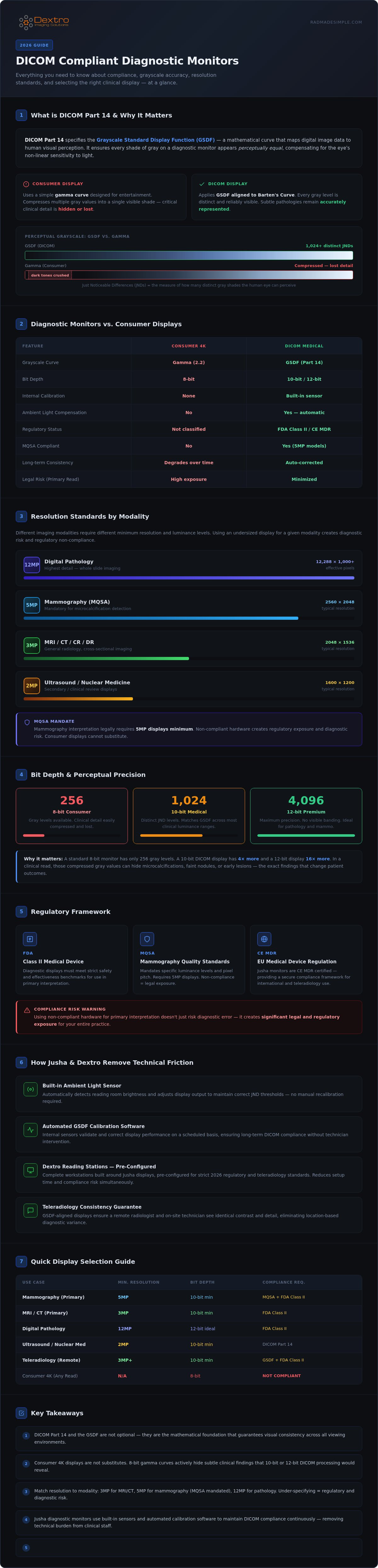
DICOM Part 14 specifies the Grayscale Standard Display Function (GSDF). This mathematical curve accounts for the fact that the human eye doesn't perceive changes in light linearly. We are much more sensitive to subtle changes in dark areas than in bright ones. By applying the GSDF, DICOM compliant diagnostic monitors ensure that every step of the grayscale is perceptually equal. This consistency is vital for teleradiology. It guarantees that a radiologist viewing a chest X-ray at a Dextro Reading Station sees the exact same contrast and detail as the technician at the hospital. Without this standard, subtle pathologies like faint nodules could become "invisible" simply because of poor luminance mapping.
Regulatory Standards: FDA, MQSA, and Beyond
Regulatory compliance is a cornerstone of modern radiology. In the United States, the FDA classifies diagnostic displays as Class II medical devices, requiring them to meet strict safety and effectiveness benchmarks. If your practice interprets mammography, you must adhere to the Mammography Quality Standards Act (MQSA). This act mandates specific luminance levels and pixel pitches that standard monitors cannot achieve. Choosing Jusha diagnostic monitors helps simplify this burden. These displays are engineered to meet international standards like CE MDR, providing a secure framework for global compliance. Using non-compliant hardware for primary interpretation doesn't just risk diagnostic error; it creates significant legal and regulatory exposure for your practice.
The Science of Grayscale: Understanding GSDF and Human Perception
The human eye is an incredibly complex optical instrument, but it has distinct physiological limitations. Our ability to perceive changes in brightness depends heavily on the starting luminance level. This reality is described by Barten’s Model, which maps how contrast sensitivity varies across different light intensities. In a dark environment, your eyes are highly sensitive to small changes in low-light grayscale. In a bright room, those same changes often become invisible. Standard consumer monitors use a simple "gamma" curve designed for entertainment, which fails to account for this non-linear sensitivity. This mismatch creates a significant risk in a clinical setting.
GSDF is the mathematical curve that ensures equal perceptual changes for equal digital input changes. Without this specific mapping, a radiologist might miss a subtle lesion because the monitor's output didn't trigger a perceivable change in their vision. DICOM compliant diagnostic monitors solve this by aligning their output precisely with Barten’s Curve. This alignment makes every gray level distinct and reliable, ensuring that the data captured by the modality is accurately represented for the human observer.
Barten’s Curve and Contrast Sensitivity
Contrast sensitivity is the ability to distinguish an object from its background, measured in units called Just Noticeable Differences (JNDs). A standard office monitor might compress several digital values into a single perceivable shade of gray, effectively hiding critical data. High-performance DICOM compliant diagnostic monitors maximize the number of JNDs available, often providing over 1,024 distinct levels of gray through 10-bit or 12-bit processing. Ambient light also plays a critical role. If your reading room is too bright, it shifts your JND threshold. Modern medical displays include ambient light sensors that adjust the GSDF curve in real-time to maintain diagnostic integrity.
Luminance Uniformity: The Hidden Compliance Factor
Luminance uniformity is a vital safety requirement that many overlook. A standard screen is typically brighter in the center and dimmer at the corners. For a radiologist, a 15% or 20% drop in brightness at the edge of the panel could mean a pathology looks different depending on its screen position. Medical-grade hardware utilizes Uniformity Compensation (UC) technology. This system monitors and adjusts the backlight at a granular level across the entire panel. It prevents dangerous "dim zones" and ensures that the center of the screen matches the corners perfectly. You can see how these technologies integrate into a modern workflow at radmadesimple.com. By utilizing hardware with built-in compensation, you remove the technical complexity from your daily diagnostic tasks.
Diagnostic Monitors vs. Consumer Displays: Why Compliance Matters
Many facilities attempt to save costs by purchasing high-end 4K gaming or graphic design displays. This is often called the "4K Myth." While 8 million pixels provide a sharp image, resolution alone does not equal diagnostic quality. In fact, a high-resolution consumer screen without proper calibration can be more dangerous than a lower-resolution compliant one. It creates a false sense of security while masking critical clinical data. The display must be able to reproduce the specific grayscale values defined by the modality, which consumer hardware is simply not built to do.
The primary technical differentiator is bit-depth. Consumer displays typically operate at 8-bit depth, which only renders 256 shades of gray. In contrast, DICOM compliant diagnostic monitors utilize 10-bit or 12-bit processing to display 1,024 or more shades. This increased granularity is essential for detecting subtle density variations in soft tissue. For a deeper dive into these technical differences, see our Diagnostic Monitor vs Consumer Monitor in Radiology comparison. Longevity is another critical factor. Consumer backlights are designed for limited daily use and begin to dim or shift in color temperature within 12 to 18 months. Medical-grade units, such as those from Jusha, include stabilized backlights and front sensors that compensate for aging, ensuring years of consistent performance.
The Risk of Misdiagnosis and Legal Liability
Using non-FDA cleared hardware for primary interpretation carries significant risk. Subtle findings, such as a small pneumothorax or faint microcalcifications, can literally vanish if a monitor cannot maintain the required luminance levels. Beyond the clinical danger, there are legal and financial implications. Most malpractice insurance policies and reimbursement frameworks assume the use of compliant equipment. If a misdiagnosis occurs on a non-medical display, the facility faces a difficult legal defense and potential loss of accreditation. Relying on DICOM compliant diagnostic monitors provides a necessary layer of institutional security.
Eye Fatigue and Radiologist Productivity
Radiologists often spend eight to twelve hours staring at screens. Consumer monitors frequently use pulse-width modulation for dimming, which causes a subtle flicker that leads to headaches and eye strain. Medical displays feature flicker-free technology and advanced blue light management to protect the user. Consistent luminance also prevents the "re-accommodation" strain that occurs when the eye must constantly adjust to different brightness levels across multiple screens. Integrating these displays into specialized radiology reading workstations further enhances productivity by providing an ergonomic, streamlined environment that supports high-volume diagnostic tasks.
Key Specifications for Selecting Your Diagnostic Display
Selecting DICOM compliant diagnostic monitors requires matching hardware capabilities to your specific clinical workload. Resolution is the first metric to consider. While more pixels often seem better, the goal is to match the native resolution of the modality to avoid interpolation artifacts. For CR and DR, a 2MP display is often sufficient. Cross-sectional imaging like CT and MRI typically requires 3MP to capture the necessary detail without excessive zooming. Mammography remains the most demanding field, requiring 5MP displays to meet MQSA standards. You can find a detailed breakdown of these requirements in our Radiology Monitor Resolution Guide.
Luminance and contrast are equally critical for diagnostic accuracy. A maximum luminance of 400 to 500 cd/m² is the clinical baseline for 2026. This range provides enough "headroom" for the monitor to age while maintaining a calibrated output of at least 350 cd/m². High contrast ratios ensure deep blacks, which are vital for identifying soft tissue contrast. Without a high contrast ratio, subtle density changes in dark areas can wash out, leading to potential oversights. High-performance hardware maintains these levels consistently across the entire panel, ensuring that your visual data remains reliable from the center to the edges.
Integrated Calibration Sensors
The industry has moved away from external "pucks" that require manual attachment. Modern Jusha diagnostic monitors feature integrated front sensors that automate the entire QA process. These sensors perform real-time checks and auto-calibration in the background, ensuring 24/7 compliance without user intervention. This technology removes the administrative burden of manual testing. For large hospital networks, these sensors allow for remote calibration management. IT teams can monitor the compliance status of an entire fleet of displays from a single location, ensuring every workstation meets the required standards without needing to visit each reading room.
Color vs. Grayscale: The 2026 Standard
Monochrome displays were once the only choice for high-contrast radiology. In 2026, high-luminance color monitors are becoming the preferred multi-modality standard. These hybrid displays offer the contrast needed for grayscale studies while allowing for 3D reconstruction and fusion imaging. This flexibility is essential for radiologists who handle diverse study types throughout their shift. While dedicated monochrome monitors still offer specialized benefits for high-volume mammography, hybrid color solutions provide the versatility required for modern, streamlined workflows. Explore our range of Jusha hardware and pre-configured workstations at radmadesimple.com to find the right fit for your practice.
Simplifying Compliance with Dextro and Jusha Solutions
Dextro Imaging Solutions streamlines the path to clinical excellence by removing the technical friction associated with medical imaging. While understanding the physics of grayscale is vital for quality control, your daily focus should remain on patient care rather than calibration schedules. By integrating Jusha hardware with specialized software, we provide a seamless environment where DICOM compliant diagnostic monitors maintain their own performance standards. This automated approach ensures every pixel remains within regulatory tolerances without requiring manual intervention from your IT staff or radiologists.
Dextro Reading Stations arrive pre-configured for immediate use, bridging the gap between hardware procurement and clinical operation. These stations are engineered for high-stakes environments, incorporating PACS Harmony to create a unified, compliant viewing experience. Beyond the initial setup, our maintenance contracts provide long-term security and peace of mind. We prioritize uptime because we know that even a single hour of downtime in a busy radiology department can disrupt an entire hospital's workflow. Our support teams ensure your equipment stays performant, so you don't have to worry about sudden compliance drift.
Jusha Medical Monitors: Built-in Intelligence
Jusha hardware utilizes "Insent" smart sensing technology to balance energy efficiency with strict compliance. These sensors detect when a radiologist is present, instantly bringing the display to its calibrated luminance and entering power-saving modes during breaks. The 2026 lineup is comprehensive, featuring everything from portable teleradiology units for home offices to 12MP mammography displays for specialized centers. For a complete technical breakdown of these options, consult our Jusha Medical Monitors Reference Guide. This intelligence ensures your workstation is always ready for high-stakes interpretation.
Future-Proofing Your Radiology Department
Modern radiology is no longer confined to the hospital basement. Dextro simplifies the transition to remote reading by providing workstations that replicate the hospital environment in any location. Our solutions scale alongside your practice, offering deep integration with aycan PACS and RadVoice reporting tools to keep your workflow agile. Whether you're expanding a local clinic or building a national teleradiology network, our infrastructure supports your growth while protecting your diagnostic integrity. Explore our range of DICOM compliant monitors to see how we can modernize your practice today.
Future-Proof Your Diagnostic Workflow
Precision in medical imaging is the foundation of every accurate diagnosis you make. As we move through 2026, the gap between consumer hardware and professional medical displays continues to widen, making the choice of equipment a critical factor in clinical success. By investing in DICOM compliant diagnostic monitors, you eliminate the risks of perceptual inconsistency and hardware degradation that compromise patient care. You've seen how GSDF mapping and high bit-depth processing reveal subtle pathologies that standard screens simply cannot render.
Jusha monitors feature built-in auto-calibration sensors that handle the technical heavy lifting, ensuring your workstation remains compliant without manual effort. Our team provides comprehensive technical support for PACS integration, which is why leading teleradiology groups worldwide rely on our solutions for their high-stakes environments. You don't have to manage the complexities of calibration alone. With the right hardware and a streamlined integration plan, you can focus entirely on interpretation and productivity. Take the next step in modernizing your practice and protecting your diagnostic integrity.
Upgrade to a DICOM Compliant Jusha Monitor Today and experience the confidence that comes with a truly optimized reading environment. We're here to support your transition to a more efficient, reliable, and compliant future.
Frequently Asked Questions
What is the difference between DICOM calibrated and DICOM compliant?
DICOM calibration refers specifically to the adjustment of a monitor's output to follow the Grayscale Standard Display Function (GSDF). DICOM compliance is a broader designation indicating that the hardware meets all medical regulatory requirements, including FDA Class II clearance and specific luminance stability benchmarks. A monitor can be calibrated to the curve but still fail to be a compliant diagnostic device if it lacks the necessary medical grade certifications and hardware stability.
Does a 4K monitor qualify as a diagnostic radiology monitor?
Resolution alone does not make a monitor suitable for primary diagnosis. While a 4K consumer display has many pixels, it lacks the 10-bit grayscale depth and stabilized backlights found in DICOM compliant diagnostic monitors. Using a consumer screen for primary interpretation violates FDA guidelines and increases the risk of missing subtle pathologies. Medical-grade units ensure that the luminance and contrast remain stable over the entire life of the display.
How often do I need to calibrate my medical-grade monitor?
Modern monitors with integrated front sensors, like the Jusha lineup, perform auto-calibration daily without any user intervention. If you use an older device without built-in sensors, you typically need to perform manual calibration every three to six months to account for backlight aging. Automated systems are the preferred standard for 2026 to ensure constant diagnostic accuracy and to remove the administrative burden of manual quality assurance testing.
Are 5MP monitors required for all types of radiology reading?
5MP resolution is not a universal requirement for all radiology modalities. It's specifically mandated for mammography under MQSA guidelines to ensure the clear visualization of fine microcalcifications. For general radiography, CT, and MRI, 2MP or 3MP displays are usually sufficient and provide an efficient balance of performance and cost. Choosing the right resolution depends entirely on the specific clinical data you are interpreting during your shift.
Can I use a portable monitor for teleradiology and still be DICOM compliant?
You can maintain compliance while working remotely by using specialized portable radiology workstations designed specifically for teleradiology. These devices are engineered to meet medical standards and include the same calibration technology as desktop units to ensure visual consistency. It's critical to verify that your portable setup is FDA cleared for primary interpretation before using it for clinical diagnosis in a home office or mobile environment.
What is the significance of the GSDF curve in medical imaging?
The GSDF curve is the mathematical standard that ensures equal digital changes result in equal perceptual changes for the human eye. It accounts for the non-linear way we see light, making sure that subtle gray levels in dark areas are just as visible as those in bright areas. This consistency is what allows for reliable diagnosis across different reading environments. Without this curve, a radiologist might miss critical findings due to poor luminance mapping.
Do I need a specialized graphics card for a DICOM compliant monitor?
A specialized medical graphics card is highly recommended to fully utilize the capabilities of DICOM compliant diagnostic monitors. These cards support high bit-depth output and ensure the stable bandwidth required for large medical image files. Standard consumer cards often lack the precision needed to render the full 1024 shades of gray required for clinical work. Using a dedicated card also ensures better compatibility with PACS software and multi-monitor configurations.
What are the MQSA requirements for mammography displays in 2026?
MQSA requirements for 2026 continue to mandate 5MP resolution and high maximum luminance for mammography displays. Facilities must also perform regular quality assurance tests and maintain detailed documentation of display performance for regulatory audits. Utilizing hardware with automated reporting features simplifies this process and ensures your practice stays ahead of compliance checks. These standards are essential for maintaining the high sensitivity required for breast cancer screening and diagnosis.


