

Is your diagnostic workstation actually a liability waiting to be flagged during your next MQSA audit? Many radiologists feel the constant pressure of keeping up with evolving FDA standards while battling the daily eye strain of high-volume reading. It's frustrating to navigate the complexity of 5MP mammography monitor requirements when you simply need a reliable tool for patient care. You shouldn't have to worry if your display’s luminance meets the 420 cd/m² ACR recommendation or if your DICOM calibration will hold up under regulatory scrutiny.
We've simplified the technical landscape to give you total confidence in your diagnostic accuracy and regulatory standing. This guide provides a clear checklist of the 2026 standards, covering everything from resolution benchmarks to seamless PACS integration. You'll gain a precise list of specifications to hand to procurement, ensuring your next upgrade eliminates technical friction and protects your facility from compliance failures. We'll explore the critical balance of high performance and ergonomic design that defines the modern reading room, allowing you to focus on results instead of hardware limitations.
Key Takeaways
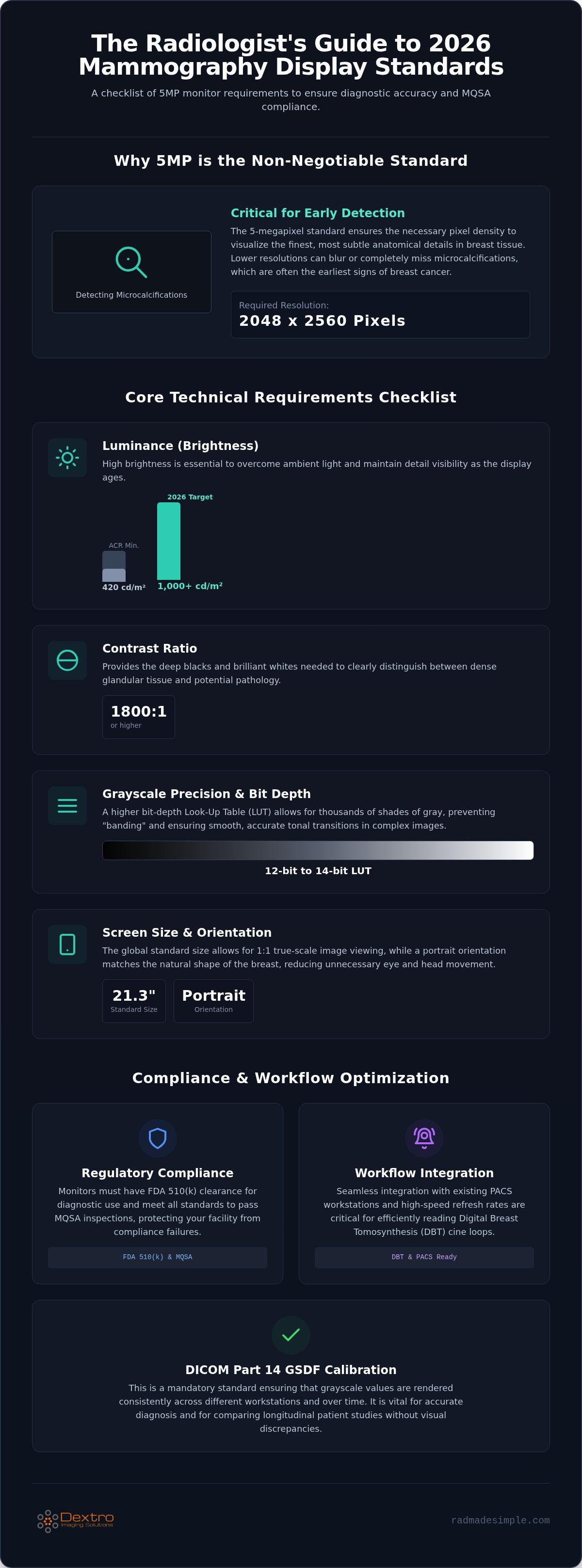
- Understand why the 2048 x 2560 pixel standard is essential for detecting subtle microcalcifications and maintaining visual acuity in portrait orientation.
- Identify the updated 2026 luminance targets of 1,000+ cd/m² and learn how high contrast ratios help distinguish glandular tissue from pathology.
- Master the critical 5MP mammography monitor requirements regarding FDA 510(k) clearance to protect your facility from failure during MQSA inspections.
- Optimize your clinical workflow for Digital Breast Tomosynthesis (DBT) by integrating high-speed refresh rates with your existing PACS workstations.
- Evaluate the total cost of ownership for your diagnostic setup by comparing ambient light performance and long-term warranty protections for hospital and home office environments.
Why 5MP is the Non-Negotiable Standard for Mammography
Diagnostic accuracy in breast imaging hinges on identifying the smallest anatomical anomalies. For years, 5-megapixel (5MP) displays have served as the industry benchmark; in 2026, they're the absolute baseline for compliance. While a 3MP monitor suffices for general radiology tasks like CT or MRI interpretation, it lacks the pixel density required to render the fine, granular details of breast tissue. Meeting 5MP mammography monitor requirements ensures that radiologists can visualize microcalcifications that might otherwise be blurred or lost on lower-resolution screens. This level of detail is critical for the early detection of breast cancer, where every pixel contributes to a potentially life-saving diagnosis.
The Clinical Necessity of High Pixel Density
Pixel density is about more than just a high number. It's about the relationship between resolution and physical screen size, known as pixel pitch. A 5MP resolution is defined as the 2048 x 2560 pixel standard for diagnostic breast imaging. Unlike consumer-grade 4K monitors, which often prioritize refresh rates or color vibrancy, Jusha diagnostic monitors focus on grayscale precision and luminance uniformity. Consumer displays frequently use sub-pixel layouts that can distort the sharp edges of a microcalcification. Medical-grade 5MP displays eliminate these artifacts, providing the high-performance clarity needed for intensive workloads.
Screen Size and Aspect Ratio Requirements
The 21.3-inch screen size has become the global standard for a reason. This dimension allows for 1:1 image viewing, ensuring the radiologist sees the anatomy at its true scale without digital zooming that could introduce interpolation errors. Most hanging protocols for mammography favor a portrait orientation to match the natural shape of the breast and the detector. Using a Dextro reading station to mount these monitors in a dual-head configuration creates a seamless viewing field, especially when using modern displays with bezels as thin as 7.5 mm. Adhering to these 5MP mammography monitor requirements reduces unnecessary eye movement and head tilting, which are primary drivers of radiologist fatigue. By optimizing the aspect ratio and physical layout, facilities can improve both diagnostic speed and accuracy.
Core Technical Requirements for 5MP Breast Imaging Displays
Modern breast imaging requires a display that maintains peak performance over a rigorous five-year lifecycle. While resolution sets the stage, the underlying technical architecture determines whether a radiologist can consistently distinguish between benign tissue and early-stage pathology. Meeting 5MP mammography monitor requirements in 2026 involves a specific synergy of luminance, contrast, and grayscale precision. These specs ensure the monitor doesn't just display an image, but renders it with the fidelity required for high-stakes clinical decisions.
Maximum Luminance and DICOM Calibration
High luminance is no longer just a luxury; it's a prerequisite for diagnostic confidence. In 2026, the target for maximum calibrated luminance is 1,000 cd/m² or higher. This intensity ensures that even as the backlight ages, the display remains well above the ACR-recommended minimums. High brightness also helps overcome ambient light interference in the reading room, maintaining the visibility of subtle details. All diagnostic displays must adhere to the technical standards for soft-copy displays defined by DICOM Part 14 GSDF. This standard ensures that grayscale values are rendered linearly and consistently across different workstations, which is vital for longitudinal patient studies.
Contrast and Grayscale Rendering
Contrast and grayscale depth provide the necessary clarity to identify architectural distortions. Modern Jusha diagnostic monitors now achieve contrast ratios of 1800:1, providing the deep blacks and brilliant highlights essential for dense breast tissue. This range is supported by a transition from traditional 10-bit processing to 12-bit or 14-bit internal Look-Up Tables (LUTs). Higher bit depth allows the monitor to select from a palette of thousands of gray shades, preventing "contouring" or "banding" in complex images. Sub-pixel driving technology further enhances this by increasing the effective resolution of grayscale transitions.
Uniformity correction technology is equally essential to eliminate "hot spots" or dim corners that could mimic pathology. Digital Uniformity Equalizer functions calculate and adjust luminance across the entire panel surface to ensure consistency. To maintain these 5MP mammography monitor requirements without manual intervention, advanced displays include integrated front sensors. These sensors perform real-time calibration checks, automatically adjusting the backlight to compensate for environmental shifts. For facilities looking to streamline these technical safeguards, exploring integrated PACS solutions can simplify the management of entire monitor fleets across multiple locations.
Regulatory Compliance: MQSA and FDA Standards
Compliance in breast imaging is a matter of legal protection as much as it is a matter of diagnostic quality. The FDA classifies mammography displays as Class II medical devices, requiring specific 510(k) clearance for both traditional mammography and Digital Breast Tomosynthesis (DBT). Meeting 5MP mammography monitor requirements means verifying that your hardware is legally cleared for these specific modalities. Using a "diagnostic-grade" monitor that lacks this dedicated clearance creates a significant liability during MQSA inspections and can jeopardize your facility's ACR accreditation.
FDA Class II Medical Device Status
Manufacturers must provide documentation that their monitors meet rigorous safety and effectiveness standards. This includes specific labeling that confirms the device is intended for the interpretation of mammograms. If a display is only cleared for general radiology, it cannot be used for primary breast imaging interpretation, regardless of its resolution or luminance. For a broader look at maintaining these standards across your entire facility, consult our 2026 Radiology Equipment Compliance Checklist. This ensures your procurement strategy aligns with the latest FDA "Final Rule" updates that became effective on September 10, 2024.
Calibration and Quality Assurance Protocols
The Mammography Quality Standards Act (MQSA) requires strict adherence to quality control (QC) procedures. Facilities must follow the specific QC schedule provided by the monitor manufacturer, which typically includes the following milestones:
- Daily QC: Automated visual checks and internal sensor verifications to ensure the display hasn't drifted from its calibrated state.
- Monthly/Quarterly QC: More intensive testing, often involving external photometer measurements to verify luminance uniformity and contrast response.
- Annual Testing: A comprehensive review by a medical physicist to ensure the entire imaging chain remains compliant.
Modern Jusha diagnostic monitors simplify this burden by integrating automated QA software. These tools perform background checks without interrupting the radiologist's workflow, automatically logging results for state auditors. This proactive approach removes the complexity of manual record-keeping. It ensures that when an inspector asks for your logs, you have a complete, digital history of compliance ready for review. By automating these 5MP mammography monitor requirements, you protect your facility from human error and focus your resources on patient outcomes.
Workflow Optimization: DBT and PACS Integration
The shift toward Digital Breast Tomosynthesis (DBT) has fundamentally changed the demands on diagnostic displays. Reading 3D studies involves scrolling through hundreds of slices. This requires high-frame-rate stability to prevent ghosting. It's about speed. Meeting 5MP mammography monitor requirements in this context isn't just about static resolution; it's about how the monitor handles rapid cine loops. If the display has a slow response time, the fine details of a lesion can blur during navigation, leading to missed findings or increased reading time.
Tomosynthesis (3D Mammography) Performance
Effective DBT interpretation requires a display that can maintain sharp edges during movement. Using 5MP as the minimum standard ensures that each slice is rendered with the necessary pixel density to reveal architectural distortions. Many facilities are integrating Jusha medical monitors for high-frame-rate stability. By adhering to these 5MP mammography monitor requirements, facilities can ensure their hardware keeps pace with software advancements. This stability is crucial for maintaining diagnostic speed without sacrificing accuracy.
Beyond the panel itself, the graphics card plays a vital role in 5MP rendering. A standard card cannot handle the high-bandwidth data required for dual-head 5MP setups or large-format 10MP displays. You need specialized medical-grade graphics cards that support 10-bit or 12-bit grayscale output. This hardware synergy ensures that your PACS Harmony software communicates perfectly with the display, preventing lag or interface glitches that disrupt focus. You're effectively building a cockpit where every component is optimized for precision.
Ergonomics and Radiologist Efficiency
Efficiency is deeply tied to comfort. Long reading sessions often lead to eye strain and physical fatigue. Modern displays address this with advanced blue light filtering and anti-glare coatings that don't compromise grayscale accuracy. While dual-head 5MP configurations remain the standard, some facilities are moving toward single large-format 10MP or 12MP monitors. These fusion displays eliminate the center bezel, providing a more flexible workspace for multi-modality reading. This setup reduces unnecessary neck strain and improves focus on the image.
Radiologists can now view Ultrasound, MRI, and Mammography images on a single screen without switching workstations. Features like Focus Mode allow the user to temporarily increase luminance in a specific region of interest. This makes subtle calcifications pop against a darker background, streamlining the interpretation process. If you want to modernize your reading room and improve throughput, explore our high-performance reading stations for an optimized, ergonomic environment.
Selection Guide: Choosing the Right 5MP Mammography Setup
Selecting the ideal workstation depends on your specific clinical environment and workload volume. In a high-traffic hospital setting, ambient light often fluctuates, requiring monitors with superior luminance to maintain consistent contrast. Home offices for teleradiology allow for more controlled lighting, yet they still require hardware that meets strict 5MP mammography monitor requirements to ensure diagnostic parity with the main campus. Choosing Jusha diagnostic monitors provides a high-performance, cost-effective alternative to legacy brands, ensuring you don't compromise on FDA-cleared precision while managing your budget effectively.
Monochrome vs. Color 5MP Monitors
While monochrome displays have long dominated the field of breast imaging, the industry is shifting toward high-luminance color 5MP monitors. This transition supports modern multi-modality workflows where radiologists must view color Doppler ultrasound or PET/CT fusion alongside standard mammography. Modern color panels now match the luminance and grayscale stability of their monochrome counterparts. This makes them a versatile choice for facilities looking to future-proof their reading rooms. If your workflow involves more than just grayscale interpretation, the flexibility of a color 5MP display is a significant advantage.
Remote Reading and Portable Requirements
Teleradiology is a standard component of the modern radiology workflow. Maintaining compliance in a home office requires the same technical rigor as a hospital workstation. Dextro Reading Stations provide a turnkey solution that integrates these high-end displays into an ergonomic, pre-configured environment. For radiologists who require mobility, Portable Radiology Workstations must still adhere to diagnostic-grade 5MP mammography monitor requirements. Secure connectivity and remote DICOM calibration tools are essential to ensure that every study interpreted at home meets the same MQSA standards as those interpreted on-site.
Evaluating the five-year total cost of ownership is a critical step in the procurement process. You should look beyond the initial purchase price and assess the longevity of the backlight and the strength of the warranty. Dextro Imaging Solutions offers integrated reading stations that remove the complexity of piecemeal setups. This holistic approach ensures that your monitors, specialized graphics cards, and furniture work in perfect synergy. Reliable technical support and proactive maintenance contracts are the final pieces of the puzzle. They safeguard your uptime and ensure your facility remains audit-ready at all times.
Future-Proofing Your Diagnostic Breast Imaging Workflow
Adhering to 5MP mammography monitor requirements is no longer just a technical hurdle. It's a strategic necessity for any facility committed to diagnostic excellence and MQSA compliance. We've explored how high-performance luminance, automated calibration, and seamless PACS integration create a secure environment for radiologists. These standards protect your facility from audit failures while ensuring that every microcalcification is rendered with absolute clarity. By selecting hardware that prioritizes both regulatory rigor and ergonomic comfort, you remove the complexity of modern breast imaging.
You deserve a workstation that works as hard as you do, providing the reliability needed for high-stakes interpretations. Don't let outdated hardware compromise your clinical accuracy or your next inspection. Upgrade your facility with FDA-cleared 5MP Jusha Diagnostic Monitors. Our displays are FDA 510(k) cleared for mammography and feature integrated DICOM calibration sensors to ensure long-term precision. Our team also provides expert technical support to assist with your MQSA audit preparation. Take the next step toward a more efficient, compliant, and accurate diagnostic future today.
Frequently Asked Questions
Can I use a 4K consumer monitor for mammography if the resolution is high enough?
No, you cannot use consumer monitors for primary interpretation. These displays lack the FDA 510(k) clearance required for mammography and tomosynthesis. They don't provide the necessary luminance stability or DICOM Part 14 calibration needed for diagnostic accuracy. Using a non-medical monitor violates MQSA standards and increases your liability. Medical-grade displays use specialized backlight technology to maintain brightness over a five-year lifecycle, which consumer screens can't achieve.
What is the difference between a 5MP radiology monitor and a 5MP mammography monitor?
The primary difference involves FDA clearance and specific luminance benchmarks. While many 5MP monitors work for general radiology, a mammography-specific display must have explicit FDA 510(k) clearance for breast imaging. These monitors also require higher calibrated luminance levels. They typically target 420 cd/m² as a minimum, but modern units often reach 1,000+ cd/m² to ensure the visibility of subtle microcalcifications in dense tissue.
How often do mammography monitors need to be calibrated to stay MQSA compliant?
You must follow the specific quality control schedule provided by your monitor manufacturer. Most 5MP mammography monitor requirements involve daily automated visual checks and internal sensor verifications to detect luminance drift. More intensive monthly or quarterly calibrations are usually required using an external photometer. Additionally, an annual review by a medical physicist is a standard MQSA requirement to verify the entire imaging chain's performance and compliance.
Is a dual 5MP setup better than a single 10MP or 12MP monitor?
This choice depends on your workflow and ergonomic preferences. A dual 5MP setup is the traditional standard, providing a clear physical separation between images in a hanging protocol. Conversely, a single 10MP or 12MP fusion display eliminates the center bezel for a more flexible workspace. Both configurations meet compliance standards as long as they maintain the required pixel density, luminance uniformity, and DICOM calibration across the entire surface.
Do I need a specific graphics card to run a 5MP mammography display?
Yes, you need a medical-grade graphics card capable of supporting high-bandwidth data and 10-bit or 12-bit grayscale output. Standard consumer cards lack the processing power to render 5MP resolution across multiple heads without significant lag. Specialized cards ensure that your PACS Harmony software communicates perfectly with the display. This prevents interface glitches or artifacts that could interfere with your diagnostic interpretation during intensive reading sessions.
What luminance level is required for Digital Breast Tomosynthesis (DBT)?
The ACR recommends a calibrated maximum luminance of at least 420 cd/m² for all mammography interpretation, including DBT. However, modern 5MP mammography monitor requirements in 2026 often target 1,000+ cd/m² to provide a buffer for backlight aging. High luminance is especially critical for tomosynthesis. It ensures that fine architectural distortions remain visible while you scroll through hundreds of dense 3D image slices at high speeds.
Are color monitors as accurate as monochrome monitors for breast imaging?
Modern high-luminance color monitors are now just as accurate as monochrome displays. They utilize advanced sub-pixel driving technology to achieve identical grayscale precision and contrast ratios. This allows radiologists to view color Doppler ultrasound or PET/CT fusion studies on the same screen as their mammograms. It creates a more efficient multi-modality workflow without sacrificing diagnostic quality or failing to meet strict medical imaging standards.
Can I read mammography studies on a portable diagnostic workstation?
You can read these studies remotely if the portable unit meets all diagnostic-grade compliance standards. Portable Radiology Workstations must feature FDA-cleared 5MP displays and maintain strict DICOM calibration to be legally compliant. These units are specifically designed for teleradiology and home office environments. They ensure that radiologists have the same level of precision, security, and performance at home as they do in a traditional hospital reading room.


