

How many different passwords did you enter before you could read your first study today? For many radiologists, the morning begins with a frustrating cycle of login fatigue, switching between three or more PACS interfaces just to piece together a patient's clinical history. It's a fragmented reality that drains productivity and introduces manual data reconciliation errors that your team simply can't afford. You know that providing high-quality care requires more than just access to data; it requires a workflow that doesn't fight against you.
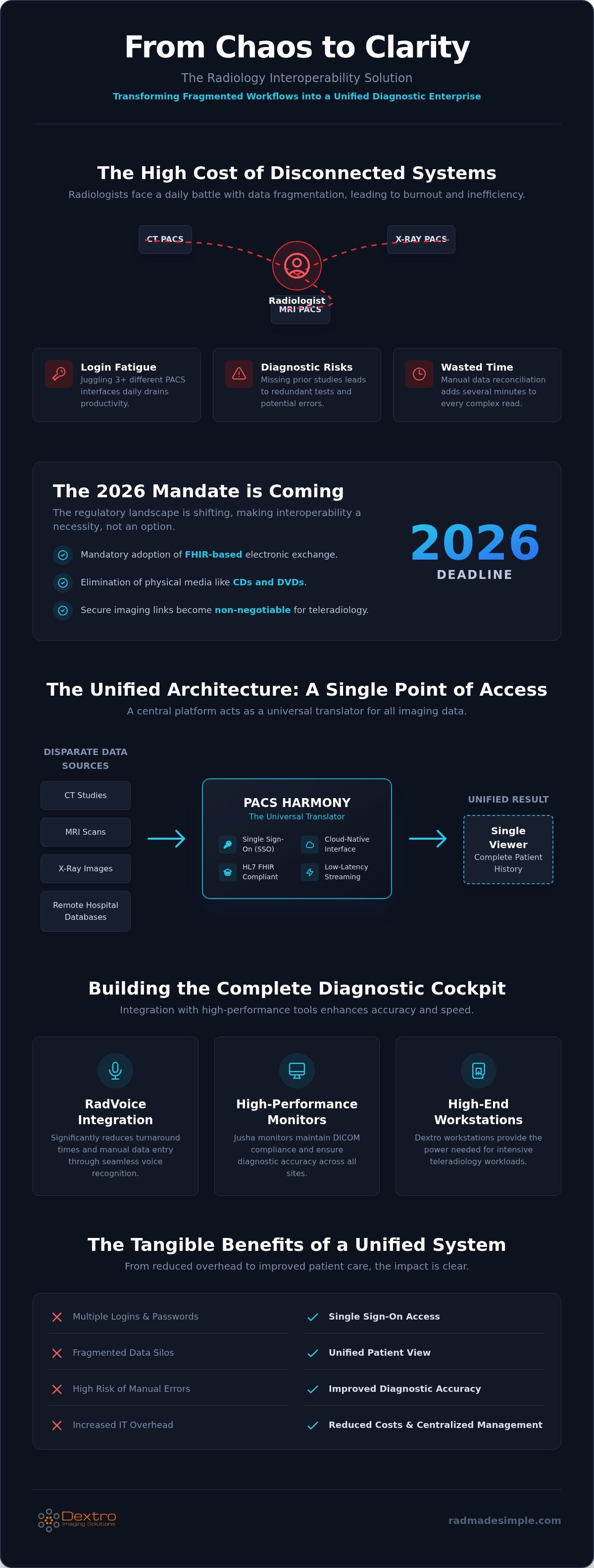
Achieving true radiology imaging interoperability is no longer a luxury, especially as the ONC moves toward mandatory FHIR-based electronic exchange standards in 2026. This article demonstrates how a unified multi-PACS integration solution, such as PACS Harmony, eliminates data silos to create a single point of access for all patient studies. We'll explore how integrating these systems with RadVoice and high-end Jusha monitors streamlines your diagnostic process, improves accuracy, and finally puts an end to the workstation shuffle. Discover how to transform your high-volume imaging center into a modern, integrated enterprise.
Key Takeaways
- Learn why traditional siloed systems fail and how modern radiology imaging interoperability standards are evolving to support enterprise-wide data exchange.
- Discover how PACS Harmony acts as a universal translator, unifying disparate imaging interfaces into a single, cloud-native view for radiologists.
- Understand the role of high-performance hardware, like Jusha monitors and Dextro workstations, in maintaining DICOM compliance and diagnostic accuracy across multiple sites.
- Explore how integrating voice recognition tools like RadVoice with a unified PACS interface significantly reduces turnaround times and manual data entry.
- Gain a clear roadmap for transitioning to a centralized management model that reduces IT overhead and eliminates the burden of multiple system logins.
The Interoperability Crisis in Modern Radiology
In 2026, radiology imaging interoperability has evolved from a technical goal into a clinical necessity. It's no longer just about moving a file from point A to point B. True interoperability means the seamless access, exchange, and use of imaging data across disparate systems and organizational boundaries. Without this, radiologists find themselves trapped in a cycle of manual data retrieval that slows down the entire care continuum.
Many centers still struggle with the "Silo Effect." This occurs when CT studies live in one PACS, MRI in another, and X-rays in a third because of legacy vendor choices or multi-site acquisitions. This fragmentation forces you to act as a manual data integrator. It's a primary driver of radiologist burnout. When you click through multiple windows to find a prior study, you lose the clinical context needed for a precise diagnosis. Fragmented data increases the risk of diagnostic errors and creates unnecessary friction in high-pressure environments.
Standard protocols like Digital Imaging and Communications in Medicine (DICOM) and HL7 provide a common language, but they don't solve the orchestration problem. They're the building blocks, not the finished structure. Relying on these standards alone isn't enough to achieve true radiology imaging interoperability. You need a layer that unifies these streams into a single, coherent diagnostic workflow.
The Cost of Fragmented Data
Every minute spent switching between viewing software is a minute lost from patient care. Industry professionals report that manual data reconciliation can add several minutes to every complex read. These delays compound across a 50-study shift. Missing a prior study because it's "locked" in a different system can lead to redundant testing or missed findings. This inefficiency also impacts your budget. Over time, fragmented architectures drive up radiology PACS pricing through increased IT maintenance, lost productivity, and the hidden costs of managing redundant storage silos.
Regulatory Pressures for Interoperability
The regulatory landscape shifted significantly in early 2026. The ONC released the Draft USCDI v7 in January 2026, emphasizing robust electronic exchange. Federal mandates now push for the elimination of physical media like CDs and DVDs in favor of secure imaging links. For teleradiology groups, this isn't optional. You need an integration strategy that works across diverse networks. While Vendor Neutral Archives (VNA) help centralize storage, they often lack the performance required for intensive teleradiology workloads. A modern strategy must pair centralized data with high-performance workstations to ensure diagnostic excellence at every site.
Decoding the Multi-PACS Integration Solution Architecture
Moving away from legacy, siloed systems requires a shift toward unified, cloud-native interfaces. This transition aligns with the global effort toward standards that simplify data accessibility across the healthcare enterprise. PACS Harmony serves as the universal translator in this modern architecture. It bridges the gap between disparate imaging data sources, ensuring that a radiologist sees a consistent view regardless of where the study originated. This platform leverages the latest 2026 HL7 FHIR implementation protocols to ensure that metadata and imaging links flow securely between certified health IT systems.
Low-latency streaming is the heartbeat of this integration. High-volume centers can't wait for massive DICOM sets to download from remote servers. Modern solutions stream pixels in real-time, allowing for immediate interpretation even on standard networks. Integrating voice recognition tools like RadVoice directly into this unified viewer eliminates the need to toggle between windows, which directly solves the cognitive load issues that lead to fatigue.
Software Layers: From VNA to Unified Viewers
A true multi-PACS solution offers a Single Sign-On (SSO) advantage that transforms the daily routine. Radiologists log in once to access every connected system, from local archives to remote hospital databases. Solutions like aycan PACS manage this scalable storage across multiple facilities, acting as a central hub for data lifecycle management. By centralizing access, aycan PACS helps facilities meet 2026 regulatory goals of moving away from physical media like CDs in favor of secure electronic exchange. To further optimize speed, AI-assisted pre-fetching analyzes the daily worklist and retrieves relevant priors before the radiologist even opens the case. This proactive approach ensures that radiology imaging interoperability serves the user rather than creating new technical hurdles.
Hardware Essentials: The Teleradiology Backbone
Software alone can't achieve total efficiency; the physical environment must match the digital capabilities. Modern radiology reading workstations must be engineered to handle these multi-source data streams without lag or display artifacts. High-bandwidth connectivity is equally critical for portable radiology workstations, allowing specialists to maintain productivity from any location without sacrificing image quality. Diagnostic Interoperability is the ability to render images from any source with 100% fidelity. If you want to streamline your current environment, you can explore integrated workstation options that support these advanced radiology imaging interoperability workflows.
Case Study: Transforming a Multi-Site Imaging Center Workflow
A regional 5-site imaging group recently faced a significant operational hurdle: managing studies across three different PACS vendors. This fragmented environment forced radiologists to switch between incompatible interfaces several times an hour. The lack of radiology imaging interoperability meant that comparing priors required manual data entry and slow DICOM transfers. Efficiency suffered, and the risk of diagnostic fatigue grew. They needed a unified solution that could scale across their enterprise without replacing their existing modalities.
The solution centered on implementing a unified PACS Harmony interface. By acting as a single point of access, it allowed the group to consolidate their disparate data streams into one diagnostic view. To support this software layer, they deployed high-performance Dextro reading stations equipped with Jusha diagnostic monitors. The results were immediate. Report turnaround times dropped by 25%, and referring physicians reported higher satisfaction due to the increased speed and accuracy of the results.
Phase 1: Auditing the Existing Infrastructure
The project began with a comprehensive audit of the group's technical landscape. The Dextro team identified critical bottlenecks in DICOM routing that caused significant delays during peak hours. Many radiologists were also using legacy monitors at home-reading sites that failed to meet current DICOM Part 14 standards. The evaluation included assessing enterprise-wide voice recognition needs to ensure that reporting could be as streamlined as the image viewing itself. This phase ensured that every software and hardware gap was mapped before the transition began.
Phase 2: Seamless Deployment and Integration
Deployment focused on speed and reliability. The Dextro team integrated aycan PACS with the existing infrastructure, ensuring minimal downtime for the 5-site group. A key part of the process involved calibrating Jusha medical monitors to ensure enterprise-wide consistency. Whether a radiologist was on-site or working from a home office, the image quality remained identical. Finally, the staff received training on the new unified reporting workflow, moving from three disparate systems to one cohesive environment. This transition proved that achieving radiology imaging interoperability is a manageable goal when software and hardware are deployed in synergy.
Selection Criteria for Enterprise Interoperability Solutions
Selecting an enterprise solution for radiology imaging interoperability involves more than checking a feature list. It's a strategic investment in your facility's operational resilience. To ensure long-term success, your platform must maintain strict compatibility with legacy DICOM Part 10 and 14 standards while offering a path toward modern FHIR-based exchange. This dual approach protects your current hardware investments while preparing the organization for the 2026 regulatory shift toward electronic imaging links.
Scalability is a non-negotiable requirement. Cloud-native archival systems offer the flexibility to expand storage as your volume grows without requiring massive on-site server upgrades. Reliability is equally vital. Ensure your vendor provides 24/7 technical support and comprehensive maintenance contracts. In a high-volume environment, even an hour of downtime can lead to a backlog that takes days to clear. A partner that acts as a simplifier will manage these technical complexities so you can focus on diagnostic output.
Evaluating Software Performance
A high-performing interface should offer seamless multi-modality viewing. This includes specialized support for Mammography alongside standard CT and MRI studies. Modern workflows also demand the ability to handle non-DICOM clinical images, such as clinical photos or scanned documents, to provide a complete patient record. Look for systems that allow radiologists to create custom hanging protocols. This personalization reduces the time spent manually arranging images. Testing the interface for user-friendly navigation is essential to ensure it supports, rather than hinders, your team's natural rhythm. Systems that integrate advanced voice recognition and auto-reporting directly into the viewer provide the most significant productivity gains.
Hardware Compliance and Ergonomics
Hardware choice directly impacts diagnostic accuracy and radiology imaging interoperability. Jusha diagnostic displays are a professional standard because they meet rigorous luminance and resolution specifications. These monitors ensure that subtle findings aren't lost due to poor display quality. For those working outside the main hospital, portable radiology workstations must possess medical-grade GPU power to render complex 3D reconstructions without lag. 2026 compliance requires automated calibration tracking for all remote monitors to guarantee consistent image quality across the entire network. If you're ready to upgrade your facility's infrastructure, you can request a consultation for an integrated interoperability solution today.
Implementing PACS Harmony for Seamless Diagnostic Excellence
Transitioning to a unified radiology imaging interoperability model requires a methodical roadmap. It's not just a software swap; it's a strategic realignment of your facility's workflow. By implementing PACS Harmony, you move away from the "Silo Effect" described earlier and toward a centralized management structure. This shift significantly reduces IT overhead. Your technical team no longer needs to manage multiple vendor updates or troubleshoot incompatible routing rules across five different sites. Instead, they oversee a single, robust integration layer that communicates across the entire enterprise.
Dextro Imaging Solutions acts as the simplifier in this high-stakes environment. We understand that your radiologists can't afford downtime or interface lag. Our role is to manage the technical complexity of multi-PACS integration so your team can focus on what matters most: diagnostic precision. This partnership ensures that your facility meets the 2026 HL7 FHIR implementation standards, keeping you ahead of federal mandates for electronic imaging exchange.
Next Steps for Radiology Directors
The first step toward modernization is scheduling a comprehensive workflow audit with a Dextro specialist. This audit identifies the specific bottlenecks in your current DICOM routing and archival processes. It's also the ideal time to compare the Total Cost of Ownership (TCO) of your current fragmented systems against a unified model. Fragmented architectures often hide costs in lost productivity, redundant licensing fees, and increased IT support hours. Consolidating these into a single integration tool like PACS Harmony provides a clearer, more efficient budget. Finally, review your technical support options. Dextro provides 24/7 maintenance contracts that protect your teleradiology networks from unexpected interruptions.
Final Checklist: Are you ready for a multi-PACS integration solution?
- Does your current system support 2026 HL7 FHIR electronic exchange standards?
- Can your radiologists access all patient studies through a single, secure login?
- Are your diagnostic monitors calibrated for enterprise-wide consistency?
- Is your voice recognition tool, like RadVoice, integrated directly into your primary viewer?
The Future of Interoperable Imaging
The role of AI and machine learning will define radiology imaging interoperability in late 2026. These technologies will automate the pre-fetching of priors and optimize hanging protocols based on the specific radiologist's habits. RadVoice and PACS Harmony are already evolving to support the next generation of holographic and 3D imaging. This ensures your facility remains a leader in the field as diagnostic tools become more sophisticated. It's time to eliminate the complexity of legacy systems and embrace a streamlined, future-proof workflow.
Modernizing Your Enterprise Imaging Strategy
The path toward true radiology imaging interoperability requires a shift from managing multiple logins to mastering a single, unified interface. It's about moving beyond legacy data silos to create a diagnostic environment that empowers your radiologists rather than fatiguing them. By centralizing your workflow through PACS Harmony, you ensure your facility stays ahead of 2026 federal exchange mandates while significantly reducing IT overhead. Success in high-volume imaging depends on the synergy between advanced software and precision hardware.
Expert software integration support makes the transition seamless, allowing your team to focus on patient outcomes. Pairing this integration with DICOM Part 14 compliant hardware and high-end displays ensures that every read is performed with 100% fidelity. As an authorized Jusha medical monitor distributor, we provide the tools necessary to maintain clinical excellence across your entire network. It's time to leave fragmented workflows behind and embrace a future of streamlined efficiency. Streamline Your Workflow with Dextro’s PACS Harmony and take the first step toward a more productive, integrated enterprise.
Frequently Asked Questions
What is the difference between a VNA and a multi-PACS integration solution?
A VNA (Vendor Neutral Archive) focuses on consolidating long-term storage into a single repository, whereas a multi-PACS integration solution like PACS Harmony unifies the user interface and diagnostic workflow. While a VNA manages the data layer, the integration solution addresses the immediate needs of the radiologist. It provides a single point of access to disparate systems, ensuring that radiology imaging interoperability translates into a more efficient daily routine rather than just a backend storage fix.
Can PACS Harmony integrate with my existing voice recognition software?
Yes, PACS Harmony is designed to integrate seamlessly with leading voice recognition platforms, including our specialized RadVoice solution. This integration allows you to dictate reports directly into the unified viewer, eliminating the need to toggle between different software windows. By centralizing both your visual and narrative workflows, you reduce the manual data entry errors that often plague fragmented systems. This synergy is essential for maintaining high diagnostic throughput in busy imaging environments.
Do I need to replace my current monitors to achieve full interoperability?
You don't always need to replace your existing hardware, but achieving true radiology imaging interoperability requires consistent display quality across all reading sites. If your current monitors don't meet DICOM Part 14 standards, they may create inconsistencies in image rendering. Upgrading to Jusha diagnostic monitors ensures that every radiologist sees the same high-fidelity image. This level of uniformity is critical for enterprise-wide accuracy and meeting 2026 regulatory calibration tracking requirements.
How does teleradiology impact imaging interoperability requirements?
Teleradiology significantly increases the complexity of interoperability because it requires secure, high-speed access to images stored on multiple external networks. A robust integration strategy ensures that remote radiologists can stream large studies without waiting for full DICOM downloads. This setup supports a longitudinal patient record by pulling relevant priors from various facilities into one view. Without a unified integration layer, teleradiology workflows often suffer from significant delays and manual reconciliation hurdles.
Is aycan PACS compatible with both Mac and Windows workstations?
Yes, aycan PACS is a cross-platform solution that maintains full functionality on both Mac and Windows workstations. This flexibility allows your facility to leverage existing hardware while still benefiting from advanced diagnostic tools. Whether your team prefers the ergonomics of a specific OS or needs to integrate with diverse hospital IT environments, aycan PACS provides a consistent user experience. This compatibility ensures that your integration strategy doesn't force a costly hardware overhaul.
What are the security implications of a unified PACS interface?
A unified interface improves your security posture by centralizing access control and reducing the number of individual system logins. Instead of managing multiple passwords across disparate PACS, your team uses a secure Single Sign-On (SSO) environment. This approach aligns with 2026 ONC standards for health information exchange, ensuring that data remains encrypted and audited. Centralized management also makes it easier for IT teams to deploy security patches across the entire imaging enterprise simultaneously.
How much downtime should we expect during a system integration?
Most facilities experience minimal downtime because our integration solutions function as a sophisticated software layer over your existing infrastructure. We typically employ a phased deployment strategy that allows your team to continue reading studies while the systems are linked. Our technical specialists coordinate the transition to ensure that DICOM routing and database synchronization happen in the background. This methodical approach protects your facility's revenue cycle while modernizing your clinical workflow.
Does Dextro provide maintenance for Jusha monitors after installation?
Dextro provides comprehensive maintenance and technical support contracts for all Jusha monitors we distribute. These service agreements include regular calibration checks to ensure continued DICOM Part 14 compliance and peak performance. Our support team is available to troubleshoot hardware issues remotely or on-site, providing the reliability required for high-stakes medical environments. This ongoing partnership ensures that your investment in high-performance hardware remains protected and functionally optimized for years to come.


