

More cases per shift don’t automatically mean better radiologist productivity. To improve it, make workflow friction, workload, case complexity, and modality mix visible, then track 4–6 core radiology productivity metrics consistently. This gives department leaders a clearer way to identify where time is going and which changes may help.
Productivity is difficult to assess when a complex study and a routine exam count the same, or when a slow handoff is mistaken for slow reading. This article explains how to improve radiologist productivity by interpreting metrics, streamlining image review, reporting, dictation, and communication, and accounting for workload differences. It also shows how benchmarking can guide practical decisions without reducing performance to a single case count.
Key Takeaways
- Use concise, consistent reports that prioritize clinically relevant findings to support clear communication.
- Review each step from image access through dictation and handoff to pinpoint workflow delays.
- Interpret case volume alongside complexity and modality mix for a more balanced view of workload.
- Choose a small, consistent set of productivity measures to guide benchmarking and targeted improvements.
1. What Are Radiology Productivity Metrics?
Radiology productivity metrics show how reading effort, reporting time, and report quality interact. Case counts alone can hide differences between routine imaging and complex examinations. Track turnaround time alongside completed studies, and interpret both in context of modality and case mix. This gives hospital leaders a more useful picture than raw volume alone.
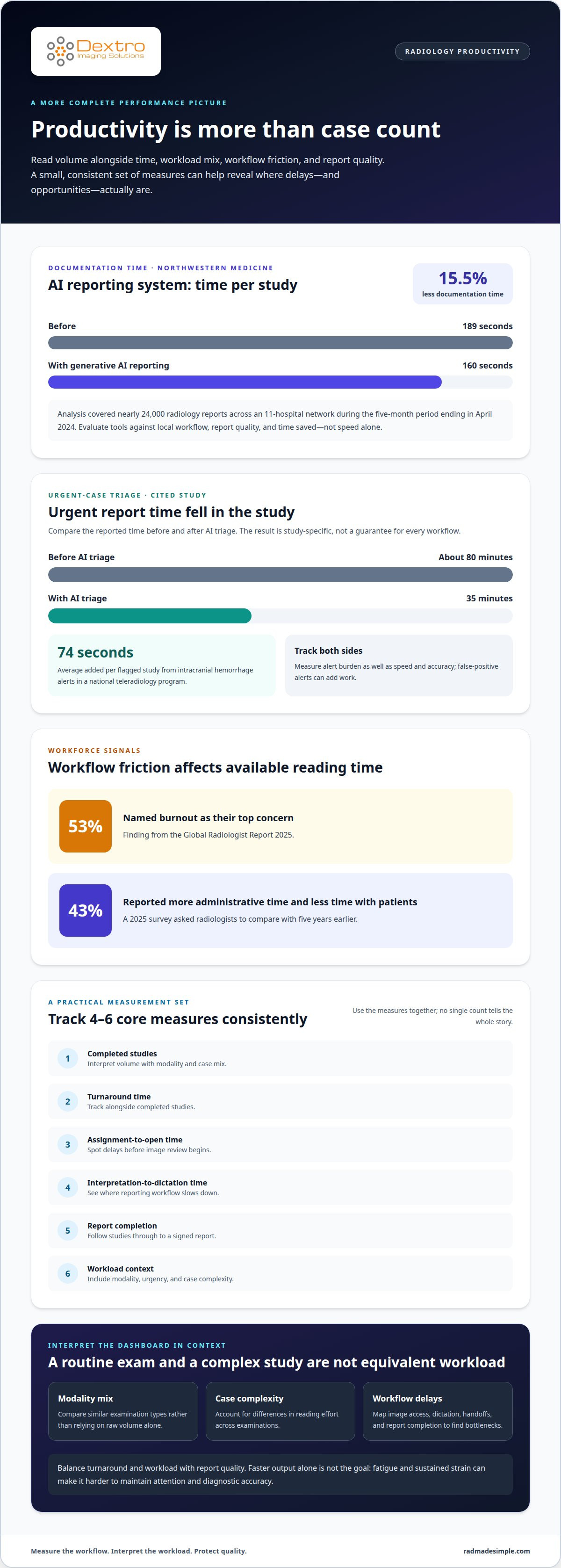
Radiologists also identify workload pressure as a productivity concern. The Global Radiologist Report 2025 found that 53% named burnout as their top concern. Long administrative tasks, interruptions, and demanding worklists can reduce time available for interpretation and reporting. To understand local barriers, map the reporting process and record where delays occur, such as image access, dictation, or report completion.
Concise reports can be easier to read without sacrificing relevant clinical information. Prioritize key observations, use clear language, and remove remarks that don’t help answer the clinical question. Smart templates can standardize structure and bring in relevant details from other sources or prior imaging reports. This can reduce repetitive documentation while keeping findings and impressions clear.
AI-enabled reporting tools may also affect documentation time. At Northwestern Medicine, a generative AI reporting system reduced documentation time by 15.5%, from 189 seconds to 160 seconds per study. The analysis covered nearly 24,000 radiology reports across an 11-hospital network during the five-month period ending in April 2024. Evaluate tools against local workflow, report quality, and time saved, rather than speed alone.
Tool costs depend on factors such as licensing, integration, training, and ongoing support. Estimate ROI by comparing these costs with measured time savings and reduced administrative effort, while monitoring report quality and turnaround time.
2. Workflow efficiency across image review, interpretation, dictation, and communication
Map each examination from worklist assignment to signed report. Record where time accumulates: opening images, switching applications, reviewing priors, dictating, or communicating urgent findings. In a 2025 survey, 43% of radiologists reported spending more time on administrative tasks and less time with patients than five years earlier. That shift makes administrative handoffs important workflow indicators, not background noise.
Standardize repeatable steps across imaging protocols, worklist priorities, and report routing. For example, define how urgent studies move ahead of routine examinations, who receives critical-result communications, and how incomplete orders are resolved. Automated scheduling and administrative processes can reduce interruptions, while a shared dashboard can reveal stalled studies. Track assignment-to-open time, interpretation-to-dictation time, and report completion to pinpoint bottlenecks.
Diagnostic workstations support efficient reading when image display, interpretation, and dictation fit a consistent routine. PACS can use default display protocols tailored to user preferences and monitor configuration. Pair this with voice recognition and reporting tools that let radiologists dictate within the reporting workflow instead of repeatedly switching screens. Dextro Reading Stations and Jusha diagnostic monitors are options to consider for imaging environments.
Worklist optimization also depends on protected reading time and clear communication. Route urgent cases by clinical priority, keep routine queues visible, and assign ownership for studies awaiting clarification. Handle tasks that take two minutes or less immediately, such as a brief email or study protocoling, when doing so won’t interrupt interpretation. Review workflow metrics with technologists, IT, and administrative teams; each group can identify different sources of delay. Fewer avoidable interruptions can support patient satisfaction by helping teams communicate status and next steps consistently.
3. Radiologist workload, case complexity, and modality mix
Raw case volume can misrepresent workload when examinations vary in complexity. A routine radiograph and a multiphase CT require different reading effort, so compare similar modalities and account for case mix. Track studies by modality, urgency, and complexity alongside turnaround time. This helps identify whether delays reflect volume, demanding cases, or an uneven distribution across the reading team.
Worklist triage should prioritize clinical urgency, not simply arrival order. AI triage reduced urgent-case report times from about 80 minutes to 35 minutes in a cited study. Yet false-positive alerts can add work: in a national teleradiology program, intracranial hemorrhage alerts added an average of 74 seconds per flagged study. Measure alert burden as well as speed and accuracy.
During a surge, redistribute cases according to modality expertise and available capacity. For example, shift suitable routine studies away from a radiologist handling complex examinations, while keeping urgent findings visible for direct review. Teleradiology can provide round-the-clock coverage and specialist expertise, helping balance workloads across locations. Clear assignment and escalation rules prevent cases from becoming ownerless during handoffs.
Increasing volume by extending hours, reading faster, or taking fewer breaks carries real risks. Fatigue and burnout can build, and sustained strain can make it harder to maintain attention and diagnostic accuracy. Protect review time and breaks, then measure turnaround alongside workload and quality indicators rather than treating faster output as the only goal.
Review workload by comparing modality mix, case complexity, urgent-case volume, and individual capacity. Examine when backlogs form and whether they cluster around specific examination types or shifts. Reduce unnecessary clicks in image access and case assignment, but don’t remove review steps that support accuracy. Teleradiology is useful when local coverage or specialist capacity is constrained; it is less useful when handoffs and routing create new delays. Reassess the distribution as demand changes.
4. Radiology productivity metrics and benchmarking
Benchmarking gives leaders context for interpreting output, but no single metric captures every study’s clinical effort. Track 4–6 core measures consistently, such as studies completed, turnaround time, work relative value units (wRVUs), and quality indicators. Pair volume with modality and case complexity, so a demanding interpretation isn’t judged like a routine examination.
For United States practices, the cited national annual productivity benchmark is a median of around 10,500 wRVUs per year. Treat this as a comparison point, not a universal staffing or workload rule. Staffing needs depend on case mix, coverage demands, and workflow; a benchmark alone cannot prescribe an individual radiologist’s workload.
Make comparisons meaningful by using the same definitions and periods across teams. For example, separate turnaround time by modality and urgency, then compare similar study groups. The Imaging Performance Partnership benchmark report found a significant difference in CT report turnaround time between facilities at the 75th and 25th percentiles. That spread makes percentile comparisons useful for spotting variation, not for assuming every site has identical resources.
Interpret productivity measures alongside clinical quality and staff wellbeing. A rising study count may look favorable while delays, rework, or burnout increase. Review patterns over time, check whether interpretation quality and report completion remain stable, and investigate unusual changes by shift or modality. Use the findings to target workflow adjustments rather than pressure individuals to read faster. Consistent definitions also help leaders distinguish real operational effects from changes in case mix or reporting practices.
Set a baseline, review the same 4–6 measures at regular intervals, and document which workflow changes affect them. To put these benchmarks into practice, review your radiology productivity workflow.
Dextro Imaging Solutions
Dextro Imaging Solutions helps radiology teams address workflow needs with imaging technology, including PACS and reading stations. When bottlenecks involve the reading environment or image-management workflow, consider how Radcom Compact, Dextro Reading Stations, PACS Harmony, and aycan PACS fit your department’s requirements.
Start with the operational challenge you want to address, such as a cumbersome reading setup or a workflow that needs review. A clear understanding of the issue can guide a focused discussion about relevant solutions, without treating case volume as the only measure of productivity.
For a conversation about radiology workflow solutions, contact Dextro Imaging Solutions.
Make the Next Workflow Change Deliberate
Improving radiologist productivity is an ongoing operational discipline, not a one-time software decision. To improve radiologist productivity, choose one friction point that affects daily reading, then define what a better workflow should change. A focused starting point helps teams evaluate technology against real operational needs rather than adding tools without a clear purpose.
Dextro Imaging Solutions offers Radcom Compact, Dextro Reading Stations, and Jusha diagnostic monitors. These products can be part of a radiology environment designed around the team’s reading workflow. Identify which part of the setup needs attention, then discuss how relevant imaging technology may fit your priorities and existing processes.
Bring your workflow goals and the challenge you want to address to a conversation with the team. Contact Dextro Imaging Solutions to discuss a practical next step for your radiology environment. A clear, measured approach can help your team build a more manageable workflow over time.
Frequently Asked Questions
What Are Radiology Productivity Metrics?
Radiology productivity metrics assess workload, output, timeliness, and quality. A practical dashboard might pair completed studies with report turnaround and a quality measure, then separate results by modality or shift. This helps leaders see whether a change affects the whole service or a particular workflow. Interpret the measures together, since a higher case count alone doesn’t show whether work is balanced.
What are the most effective ways to improve radiologist productivity?
Start by identifying one recurring point of friction, such as repeated application switching or unclear case assignment. Assign an owner to address it, make a focused workflow change, and review the relevant operational measures afterward. For example, a team could standardize how studies move from assignment to reporting, then examine whether handoffs become more consistent without compromising clinical review.
How is radiologist productivity measured, such as RVUs per hour or reports per day?
Use a defined time period and consistent counting rules for measures such as wRVUs per hour or reports completed per day. Separate results by modality and account for complexity, since report counts don’t represent equal effort across different studies. Pair output measures with turnaround time and quality indicators. This makes comparisons more informative than treating one daily report target as suitable for every radiologist.
How can radiology workflow and scheduling reduce reporting turnaround times?
Scheduling can reduce avoidable queue delays by matching study availability and priority with reader capacity. For example, teams can assign urgent examinations directly to the appropriate worklist while reserving focused periods for routine interpretation. Clear responsibility for pending studies also prevents cases from sitting between shifts. Review turnaround by modality and time of day to identify where scheduling changes may help.
How can AI and automation improve radiologist productivity, and what evidence supports their use?
AI and automation can support repetitive tasks, triage, and reporting, while radiologists retain responsibility for interpretation. The MASAI trial found that AI-supported single reading reduced radiologist workload by 44.2% while remaining non-inferior to standard double reading. Assess tools using local measures of workload, clinical quality, and workflow fit; the trial result describes that setting, not a guaranteed outcome for every department.
How can radiology departments reduce interruptions, unnecessary imaging, and administrative burden?
Reduce interruptions by protecting reading periods, routing nonurgent messages through a defined channel, and clarifying who handles routine administrative requests. Address unnecessary imaging upstream through clear ordering criteria and communication between imaging teams and referring clinicians. For example, collect incomplete-order questions in one queue instead of sending repeated messages during interpretation. Review recurring interruptions and rework to find process changes that preserve clinical oversight.


