

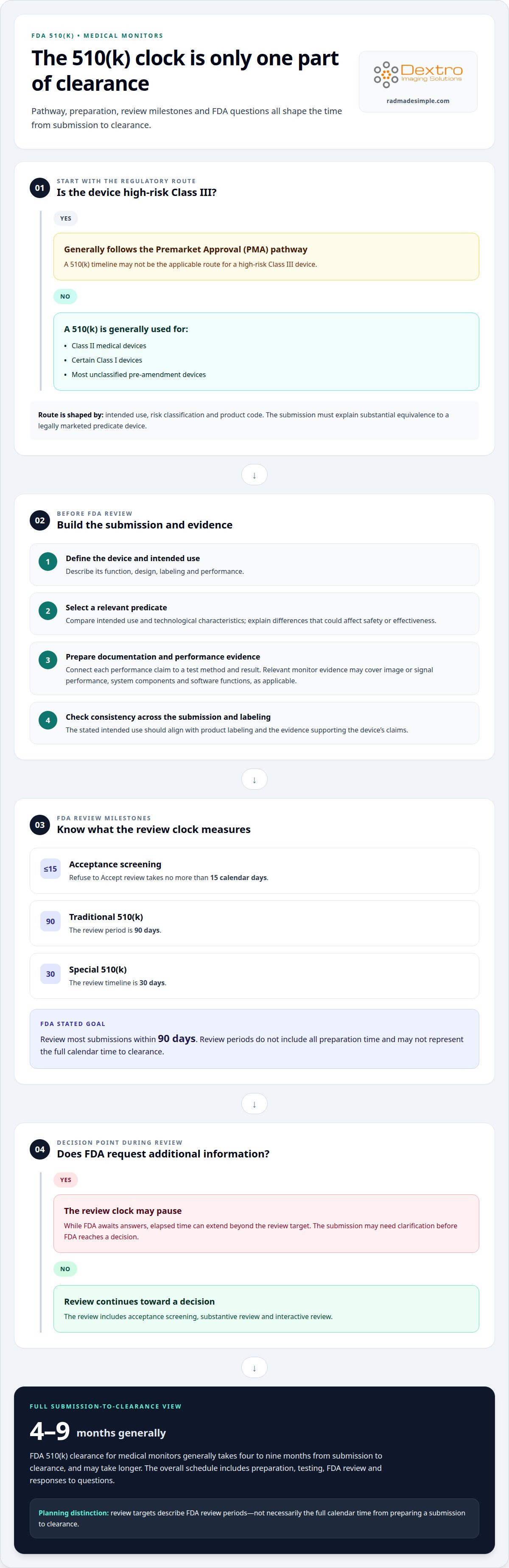
The FDA 510(k) timeline is not simply a 90-day clock. FDA 510(k) clearance for medical monitors generally takes four to nine months from submission to clearance, and may take longer. The FDA’s stated goal is to review most submissions within 90 days, but requests for additional information can extend the overall process.
That distinction matters when planning a device launch. Review time is only part of the timeline: a submission also needs documentation and performance-testing evidence to support substantial equivalence to a legally marketed predicate device. The product code matters because it helps identify how the FDA classifies the device and which review pathway applies.
This guide explains what can affect the timeline, what to prepare for a 510(k) submission, and how FDA review requests can pause progress. It also examines the product-code angle for patient monitors, including the relevant classification information, so you can better understand how the pathway applies to your device.
Key Takeaways
- Learn how predicate-device selection and intended use shape the substantial-equivalence case.
- Identify the technical documentation and performance evidence that can support your submission.
- Understand how an FDA request for additional information affects review timing and the response window.
- See how patient-monitor classification and product codes help frame the applicable submission pathway.
How long will it take to clear my device through the 510(k) process?
FDA 510(k) clearance for medical monitors generally takes four to nine months from submission to clearance, and may take longer. The overall schedule includes preparation, testing, FDA review, and responses to questions. According to the U.S. Food and Drug Administration, clearance through the 510(k) process is based on finding a device substantially equivalent to a legally marketed predicate device. The submission must make that comparison clear.
Selecting a predicate is a central regulatory decision. The candidate should have a relevant intended use and technological characteristics that allow a meaningful comparison. The submission describes the proposed device’s intended use, design, labeling, and performance, then explains any differences that could affect safety or effectiveness. A digital monitor with a different function or patient population may require a different comparison from a device with closely aligned uses. A product name alone does not establish equivalence.
Clearance applies to the specific device described in its FDA record, not automatically to every product in a broad category. A diagnostic monitor and an imaging display, for example, may serve different purposes. Clearance for one device does not establish another’s status. To understand an example device’s status, identify its manufacturer and model, then review the associated FDA clearance record and letter. This distinguishes a product description from evidence of clearance.
In the United States, manufacturers generally submit a 510(k) for Class II medical devices, certain Class I devices, and most unclassified pre-amendment devices. High-risk Class III devices generally follow the Premarket Approval pathway instead. Intended use, risk classification, and product code help shape the regulatory route. A change to intended use or technology that may significantly affect safety or effectiveness can also require a new 510(k), even if it improves the device. Planning for FDA 510(k) clearance for medical monitors starts with defining the device and intended use, then assessing the predicate and supporting evidence.
510(K) technical documentation and performance testing
A strong submission connects the device’s design and intended use to evidence supporting substantial equivalence. For a medical monitor, the documentation should clearly describe its functions and performance.
Submission Documents and Performance Evidence
Submission documentation describes the device, its intended use, its technological characteristics, and the evidence supporting comparison with a predicate. Performance testing shows how the device performs for its intended purpose. Comparative testing can help explain whether differences affect safety or effectiveness.
Organize the evidence so reviewers can trace each performance claim to a test method and result. For a monitor, relevant material may describe image or signal performance, system components, and software functions, as applicable. The FDA has published Safety and Performance Based Pathway guidance for some product codes. The applicable code can therefore help shape the evidence plan.
Product Labeling and Clearance Documents
Labeling communicates a device’s intended use and directions for use, while clearance documents record the FDA’s decision on the submitted device. These materials should align: the intended use described in the submission should match the use stated in product labeling. Clear, consistent language helps prevent a mismatch between the evidence and the device’s claims.
After clearance, the FDA issues a 510(k) clearance letter and posts it in its database. The letter is official proof of clearance, not a registration certificate. Manufacturers should distinguish the cleared model and intended use from other products or versions. For software updates or design changes, document what changed and assess whether the change affects safety or effectiveness.
Submission Steps, Fees, and Testing Costs
The submission steps are to define the device and intended use, select a predicate, prepare the required documentation and performance evidence, then submit the 510(k) to the FDA. How much does a medical monitor 510(k) submission cost, including FDA fees and testing? Testing costs depend on the tests needed for the device and its evidence plan.
Network-related software and device changes may add documentation and testing considerations. Keep records that identify software versions, functions, and test results, and explain how they support the device’s performance claims. To connect regulatory planning with display deployment, review radiology workflow considerations alongside the submission plan.
FDA review timelines and additional-information requests
FDA review has defined milestones, but total elapsed time also depends on submission quality and responses. Distinguish the agency’s review clock from the full preparation and review process.
FDA Review Phases and Timelines
The review process includes acceptance screening, substantive review, and interactive review. Each phase can identify issues that need clarification before the FDA reaches a decision.
The FDA’s stated goal is to review most 510(k) submissions within 90 days. A Traditional 510(k) review period is 90 days, while the Special 510(k) program has a 30-day review timeline. Acceptance screening, known as Refuse to Accept review, takes no more than 15 calendar days. These review periods do not include all preparation time or necessarily reflect the full calendar time to clearance.
Classification and pathway shape how a submission is reviewed. A Class II medical device submission must support its indications and substantial equivalence with evidence relevant to safety and effectiveness. The review clock may pause while the FDA awaits answers to an additional-information request, extending elapsed time beyond the review target.
Additional Information Requests and Review Delays
An Additional Information request identifies questions the FDA needs resolved to complete its review. According to the U.S. Food and Drug Administration, a manufacturer has up to 180 days to respond. The review clock can pause during the response period, so a prompt, complete reply helps keep the review moving.
What are common reasons FDA rejects or delays medical monitor 510(k) submissions? Incomplete documentation, unclear indications, a weak predicate comparison, or performance evidence that does not address the device’s claims can prompt questions or prevent acceptance. Inconsistent descriptions of the device across its labeling and submission can also create uncertainty.
Address each request directly by mapping every FDA question to supporting documents, test results, or a clear explanation. For example, if the FDA asks how a monitor’s software supports a performance claim, provide the relevant software description and evidence together. Organized responses help reviewers assess the issue without searching through unrelated materials.
FDA 510(k) product codes for patient monitors
A product code describes the type of medical device under FDA classification. For patient monitors, consider it alongside intended use, clinical function, and the device’s submission record. A code can guide regulatory research, but it does not establish clearance or prove that a particular model is approved.
The FDA classification information identifies the regulation for these monitors as 21 CFR 870.1025. It gives the device classification name as “Monitor, Physiological, Patient (With Arrhythmia Detection Or Alarms).” The listed medical specialty and review panel are Cardiovascular. These identifiers describe the classification context, not an automatic match for every device described commercially as a monitor.
Use the identifiers as part of a focused review:
- Start with the device’s intended use and the patient-monitor function it performs.
- Compare that function with the FDA classification name and applicable regulation.
- Use the device’s FDA record to identify its product code and 510(k) history.
- Confirm that the record’s manufacturer, model, and indications fit the device under review.
This distinction matters because “patient monitor” can refer to devices with different clinical purposes. A physiological monitor with arrhythmia detection or alarms may not share the classification context of a diagnostic imaging display. The product code helps organize the regulatory category, but intended use and technological characteristics still shape the submission and supporting testing. A matching code alone does not show substantial equivalence to a predicate.
For a practical assessment, connect the product code to the exact device configuration, labeling, and intended clinical use. Then use the closest relevant FDA records to understand how comparable devices are classified and cleared. This supports a more precise regulatory pathway assessment and helps keep the submission focused on the device’s actual functions, rather than broad marketing terms. For imaging workflow planning, explore radiology workflow considerations alongside your monitor requirements.
Dextro Imaging Solutions: Jusha Diagnostic Monitors
Dextro Imaging Solutions offers advanced diagnostic monitor options for imaging teams evaluating diagnostic displays as part of their equipment planning. The right equipment depends on your clinical workflow and how the monitor fits into your imaging environment.
For a broader workflow setup, Dextro Reading Stations, Radcom Compact, and PACS Harmony are also available. These products support different parts of imaging operations, so selection starts with your department’s needs, existing systems, and intended use. Product selection is separate from FDA clearance: a monitor’s regulatory status depends on its own device record, not simply its display category.
If you’re assessing diagnostic monitors or related imaging workflow equipment, contact Dextro Imaging Solutions to discuss your requirements.
Plan the Next Step for Your Imaging Environment
Use your regulatory planning to clarify what your team needs from its imaging environment. FDA 510(k) clearance for medical monitors relates to a specific device and its intended use, while equipment decisions should reflect your department’s workflow and imaging requirements. Keeping those decisions distinct helps you assess the regulatory pathway without treating product selection as proof of clearance.
As you plan, consider how diagnostic displays fit into the reading environment and work with the systems your team uses. Dextro Imaging Solutions can help you explore imaging equipment options in the context of your department’s needs. Start with a focused discussion about your workflow and priorities rather than a one-size-fits-all choice.
Contact Dextro Imaging Solutions to discuss your imaging requirements and identify a practical direction for your environment.
Frequently Asked Questions
For devices made outside the U.S., is home country approval required?
No. Home-country approval is not required for a medical device to receive FDA clearance. A foreign manufacturer can submit a 510(k) and must meet the same submission requirements as a U.S. manufacturer, including applicable FDA fees. For example, a company manufacturing a monitor abroad can pursue the U.S. pathway without first securing marketing approval in its home country.
How long is my 510(k) approval valid?
A 510(k) clearance has no set expiration date as long as the device has not changed. The important distinction is whether a later modification affects the device’s intended use or could significantly affect safety or effectiveness. For example, a manufacturer considering a software or design update should assess the change’s regulatory impact rather than assume the original clearance automatically covers it.
If there is a predicate, do I have to do the same testing?
No. Having a predicate does not automatically mean repeating all of its testing. Your submission needs evidence to support the comparison, and testing should address the proposed device’s performance and relevant differences. Comparative testing may be useful, but methods depend on the device and the claims being supported. A predicate is a basis for comparison, not a substitute for evidence about your device.
Is 510k the same as 510(k)?
Yes. “510k” is an informal spelling of “510(k),” the standard written form of the FDA premarket notification pathway’s name. The parenthetical “k” is part of the identifier, so use “510(k)” in formal regulatory documents and correspondence. In everyday discussion, people may omit the parentheses, but they are referring to the same pathway, not a separate type of clearance.
What Is FDA 510(k) Clearance?
FDA 510(k) clearance is the FDA’s decision that a submitted device is substantially equivalent to a legally marketed predicate device. It applies to the device and intended use described in the submission, not every product in its general category. For a monitor, the clearance record identifies the specific device reviewed, helping distinguish its regulatory status from similar displays or diagnostic equipment.
What is the 510(k)?
The 510(k) is a premarket notification submission to the FDA. Its name comes from Section 510(k) of the Federal Food, Drug, and Cosmetic Act. A manufacturer uses the submission to show that a device is substantially equivalent to a legally marketed predicate. The pathway is commonly used for Class II devices, certain Class I devices, and most unclassified pre-amendment devices.


