

A working monitor isn’t necessarily a reliable diagnostic display. Diagnostic display quality assurance combines visual checks, measured quality-control tests, and DICOM GSDF conformance to identify luminance drift and grayscale inconsistencies. Together, these checks help maintain consistent image presentation for diagnostic review.
Display consistency matters because image interpretation depends on seeing grayscale details clearly and reliably. A quality-assurance program helps track performance, flag potential problems early, and show when calibration or further assessment may be needed.
This guide explains how diagnostic display quality assurance works, which quality indicators matter, and how DICOM GSDF supports consistent grayscale presentation. It also covers quality-control routines, risk management, and applicable standards, clarifying what reliable display oversight involves.
Key Takeaways
- Track quality-control results over time so luminance drift and recurring performance changes can prompt timely calibration or assessment.
- Align DICOM GSDF verification and calibration frequency with monitor capabilities and applicable requirements; New York State guidance distinguishes between systems that support verification and those that do not.
- Use visual test patterns, measured luminance checks, and consistent room lighting to assess whether grayscale details remain visible during diagnostic review.
- Apply standards and regulations that fit the display’s clinical use and location, and establish site-specific acceptance criteria with appropriate technical oversight.
Quality indicators and risk management
Effective risk management turns display checks into useful decisions. Quality indicators should show whether a monitor remains suitable for its clinical role or whether a change needs investigation. Luminance drift, for example, may indicate that calibration is needed more frequently. Tracking results over time helps distinguish gradual change from an isolated reading.
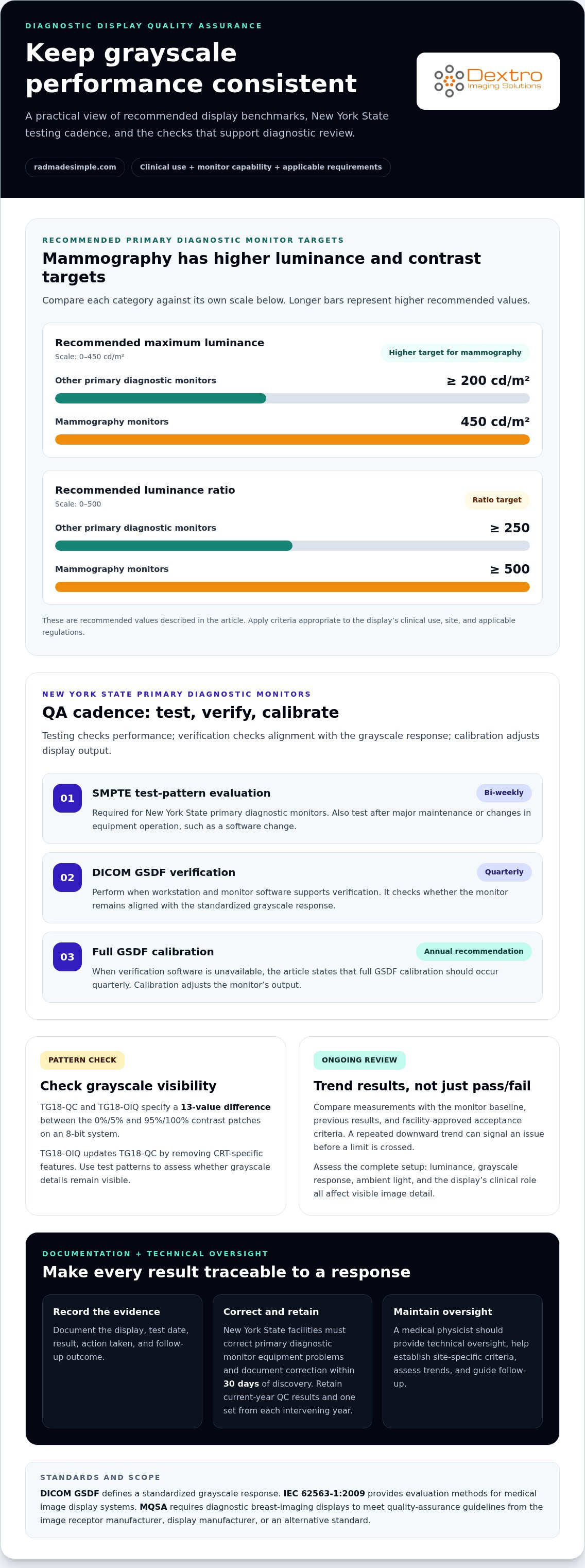
New York State facilities must correct primary diagnostic monitor equipment problems and document the correction within 30 days of discovery. They must retain current-year primary diagnostic monitor quality-control results and one set of results from each intervening year. This record provides evidence of performance changes and supports a traceable response when a monitor falls outside its established criteria.
Results need context, not just pass-or-fail labels. Compare each measurement with the monitor’s baseline, previous results, and the facility’s approved acceptance criteria. A repeated downward trend can signal an emerging issue before a limit is crossed. Record the display, test date, result, action taken, and follow-up outcome so staff can connect each risk indicator to a clear response.
Risk controls should define who reviews results and what happens next. A medical physicist should maintain technical oversight of each facility’s primary diagnostic monitor quality-control program. The physicist can help establish site-specific criteria, assess trends, and determine whether a failed result needs correction or further evaluation. Applicable regulations remain controlling; suggested criteria do not replace them.
- Escalate equipment problems promptly, and preserve evidence of correction within New York State’s 30-day requirement.
- Review historical quality-control records to identify gradual luminance changes that a single sample may miss.
- Assign technical oversight and document follow-up actions, giving clinical teams a consistent basis for confidence in display performance.
DICOM GSDF conformance
For primary diagnostic monitors, recommended luminance and contrast depend on clinical use. Mammography has higher targets than other diagnostic work. DICOM GSDF conformance checks grayscale response to help keep brightness differences consistent across the display.
Applicable Standards and Regulations
IEC 62563-1:2009 provides evaluation methods for medical image display systems, while DICOM GSDF defines a standardized grayscale response. In the United States, MQSA requires diagnostic breast-imaging displays to meet quality-assurance guidelines from the image receptor manufacturer, display manufacturer, or an alternative standard. MQSA doesn’t explicitly require a minimum pixel count for diagnostic review. These distinctions help facilities align assessment and documentation with display use and applicable regulations.
Luminance, Contrast, and Grayscale Requirements
For primary diagnostic monitors not used for mammography, recommended maximum luminance is at least 200 cd/m2, with a luminance ratio of 250 or greater. For mammography monitors, recommended maximum luminance is 450 cd/m2, with a ratio of 500 or greater. The TG18-QC and TG18-OIQ patterns specify a 13-value difference between the 0%/5% and 95%/100% contrast patches on an 8-bit system. These targets support visible grayscale distinctions during image review.
New York State facilities should perform DICOM GSDF verification quarterly when workstation and monitor software supports it; full GSDF calibration is recommended annually. If verification software is unavailable, facilities should assess monitor grayscale performance regularly and arrange calibration when needed. Verification assesses whether the monitor remains aligned with the grayscale response, while calibration adjusts its output when needed.
Use test patterns to assess grayscale visibility, then record results and corrective actions. IEC 62563-1 identifies display evaluation methods, and TG18-OIQ updates TG18-QC by removing CRT-specific features. A medical physicist can provide technical oversight for the facility’s assessment program, supporting consistent documentation relevant to patient imaging.
For display options suited to diagnostic workflows, explore Dextro Imaging Solutions.
Diagnostic display quality assurance
A reliable program combines display assessment, calibration, and documented follow-up. The appropriate practices depend on clinical use, monitor capability, and applicable regulations.
Diagnostic and Consumer Display Differences
A diagnostic display is intended for medical image interpretation and can be assessed against diagnostic performance criteria. A consumer display is designed for general viewing, so its appearance alone doesn’t establish that it is suitable for clinical reading.
The distinction matters because grayscale response, luminance, and ambient light affect visible image detail. Select displays for their clinical role, then assess the complete setup rather than relying on the screen’s product category.
Calibration and Testing Frequency
Calibration adjusts display output; testing checks whether performance remains within defined criteria. New York State primary diagnostic monitors require a bi-weekly SMPTE test-pattern evaluation. Facilities should also test after major maintenance or changes in equipment operation, such as a software change.
For GSDF, New York State facilities should verify quarterly when software supports verification; full calibration is recommended annually. If verification software isn’t available, full GSDF calibration should occur quarterly.
Qualified QA Personnel and Documentation
Trained staff perform quality assurance within a program overseen technically by a medical physicist. In New York State, a licensed medical physicist should evaluate primary diagnostic monitors annually using an external calibrated photometer.
Document the monitor, test method, date, results, and any corrective action. Retain current-year results and one set from each intervening year so reviewers can assess performance changes and follow-up.
Tests in a Quality Assurance Program
Testing may combine visual patterns, measured luminance, grayscale response, and ambient-light assessment. During New York State’s SMPTE check, grayscale squares must be distinguishable at every step from 0% through 100%; the 95%-100% and 0%-5% patches must also be easily visible. Clean each primary diagnostic monitor during the bi-weekly routine check.
Calibration and measurement require suitable test patterns, software that supports GSDF verification where available, and measurement equipment such as an external calibrated photometer. Record results consistently to give the organization a traceable basis for identifying changes and planning corrective action.
What standards and regulations apply to diagnostic display quality assurance in the United States?
U.S. display oversight combines technical evaluation standards with requirements tied to specific clinical uses and jurisdictions. IEC 62563-1:2009 provides evaluation methods for medical image display systems, while federal MQSA requirements apply to diagnostic breast-imaging displays. Facilities should distinguish a technical reference from a regulation and identify which rules govern their operations.
For diagnostic breast-imaging displays used for review, MQSA requires compliance with quality-assurance guidelines from the image receptor manufacturer, display manufacturer, or an alternative standard. MQSA doesn’t explicitly require a minimum pixel count for diagnostic review. The applicable guideline therefore shapes the facility’s quality-control criteria, rather than a universal pixel-count threshold.
New York State sets additional requirements for primary diagnostic monitors in Sections 16.5 and 16.23 of Part 16, Title 10 of its Official Compilation of Codes, Rules and Regulations. Section 225 of the New York State Public Health Law provides statutory authority. For monitors not used for mammography, maximum luminance must be at least 171 cd/m2, and the luminance ratio must be at least 170.
For New York State primary diagnostic monitors used for mammography, maximum luminance must be at least 250 cd/m2, with a luminance ratio of at least 250. A licensed medical physicist should evaluate these monitors annually using an external calibrated photometer. Facilities must correct primary diagnostic monitor equipment problems and document correction within 30 days of discovery. They must retain current-year quality-control results and one set from each intervening year.
These distinctions matter: New York thresholds are state requirements, not nationwide values. Apply the rules relevant to location and display use, then maintain records that demonstrate the program’s implementation. Explore Jusha Diagnostic Monitors for display options used in diagnostic imaging workflows.
Dextro Imaging Solutions: Radcom Compact
Dextro Imaging Solutions offers Radcom Compact for teams planning their radiology imaging environment. After defining display quality-control requirements, consider how equipment choices fit the wider reading workflow. Dextro Reading Stations, PACS Harmony, and aycan PACS are also available offerings. These options give imaging teams a practical starting point for aligning equipment and systems with operational needs, without treating a display purchase as a substitute for ongoing quality assurance. The right next step is to identify the workflow need: reviewing display options, considering reading-station equipment, or evaluating PACS offerings. Contact Dextro Imaging Solutions or visit radmadesimple.com to discuss your requirements.
Make Display Quality Part of Your Workflow
Reliable imaging depends on making display oversight part of everyday operations, not treating it as a separate technical task. Assign clear responsibility for reviewing results, recording follow-up, and coordinating display decisions with the people managing your imaging environment. This connects quality requirements to consistent workflows.
As you plan your imaging environment, consider how displays fit with reading stations and the broader radiology setup. Dextro Imaging Solutions offers Radcom Compact, Dextro Reading Stations, and Jusha Diagnostic Monitors to support teams building workflows around their operational needs. Equipment selection complements, but doesn’t replace, an ongoing diagnostic display quality assurance program.
Discuss your imaging workflow and equipment needs with Dextro Imaging Solutions. Contact Dextro Imaging Solutions to explore the next step, and keep building a dependable foundation for your team’s work.
Frequently Asked Questions
Why is quality assurance important?
Quality assurance helps teams detect display changes before they disrupt routine image review. For example, a screen that gradually loses luminance may show subtle structures differently from its baseline. A documented process gives staff a consistent way to identify concerns, assign follow-up, and determine whether corrective action resolved them. This supports dependable interpretation conditions and makes display performance easier to manage in a clinical workflow.
Do clinical review displays need QA too?
Yes. Include displays used for clinical image review in a quality-assurance plan suited to their role. Any display used to review images can affect how clearly details appear, even if it isn’t designated as a primary diagnostic monitor. Define its intended use, set relevant assessment criteria, and include it in routine checks. This helps prevent a secondary workstation from becoming an overlooked source of inconsistent image presentation.
What is DICOM GSDF conformance in plain terms?
DICOM GSDF conformance means a display’s grayscale response follows a standardized curve for presenting changes in image brightness. In plain terms, equal brightness steps in an image should appear as perceptually consistent differences on screen. This matters when comparing images or reviewing faint details: if the display response shifts, the same image values may no longer look equally distinct. Verification assesses the response; calibration adjusts it.
What is diagnostic display QA?
Diagnostic display QA is the planned assessment of screens used to view medical images. It combines visual inspection with suitable measurements and records, helping staff spot changes and decide on follow-up. For example, a program can pair a test-pattern review with a luminance measurement and a record of the result. The aim is to assess display performance consistently, not merely confirm that the screen turns on.
What is diagnostic display quality assurance in medical imaging?
In medical imaging, diagnostic display quality assurance is the ongoing process of assessing whether displays present images consistently for their intended clinical use. It considers both the monitor and viewing environment, since reflections or changing room light can affect perceived contrast. A useful plan connects test results to clear actions, such as investigating a changed reading or reviewing the setup after equipment or software changes.


