

What if the strongest budget case for a new PACS isn’t the lowest upfront cost, but the clearest link between the investment and an operational need? Building a budget justification for new PACS system can be challenging when radiology, IT, finance, and clinical teams see different costs and benefits. Broad claims about savings or uptime may leave executives questioning the assumptions.
The need for change may be clear to imaging teams, but leaders need a shared, evidence-based rationale. This article shows how to connect PACS lifecycle costs with departmental priorities and measurable outcomes, while making risks and assumptions transparent. You’ll learn to frame the decision around total cost of ownership, workflow impact, integration, implementation readiness, and your organization’s baseline data, rather than relying on unverified savings estimates.
We’ll also cover how to present alternatives, plan for migration and downtime, and give decision-makers a clear path from evaluation to implementation. A structured business case makes PACS planning a coordinated software, integration, and operational-readiness decision that leaders can assess with confidence.
Key Takeaways
- Anchor a PACS request in specific workflow constraints and the departments affected, not technology preference alone.
- Build a budget justification for new PACS system around clear scope, baseline data, lifecycle costs, expected benefits, and tested assumptions.
- Compare capital and operating funding approaches across cash flow, flexibility, cost visibility, and internal approval needs.
- Structure the proposal so stakeholders can assess options, evidence, risks, responsibilities, and the decision being requested.
- Translate approval into a sequenced implementation plan, then track actual costs and agreed operational measures against the original case.
Why a New PACS Budget Case Must Start with the Departmental Need
A PACS refresh may feel overdue to users, but a preference for newer technology is not, by itself, a budget rationale. A defensible budget justification for new PACS system starts with a service need: a recurring constraint that affects how teams manage imaging work, coordinate care processes, or support organizational priorities. State what is difficult today, who is affected, and why the issue merits a decision now.
Set the operational context before comparing solutions. A Picture Archiving and Communication System (PACS) supports image storage and access across connected workflows, so a constraint may reach beyond radiology. Map where the issue appears, which roles and processes it touches, and what happens next. For example, repeated manual steps to retrieve prior images may involve imaging staff, IT, and clinical teams. Document the actual workflow rather than assuming its impact.
Which PACS problems belong in a budget request?
Prioritize recurring constraints over isolated frustrations. Record workflow interruptions, manual workarounds, and system dependencies, then identify the affected role, process, or service. Local evidence might include help-desk records, observed task steps, incident logs, or staff feedback. Note how and when the information was collected, and distinguish a repeated pattern from a one-off event.
- Workflow: Where do staff repeat steps, wait, or switch between systems?
- Interruption: What incidents or delays are recorded, and which work processes do they affect?
- Dependency: Which integrations or handoffs are involved when an issue occurs?
- Impact: Which teams or services experience the constraint, and what evidence shows its effect?
Use measures the organization already tracks where possible. Depending on local data, these might include interruption frequency, time spent on a manual task, or support requests tied to a workflow. Don’t present an unmeasured burden as a proven saving. If evidence is incomplete, state the gap and describe how to establish a baseline before evaluating results.
How do you make the case relevant to executives?
Translate technical symptoms into implications leaders can assess. Describe how a recurring access issue affects staff time, service coordination, operational continuity, or a stated strategic priority. Label each point as observed evidence, forecast, or stakeholder perception. A forecast can inform planning, but show its assumptions and don’t present it as a confirmed outcome.
Define what a successful decision should enable, not what it is guaranteed to deliver. Leadership may need to decide whether the documented constraints justify evaluating a replacement, what scope merits further analysis, and which stakeholders should shape the next phase. Keep the decision specific and tie each request to evidence.
A concise problem statement can bring the case into focus: “The current workflow requires [documented workaround or dependency], affecting [roles or services]. Available records show [baseline observation]. Leadership review is requested to determine whether a PACS investment should be evaluated against these needs.” This describes the status quo while leaving room for cost and option analysis in the next step.
How to Build a PACS Business Case from Lifecycle Costs and Benefits
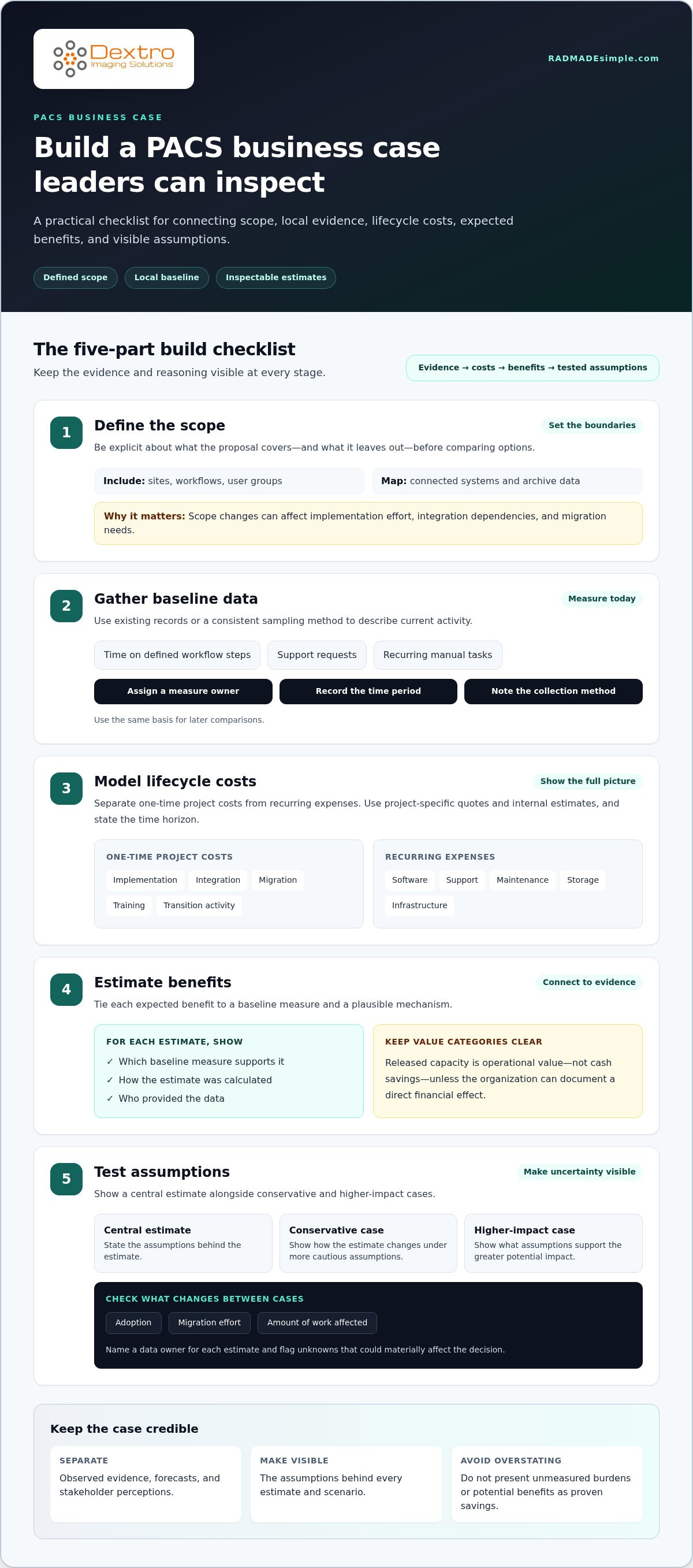
A credible PACS business case is a model leaders can inspect, not a single return-on-investment figure. Build it from defined scope, local evidence, and estimates with visible assumptions. This makes the budget justification for new PACS system easier to review and keeps potential benefits distinct from confirmed savings.
- Define the scope. Specify the sites, workflows, user groups, systems, and archive data included. Record what the proposal excludes, too. Scope changes can affect implementation effort, integration dependencies, and migration needs, so make the boundaries clear before comparing options.
- Gather baseline data. Use existing records or a consistent sampling method to document current activity. Examples include time spent on defined workflow steps, support requests, or recurring manual tasks. Assign an owner to each measure and note the period and collection method, so later comparisons use the same basis.
- Model lifecycle costs. Separate one-time project costs from recurring expenses. Use project-specific quotes and internal estimates, and state the time horizon. Include relevant costs for software, implementation, integration, migration, training, support, maintenance, storage, infrastructure, and transition activity.
- Estimate benefits. Connect each expected benefit to a baseline measure and a plausible mechanism. If a workflow change may reduce manual effort, show how the estimate was calculated and who provided the data. Treat released capacity as operational value, not cash savings, unless the organization can document a direct financial effect.
- Test assumptions. Show a central estimate alongside conservative and higher-impact cases. Explain which assumptions change between cases, such as adoption, migration effort, or the amount of work affected. Name a data owner for each estimate and flag unknowns that could materially affect the decision.
Which PACS costs should the budget model include?
Build a complete cost inventory rather than treating the software license as the whole investment. Account for initial setup and implementation, integration with relevant systems, data migration, staff training, and transition planning. Then include recurring support, maintenance, storage, and infrastructure where applicable. The radiology PACS pricing and total cost of ownership guide offers further detail for organizing a lifecycle model. Populate your proposal with project-specific quotes and internal estimates, not generic prices.
How should you quantify PACS benefits credibly?
Compare current and proposed workflows using the same defined measures. Use local activity and cost data, and state how forecasts were derived. A projected reduction in manual steps is not a realized saving; label it as a projection until measured after implementation. This helps prevent overstated value and gives reviewers a clear way to assess uncertainty.
Keep the model decision-ready: show the time horizon, assumptions, sensitivity cases, and responsible data owners beside each estimate. For PACS software licensing, setup, and integration planning, explore PACS implementation and integration support as you define the project scope.
Capital or Operating Budget: Compare PACS Funding Approaches Fairly
The right funding route depends on the PACS contract structure and your organization’s accounting, procurement, and approval policies. A capital purchase may require an upfront allocation and formal project approvals. An operating model may spread payments over time but create recurring commitments. Neither approach is automatically less costly or more suitable. Compare them against the same scope and lifecycle assumptions, then confirm how finance will classify and govern each option.
Use a consistent decision matrix to show trade-offs rather than treating “CapEx” or “OpEx” as the answer. The categories below are prompts for review, not fixed characteristics: actual terms and internal rules shape the result.
Predictability: Compare planned upfront funding with recurring payments, including how each fits budget cycles.
Flexibility: Assess how the funding structure handles scope changes, growth, or changing operational needs.
Lifecycle visibility: Show the full cost horizon for software, implementation, integration, support, migration, and relevant infrastructure.
Internal approvals: Identify procurement steps, accounting review, budget owners, and approval milestones for each approach.
For a budget justification for new PACS system, make the comparison fair by applying the same project boundaries, time horizon, and assumptions to every option. Assign ownership for each estimate and identify who will monitor ongoing commitments. Finance and procurement stakeholders can then assess payment timing as well as how costs will be approved, recorded, and managed.
When might a capital request fit the PACS project?
A one-time acquisition may align with an organization’s capital process when the project includes costs treated as capital under local policy. Don’t assume every related item receives the same classification. Work with finance to review software, implementation, integration, and associated costs. Map the required approvals, budget owner, procurement milestones, and decision dates so the request follows the organization’s process.
When might operating expenditure deserve consideration?
An operating approach may suit a project whose contract creates recurring payments, but assess the full commitment and service scope rather than focusing only on periodic charges. Compare payment timing with approved funding and procurement rules. Document the contract period, renewal assumptions, responsibilities, and exit implications based on the proposed terms. Finance and procurement should establish how these commitments will be reviewed over time.
Present the result as a side-by-side assessment, not a recommendation based on a general preference for ownership or subscription. If an option depends on assumptions about renewal, future scope, or internal classification, state that clearly and show how it affects the comparison. A focused review of PACS software and implementation options can connect funding discussions to software, integration, and operational-readiness requirements.
What to Include in a PACS Budget Justification Document
A strong PACS budget document gives reviewers a clear route from the operational need to the decision requested. Keep the main case concise, then use supporting material for detailed estimates, workflow maps, and technical requirements. This helps clinical and financial leaders review the same proposal without losing sight of the project’s purpose.
- Need: State the documented problem and the services or teams affected.
- Scope: Define sites, workflows, user groups, integrations, and data included.
- Options: Compare feasible approaches against the same requirements.
- Lifecycle model: Summarize initial and recurring costs, assumptions, and the time horizon.
- Evidence: Cite baseline sources and explain how projected benefits were estimated.
- Risks: Describe dependencies, uncertainties, and mitigation plans.
- Decision: Specify the approval, funding, or next-stage authorization requested.
Assign reviewers by responsibility. Clinical representatives assess workflow and user needs; IT reviews integration, migration, and infrastructure dependencies; finance evaluates cost assumptions and budget treatment; security stakeholders review relevant organizational requirements; and operational leads assess training and continuity planning. Give each group a lead and a specific review task so questions have clear owners.
How do you present assumptions and risks transparently?
For each estimate, record its source, calculation method, owner, and confidence level. Separate observed baseline data from forecasts and stakeholder judgments. Include downside scenarios, such as slower adoption, more complex integration, or a delayed transition. Pair each risk with a practical response, such as phased validation or contingency planning, while recognizing that mitigation can reduce exposure but cannot eliminate uncertainty.
How can the proposal address clinical and technical requirements?
Document user needs as workflow requirements, then identify the systems and handoffs the PACS must support. Separate mandatory requirements from preferences and possible future capabilities. This keeps the initial scope focused and makes trade-offs visible. Include workstation needs only where they directly affect PACS workflows, and use the radiology reading workstation guide for related planning context.
Make implementation dependencies explicit. List data migration, integration sequencing, staff training, testing, and continuity planning as workstreams with accountable owners. Identify the decisions or resources each depends on, such as access to source-system information or staff availability for workflow review. Related considerations can be organized alongside the 2026 radiology equipment compliance checklist, with applicable requirements reviewed through your organization’s process.
A clear budget justification for new PACS system is easier to review when every requirement connects to evidence, a responsible stakeholder, or a defined project dependency. To turn the approved scope into a coordinated software, integration, and operational-readiness plan, explore PACS implementation support.
Move from PACS Budget Approval to a Practical Implementation Plan
Budget approval is a decision to proceed within an agreed scope, not the end of planning. Convert the approved case into a controlled implementation plan that preserves its assumptions, assigns ownership, and makes changes visible. A clear sequence helps teams coordinate software, integration, migration, training, and operational readiness while keeping the need behind the investment in view.
- Confirm the decision. Record the approved scope, funding conditions, decision owners, and assumptions or exclusions that require follow-up.
- Develop the detailed plan. Confirm stakeholder roles, dependencies, governance, and decision records. Translate the proposal into assigned work for integration planning, data migration, training, testing, and continuity.
- Coordinate implementation. Set milestones for system configuration, integration activities, migration preparation, user readiness, and transition. Make dependencies and decision points clear to the teams responsible.
- Review performance against the case. At agreed checkpoints, compare planned and actual costs, schedule, adoption, and operational measures. Document variances, explain their causes, and assign follow-up actions.
What should happen immediately after budget approval?
Start with a formal handoff from proposal to project governance. Confirm who can approve scope changes, who owns each workstream, and how risks or decisions will be recorded. Convert estimates into a working plan with responsibilities and review dates. Preserve the baseline measures from the business case so post-implementation reviews use consistent definitions rather than measures that make comparison difficult.
Track financial and operational progress. A straightforward review record can show the planned amount or milestone, actual status, variance, explanation, owner, and next action. For operational measures, use the same data source and calculation method used to establish the baseline. If a measure cannot yet be collected consistently, identify the gap instead of presenting a partial comparison as a result.
How can a PACS solution align with the approved case?
During solution planning, map documented requirements to PACS capabilities and integration needs. Keep mandatory workflow and technical requirements distinct from preferences or possible future scope. Dextro provides PACS licensing, integration, technical support, and maintenance services that can be considered as part of a combined software and operational-readiness plan, with responsibilities aligned to the project’s defined needs.
Dextro’s PACS options include PACS Harmony and aycan PACS. Evaluate them against approved requirements, dependencies, and the implementation plan rather than assuming a product choice proves the business case. For each requirement, document how it will be addressed and who will validate it during planning or testing. This creates a traceable link between the budget decision and implementation work.
A well-prepared budget justification for new PACS system carries through approval into measurable review, with planned costs and operational indicators checked against actual results. Explore PACS Harmony and discuss your PACS project with Dextro as you move from an approved case to implementation planning.
Turn a Defensible PACS Case into Your Next Step
A strong budget case should keep guiding decisions after approval. Use it as a reference as the project moves forward: when scope changes, new dependencies emerge, or teams revisit priorities, return to the evidence and assumptions behind the decision. This helps keep implementation aligned with organizational needs and the project’s original purpose.
Dextro supports PACS planning with software licensing, integration, technical support, and maintenance. Its PACS offerings include PACS Harmony and aycan PACS. These provide a starting point for discussing how a PACS project can align with documented requirements and implementation priorities.
Whether you’re preparing a proposal or moving from approval into planning, make the next step a focused review of your PACS goals and project needs. Explore Dextro PACS solutions and plan your next step. A clear budget justification for new PACS system gives your team a stronger foundation for moving forward with purpose and confidence.
Frequently Asked Questions
What is a PACS budget justification?
A budget justification for new PACS system funding explains why an imaging organization should consider investing in a new or replacement Picture Archiving and Communication System. It gives reviewers a shared basis for assessing the need, scope, costs, expected benefits, and uncertainties. For example, the document can specify whether the request covers one imaging site, several locations, or a defined archive migration, so stakeholders evaluate the same project.
How do you calculate ROI for a new PACS?
Calculate ROI by agreeing on a method with finance, then applying local baseline and project-specific cost data over a defined period. Select measures connected to a plausible change, such as time spent on a repeated image-retrieval task or staff effort spent resolving workflow issues. Record how each measure was collected, avoid counting the same benefit twice, and label results as projected until post-launch data supports them.
Should PACS be funded from a capital or operating budget?
There’s no universally correct funding route. The appropriate choice depends on organizational accounting and procurement policies, contract structure, available funding, and how the organization manages ongoing commitments. A project that includes an acquisition may follow a different approval path from one with recurring payments. Ask finance and procurement to review the proposed terms early, then compare options using consistent project scope and lifecycle assumptions.
What costs should be included in a PACS business case?
Include the direct and supporting costs relevant to the project, such as licensing, implementation, integration, data migration, training, infrastructure, storage, support, and transition activities. Record each estimate’s source, owner, timing, and whether it is one-time or recurring. If internal labor is part of your organization’s project accounting, include it consistently. Review overlapping line items, such as packaged implementation work and separately estimated tasks, to avoid double counting.
Who should be involved in approving a new PACS?
Involve the people accountable for clinical workflows, imaging IT, finance, procurement, and relevant security or operational reviews. Make each role concrete: clinical leads can validate user requirements, IT can document interface dependencies, and finance can review the cost model. Procurement can track the approval route and contract decisions. A responsibility matrix helps clarify who provides input, who signs off, and who owns follow-up actions.
How can a hospital justify replacing a PACS that still works?
Show why the current system may no longer meet documented service needs, even if it remains operational. Compare the status quo with replacement using local evidence, such as recurring maintenance work, workflow constraints, or integration limitations. Include uncertainty and the effort of maintaining the current environment. The case should explain why leadership review is timely without implying that replacement guarantees better performance.
What is the difference between PACS and RIS in a budget proposal?
PACS manages the storage, retrieval, and distribution of medical images. A Radiology Information System (RIS) supports radiology department workflows and related information. Since the systems can connect through integrations, define which platform, interfaces, and responsibilities the proposed project includes. For example, identify the owner of each interface and assign associated work to the right scope, so reviewers can distinguish PACS investment from related RIS requirements.


